Knowledge Base
Scalable cloud architecture for startups: 2026 guide
Discover key strategies for building scalable cloud architecture for startups. Make smart decisions that drive growth and efficiency today.

Scalable cloud architecture for startups: 2026 guide
Building scalable cloud architecture for startups comes down to a handful of high-leverage decisions made early, not a sprawling set of tools adopted all at once. The core principles are:
Start with a modular monolith and resist microservices until your team and revenue justify the operational overhead.
Design stateless services from the outset, externalising session state to caching layers such as Redis or Memcached.
Choose PostgreSQL as your primary database and enable Row-Level Security (RLS) from day one for multi-tenant SaaS workloads.
Automate infrastructure with Infrastructure as Code tools like Terraform so environments are reproducible and auditable.
Offload non-blocking work to event-driven queues to protect user-facing response times.
Instrument monitoring, observability, and cost visibility before you need them, not after a production incident forces your hand.
Each of these decisions carries a switching cost. Get them right at the start and you buy yourself months of uninterrupted product development.
Table of Contents
How to build scalable cloud architecture for startups without over-engineering
Stateless services and database strategies that support startup growth
Event-driven architecture and infrastructure automation at startup scale
Monitoring, observability, and cost optimisation for growing startups
A business-aware framework for making architecture decisions at each growth stage
Disaster recovery and backup strategies for startups
SST Cloud helps you build cloud infrastructure that scales with your business
Key takeaways
How to build scalable cloud architecture for startups without over-engineering
The most expensive mistake a startup can make is building for a scale it has not yet reached. Premature microservices, over-provisioned Kubernetes clusters, and bespoke infrastructure all impose what practitioners call the “scalability tax”: engineering time spent managing complexity instead of shipping product.
The right approach aligns your architecture with your current business stage. At the MVP and early-growth phase, a well-structured monolith deployed on a managed platform gives you developer velocity, straightforward debugging, and a clear domain model. Modular monoliths are recommended until a startup reaches approximately $5M ARR or 15+ engineers, at which point the operational overhead of distributed services starts to pay for itself.
Choosing a “boring” tech stack is a deliberate strategy, not a lack of ambition. PostgreSQL, Redis, and a mainstream application framework have deep community support, predictable failure modes, and extensive managed-service options across AWS, Microsoft Azure, and Google Cloud Platform. That reliability compounds over time. Early decisions around multi-tenancy and database selection carry high switching costs, so getting them right upfront protects future velocity.
Pro Tip: Build observability and cost visibility into your stack from the very first deployment. Knowing where your compute and database spend is going on day one means you make scale decisions based on data, not assumptions.
Stateless services and database strategies that support startup growth
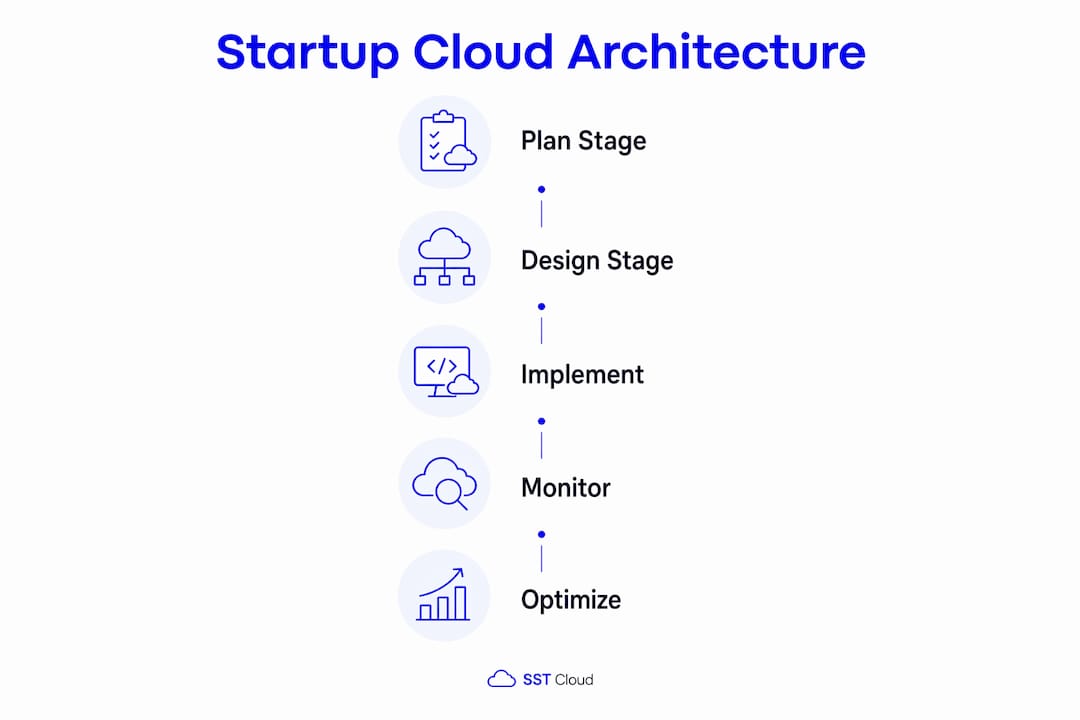
Designing stateless application layers
Stateless architectures with session caching layers like Redis enable horizontal scaling and fault tolerance without sticky sessions or complex state synchronisation. When any application instance can serve any request, you can add or remove nodes freely, and a failed instance does not take user sessions with it. Memcached is a viable alternative for simpler caching needs, though Redis’s support for data structures, pub/sub, and persistence makes it the more versatile choice for most startup workloads.

PostgreSQL as your primary database
PostgreSQL handles the vast majority of startup database requirements without requiring a migration to a specialised system. Its support for JSONB, full-text search, and advanced indexing means you can defer decisions about separate search or document stores until the data genuinely demands them. For multi-tenant SaaS products, enabling Row-Level Security from day one is a critical irreversible early decision: retrofitting tenant isolation later can consume months of engineering effort and introduce significant downtime risk. Shared tables with RLS policies are far simpler to operate than schema-per-tenant or database-per-tenant approaches at early scale.
Connection pooling via PgBouncer sits between your application and PostgreSQL, managing concurrent connections efficiently and preventing the database from becoming a bottleneck under load. As read traffic grows, adding read replicas is the correct first step before considering more complex sharding strategies.
Component | Technology | Scalability role |
|---|---|---|
Session storage | Redis / Memcached | Horizontal scaling, stateless app layer |
Primary database | PostgreSQL with RLS | Multi-tenancy, ACID compliance, extensibility |
Connection pooling | PgBouncer | Concurrent connection management |
Read scaling | PostgreSQL read replicas | Offload read traffic from primary |
CDN / edge cache | Cloudflare | Reduce origin load, improve latency |
Container orchestration | AWS ECS / GKE / Azure AKS | Managed scaling for containerised workloads |
Event-driven architecture and infrastructure automation at startup scale
Asynchronous processing is one of the highest-return architectural investments a startup can make. Event-driven, asynchronous processing using queues for non-user-blocking workloads improves both responsiveness and reliability. When a user triggers an action that involves sending emails, generating reports, or processing payments, offloading that work to a background queue keeps the HTTP response fast and the user experience intact.

Infrastructure as Code tools such as Terraform enable repeatable, auditable infrastructure deployments. Every environment, from development through to production, is defined in version-controlled configuration, which eliminates configuration drift and makes disaster recovery far more predictable. Combined with CI/CD pipelines, IaC means a new engineer can provision a complete environment without tribal knowledge.
Best practices for event-driven design and automation in startup contexts:
Use BullMQ (Node.js) or Sidekiq (Ruby) for background job processing; both integrate well with Redis and support retries, prioritisation, and dead-letter queues.
Adopt a pub/sub or message queue pattern for cross-service communication early, even within a monolith, to make future service extraction less disruptive.
Define all infrastructure in Terraform modules and store state remotely (AWS S3 with DynamoDB locking, or Terraform Cloud) to support team collaboration.
Automate container builds and deployments through GitHub Actions or GitLab CI, with environment-specific promotion gates to prevent untested code reaching production.
Use managed container services (AWS ECS Fargate, Google Cloud Run, Azure Container Apps) rather than self-managed Kubernetes until your team has the platform engineering capacity to operate it.
Apply feature flags via a tool like LaunchDarkly or a simple database-backed implementation to decouple deployment from release, reducing the risk of each production push.
For startups preparing their data infrastructure for AI-driven growth, data readiness practices become relevant earlier than most founders expect, particularly when event streams start feeding analytical or ML pipelines.
Monitoring, observability, and cost optimisation for growing startups
Early observability integration combined with cost monitoring prevents cloud waste, which averages 32% of cloud spend unused or underutilised in enterprises. Startups that instrument their systems from the start avoid the reactive cycle of performance incidents followed by expensive emergency refactoring.
The observability stack for a typical startup should cover four signals: errors (Sentry), metrics (Datadog or Prometheus with Grafana), logs (structured JSON shipped to a log aggregation service), and distributed traces (OpenTelemetry). OpenTelemetry is particularly valuable because it is vendor-neutral, meaning you can switch backends without re-instrumenting your application code.
Practical monitoring and cost optimisation tactics:
Set cloud budget alerts in AWS Cost Explorer, Azure Cost Management, or Google Cloud Billing to catch unexpected spend before it compounds.
Use autoscaling groups or managed service scaling policies tied to CPU, memory, or custom application metrics rather than fixed instance counts.
Apply multi-layer caching: Redis for application-level data, a CDN such as Cloudflare for static assets and API responses, and database query caching where query patterns are predictable.
Separate environments (development, staging, production) with distinct IAM roles and secrets management via AWS Secrets Manager or HashiCorp Vault to enforce least-privilege access.
Rotate credentials automatically and enforce OIDC-based authentication for CI/CD pipelines to eliminate long-lived access keys.
Review right-sizing recommendations monthly in your cloud provider’s cost console; over-provisioned instances are the most common source of avoidable spend in early-stage startups.
Load balancing via AWS Application Load Balancer, Azure Application Gateway, or Google Cloud Load Balancing distributes traffic across instances and provides health-check-based failover, which is the foundation of high availability without complex custom logic.
A business-aware framework for making architecture decisions at each growth stage
Architecture decisions should be driven by measurable business thresholds, not engineering intuition or fear of future scale. The platform engineering shift from pure DevOps to dedicated internal developer platforms becomes necessary before hitting 30 engineers, at which point ad-hoc infrastructure management creates enough friction to measurably slow feature delivery.
The progression looks like this in practice:
0–15 engineers / pre-$5M ARR: Modular monolith on a managed platform (AWS Elastic Beanstalk, Google App Engine, or Azure App Service). PostgreSQL with RLS, Redis for caching and queues, Terraform for infrastructure, and a single CI/CD pipeline. Observability from day one.
15–30 engineers / $5M–$10M ARR: Begin extracting high-traffic or independently deployable services. Introduce an internal developer platform or standardised deployment templates. Add read replicas and evaluate managed Kubernetes (EKS, GKE, AKS) if container complexity warrants it.
30+ engineers / $10M+ ARR: Platform engineering team owns the internal developer platform. Microservices where domain boundaries and team ownership are clear. Advanced data pipelines, multi-region deployments, and engineering platform thinking replace ad-hoc tooling decisions.
Retrofitting tenant isolation is one of the most disruptive and expensive migrations a SaaS startup can face. Starting with shared tables and PostgreSQL Row-Level Security avoids that migration entirely.
Pro Tip: Define metric-driven thresholds for architectural evolution: p95 API latency above 500ms, database CPU consistently above 70%, or deployment frequency dropping below daily are all concrete signals that a specific component needs attention. Avoid rebuilding for hypothetical scale.
Statistic callout: Retrofitting tenant isolation after launch can cost significantly more effort than implementing Row-Level Security from the outset, according to SaaS architecture practitioners who have managed these migrations.
For startups that want to move from a prototype to a production-grade architecture without accumulating technical debt, production-readiness frameworks address the gap between a working MVP and a system that can scale reliably.
Disaster recovery and backup strategies for startups
Disaster recovery is not a feature you add later. A startup that loses production data or suffers extended downtime before it has a tested recovery plan faces reputational and financial consequences that are disproportionate to its size.
The foundation is automated, verified backups. PostgreSQL managed services on AWS (RDS), Azure (Azure Database for PostgreSQL), and Google Cloud (Cloud SQL) all support automated daily snapshots and point-in-time recovery (PITR), which lets you restore to any second within your retention window. Enable PITR from day one and test a restore at least quarterly.
Define your Recovery Time Objective (RTO) and Recovery Point Objective (RPO) explicitly, even at the MVP stage. A SaaS product with paying customers typically needs an RTO under four hours and an RPO under one hour. Those targets determine which backup and replication strategies are appropriate. Multi-AZ deployments on AWS, zone-redundant configurations on Azure, and regional replication on Google Cloud Platform all provide automatic failover that meets these targets without custom infrastructure.
Infrastructure as Code is also your disaster recovery plan for the compute layer. When every resource is defined in Terraform, rebuilding a destroyed environment is a pipeline run, not a manual reconstruction from memory. Store Terraform state and application secrets in separate, access-controlled locations from your primary workloads, and document the recovery runbook so any engineer on the team can execute it.
For application-level resilience, implement circuit breakers and retry logic with exponential backoff on all external service calls. This prevents a downstream failure from cascading into a full application outage, which is the most common cause of extended incidents in distributed systems.
SST Cloud helps you build cloud infrastructure that scales with your business
Technical founders and CTOs who have read this far understand the decisions involved. The harder question is execution: finding the engineering capacity to design, implement, and operate a production-grade cloud architecture while simultaneously shipping product.
SST Cloud is a cloud consulting and digital engineering partner that works with Australian startups and growth-stage businesses to design and build cloud infrastructure across AWS, Microsoft Azure, and Google Cloud Platform. The concrete advantage over building in-house from scratch is time-to-production: SST Cloud brings established patterns for IaC, CI/CD, observability, and security that would otherwise take months to develop internally. Services cover cloud transformation and platform engineering, DevOps, Kubernetes, data engineering, and managed cloud operations, with the depth to support both greenfield architecture design and the modernisation of existing systems. SST Cloud has delivered scalable infrastructure for growth-stage clients across sectors, applying the same architectural principles covered in this article to real production workloads.
If your startup is at the point where cloud architecture decisions are becoming business-critical, speak with SST Cloud’s engineering team about your current stack and growth targets.
Key takeaways
Scalable cloud architecture for startups succeeds when architecture decisions are matched to the current business stage, with PostgreSQL Row-Level Security, stateless services, and Infrastructure as Code established from the outset.
Point | Details |
|---|---|
Start with a modular monolith | Microservices are justified only at approximately $5M ARR or 15+ engineers; earlier adoption adds complexity without benefit. |
Enable PostgreSQL RLS from day one | Retrofitting tenant isolation after launch can consume months of engineering effort and introduce significant downtime risk. |
Externalise session state | Store sessions in Redis or Memcached to enable stateless horizontal scaling and fault tolerance. |
Instrument observability early | Cloud waste averages 32% of spend unused or underutilised in enterprises; early monitoring prevents the same pattern in startups. |
SST Cloud for production-grade delivery | SST Cloud designs and builds scalable cloud infrastructure across AWS, Azure, and GCP for Australian startups. |