Knowledge Base
Business agility: what it means and why it matters in 2026
Discover what business agility means and why it’s crucial for success in 2026. Adapt quickly and deliver value to your customers.

Business agility: what it means and why it matters in 2026
What is business agility?
Business agility is an organisational capability that enables companies to preemptively detect and adapt rapidly to change through innovative, people-centric approaches, all while continuously delivering value to customers, employees, and stakeholders. It is not a single methodology, a framework you install, or a project management technique. It is the combined result of culture, leadership, governance, and operational behaviours working together across the entire enterprise.
The Agile Business Consortium frames it clearly:
For business leaders, this distinction carries real weight. Agility at the organisational level means your company can pivot its strategy, restructure its teams, and redirect investment without months of committee approvals. It means your people have the authority, the information, and the psychological safety to act on what they observe in the market. Achieving that state requires deliberate, sustained effort across multiple years, not a single transformation programme.
The core elements that constitute business agility include:
Culture and mindset: an environment where experimentation is encouraged and failure is treated as a learning input
Leadership: leaders who model adaptive behaviours and distribute decision-making authority
Governance: structures that enable fast, accountable choices rather than slow, hierarchical approvals
Continuous learning: systematic feedback loops at team, product, and organisational levels
Customer-centricity: decisions anchored in real customer outcomes, not internal metrics
Rapid value delivery: the operational capacity to ship products, services, and decisions quickly
Table of Contents
What does an agile organisation actually look like?
The core pillars that hold business agility together
What are the measurable benefits of business agility?
How leading organisations implement business agility
How does business agility differ from agile project management?
Key takeaways
What does an agile organisation actually look like?
An agile organisation is a human-centric enterprise that responds and adapts quickly to change while creating sustainable value for customers, employees, and stakeholders. The defining characteristic is not the tools it uses or the ceremonies its teams run. It is the degree to which culture, leadership, and governance empower fast decision-making, psychological safety, and continuous learning at every level.
The contrast with traditional organisations is structural. Conventional businesses tend to concentrate decision-making authority at the top, rely on annual planning cycles, and treat change as an exception to be managed. Agile organisations distribute authority to the teams closest to the work, plan in shorter cycles, and treat change as a routine condition to be embraced.
Key traits of an agile organisation include:
Empowered teams that make decisions without waiting for executive approval on every action
Adaptive structures that reconfigure around customer problems rather than fixed functional silos
Psychological safety where people surface problems early without fear of blame
Cross-functional collaboration that removes handoff delays between departments
Customer focus embedded in how teams define success, not just how marketing communicates
Resilience built through redundancy, learning, and the capacity to absorb disruption
How does this translate into practice? Consider the difference between a company that discovers a competitor has launched a superior product and spends three months in internal review before responding, versus one whose cross-functional product team identifies the threat in a weekly customer feedback review and ships a counter-response within a fortnight. The second company is not necessarily larger or better resourced. It is structured differently.
The shift from rigid hierarchy to networked, collaborative teams is the foundational move. Everything else, including the frameworks and tools, builds on top of it.

The core pillars that hold business agility together
The business agility framework recognised by leading industry bodies rests on two interdependent foundations: the “being agile” side, which covers culture, leadership, and governance, and the “doing agile” side, which covers operational delivery and change capabilities. Neither works without the other. Organisations that invest heavily in delivery frameworks while neglecting cultural and leadership development tend to plateau early in their agility maturity.
True business agility requires balancing cultural shifts with operational delivery frameworks. Culture and mindset changes are often harder and more critical than process implementations.
The commonly accepted pillars are:
Culture and mindset: the shared values, beliefs, and behaviours that make agility possible
Leadership: the capacity of leaders at all levels to model, sponsor, and sustain agile ways of working
Governance: decision rights, funding models, and accountability structures that enable speed
Continuous learning: feedback mechanisms, retrospectives, and knowledge-sharing practices
Customer-centricity: direct connection between team decisions and customer outcomes
Operational delivery: the technical and process capabilities to deliver value in short cycles
Organisational design: team structures, roles, and reporting lines that reduce friction
The seven SAFe core competencies offer one recognised articulation of these pillars at enterprise scale: Lean-Agile Leadership, Team and Technical Agility, Agile Product Delivery, Enterprise Solutions Delivery, Lean Portfolio Management, Organisational Agility, and Continuous Learning Culture. These competencies collectively enable organisations to respond rapidly and sustainably to change. The Scrum Alliance similarly emphasises that sustainable business agility requires cultural innovation at all levels and in all departments, not just within delivery teams.
Pro Tip: When assessing your organisation’s agility maturity, audit the “being agile” pillars first. Most organisations overestimate their cultural readiness and underestimate how much their governance structures slow down decision-making. Fix the governance model before adding more delivery frameworks.
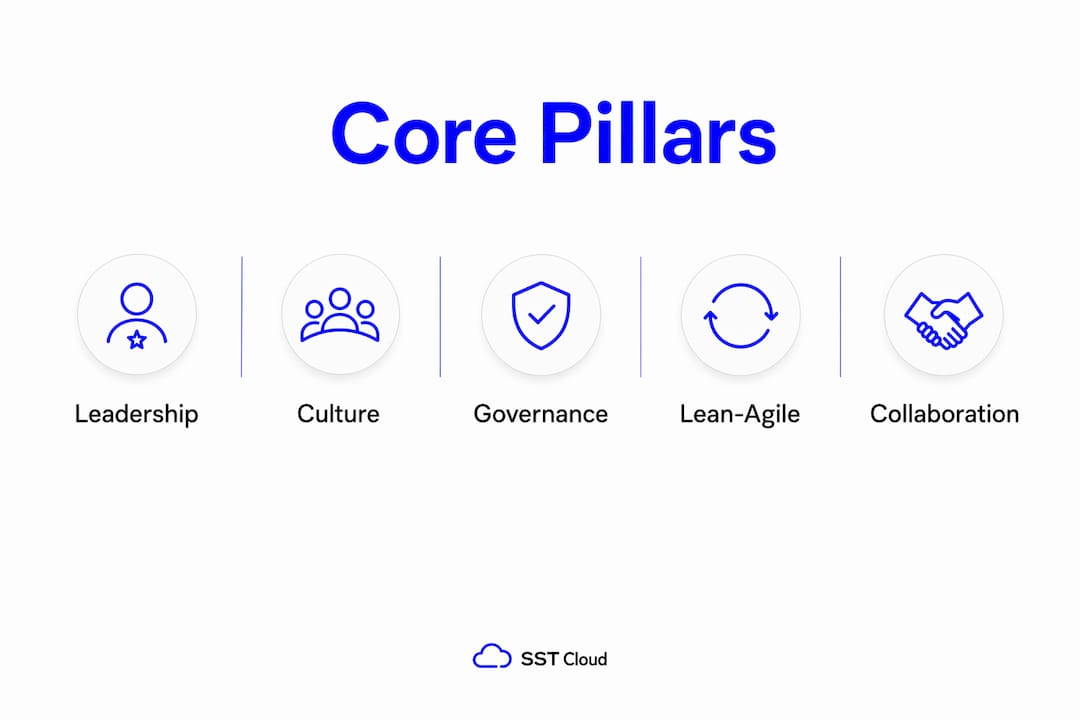
The pillars are not sequential. Leadership cannot wait until culture is “fixed” before governance is addressed. Progress across all pillars in parallel, even if unevenly, produces better outcomes than a phased approach that treats each pillar as a prerequisite for the next.
What are the measurable benefits of business agility?
Organisations that successfully apply business agility see measurable gains across multiple performance dimensions. The 2025 Business Agility Report from the Business Agility Institute documents reported improvements in customer satisfaction, operational performance, employee engagement, and revenue growth among organisations that have progressed along the agility maturity curve.
The benefits extend across the enterprise:
Higher customer satisfaction: empowered teams respond to customer needs faster and with greater precision
Faster time to market: shorter delivery cycles reduce the lag between idea and customer value
Increased employee engagement: people who have autonomy and clear purpose report higher satisfaction and lower turnover
Improved operational performance: reduced waste, faster feedback loops, and better prioritisation improve throughput
Greater resilience: organisations that practise continuous adaptation absorb disruption more effectively than those optimised for stability
Enhanced innovation: psychological safety and experimentation cultures generate more viable ideas per unit of effort
Revenue growth: agile organisations report better financial outcomes as a consequence of the above
Customer-centricity is the thread connecting most of these benefits. Organisations that connect their agility efforts directly to customer outcomes, rather than treating agility as an internal optimisation exercise, consistently outperform those that focus primarily on delivery velocity. Measuring outcomes like customer value and Net Promoter Score proves more effective than tracking delivery metrics like velocity or ticket counts alone.
The secondary benefit that often surprises leaders is the effect on talent. Agile organisations attract and retain people who want meaningful work, clear accountability, and the ability to see the impact of their decisions. In a competitive talent market, that is a genuine structural advantage.
How leading organisations implement business agility
IBM’s agility transformation is one of the most cited examples of enterprise-scale change. The organisation aligned leadership around a shared commitment to cultural shift, enabled cross-functional teams to operate with greater autonomy, and invested in continuous learning infrastructure to navigate uncertainty at scale. The transformation required sustained executive sponsorship over multiple years, not a single reorganisation.
Transformation requires executive sponsorship and sustained effort. Case studies consistently show that organisations which treat business agility as a multi-year capability investment outperform those that treat it as a one-time change programme.
The common implementation path follows a recognisable sequence, even if the specifics vary by organisation:
Leadership alignment: executives agree on the “why” and commit to modelling agile behaviours themselves
Baseline assessment: the organisation maps its current culture, governance, and delivery maturity honestly
Pilot and learn: a small number of cross-functional teams adopt agile ways of working and generate evidence
Scale with structure: successful patterns are codified and spread, with governance adapted to support rather than obstruct
Embed and sustain: agility becomes part of how the organisation hires, promotes, funds, and measures performance
A practical example of operationalising agility beyond software delivery: a company deploys business intelligence tools to surface real-time market data, then empowers its product and commercial teams to act on that data autonomously within defined parameters. The speed advantage comes not from the technology alone but from the governance model that trusts teams to act without escalation. SST Cloud’s work on enterprise data integration reflects exactly this pattern, connecting unified data infrastructure to faster, better-informed decisions across the business.
Critical success factors drawn from implementation evidence include:
Executive sponsorship that is visible and sustained, not delegated to a transformation office
Measurement focused on customer and business outcomes, not delivery activity
Investment in psychological safety as a precondition for honest feedback and experimentation
Governance reform that gives teams real authority, not just the appearance of autonomy
Patience with the maturity curve, recognising that business agility is a multi-year journey from “doing agile” to “being agile”
For technology organisations specifically, IT infrastructure optimisation plays a supporting role in agility by reducing the technical debt and system fragility that slow down delivery teams. The technical foundation matters, but it is an enabler of agility, not a substitute for the cultural and leadership work.
How does business agility differ from agile project management?

This is the most common source of confusion for organisations beginning their agility journey, and getting it wrong is expensive. Agile project management, encompassing methods like Scrum and Kanban as defined by the Scrum Alliance, operates at the team level. Its focus is delivery velocity, iterative development, and adaptability within a project or product context. Business agility, by contrast, is a broader strategic capability that spans the entire enterprise, integrating culture, leadership, governance, and customer focus across every function.
Dimension | Agile project management | Business agility |
|---|---|---|
Scope | Team or project level | Enterprise-wide |
Primary focus | Delivery execution and velocity | Organisational adaptability and resilience |
Key practices | Scrum, Kanban, sprint cycles | Culture change, governance reform, leadership development |
Outcomes measured | Velocity, throughput, release frequency | Customer value, revenue growth, employee engagement |
Timeframe | Sprint to sprint | Multi-year maturity journey |
Who leads it | Scrum Masters, delivery leads | Executive leadership, supported by all levels |
Organisations that adopt Scrum or Kanban at the team level and declare themselves “agile” have completed the easiest part of the work. The harder part, and the part that produces enterprise-level outcomes, is changing how the organisation makes decisions, allocates resources, structures teams, and defines success. That is the domain of business agility.
Pro Tip: If your organisation has adopted agile delivery frameworks but still runs annual budgeting cycles, approves all strategic decisions at the executive level, and measures teams primarily on output rather than customer outcomes, you are “doing agile” without “being agile.” The gap between those two states is where most transformation value is lost.
The Agile Manifesto, published in 2001, established the values and principles that underpin agile methods. Business agility extends those principles beyond software teams to the whole organisation, applying the same logic of iterative learning, customer feedback, and adaptive planning to strategy, governance, and culture. The Agile Business Consortium and Scrum Alliance both emphasise that framework adoption alone does not produce business agility. Mindset and cultural shifts are the harder, more consequential work.
Organisations with slow, legacy decision-making structures risk disruption precisely because their competitors are not just using better tools. They are operating with fundamentally different governance models that allow cross-functional teams to use real-time data for autonomous decisions. That structural difference, not the choice of delivery framework, is what separates genuinely agile enterprises from those that have adopted the vocabulary without the substance.
SST Cloud’s cloud transformation services are designed to support exactly this kind of enterprise-wide change, providing the technical infrastructure and engineering capability that enables organisations to move faster, reduce complexity, and build the operational foundation that business agility requires.
Key takeaways
Business agility is an enterprise-wide organisational capability built on culture, leadership, and governance, not a delivery framework or project methodology.
Point | Details |
|---|---|
Definition clarity | Business agility is an organisational capability for rapid, people-centric adaptation, distinct from team-level agile methods. |
Human-centric foundation | Culture, psychological safety, and leadership behaviours are harder to change than processes and more critical to sustained agility. |
Measurable benefits | Agile organisations report gains in customer satisfaction, employee engagement, operational performance, and revenue growth. |
Implementation requires patience | Business agility is a multi-year maturity journey from “doing agile” to “being agile,” requiring sustained executive sponsorship. |
Outcomes over outputs | Measuring customer value and Net Promoter Score proves more effective than tracking delivery velocity or ticket counts. |