Knowledge Base
Cloud migration roadmap explained: an enterprise guide
Discover the cloud migration roadmap explained. Learn to confidently plan each phase, manage risks, and ensure operational success.

Cloud migration roadmap explained: an enterprise guide
A cloud migration roadmap is a structured, business-aligned plan that sequences workloads into governed waves, controls risk at every phase gate, and produces a predictable operating model on the other side of cutover. The single most important outcome it delivers is not technical: it is the confidence that leadership, finance, and operations can all act on the same plan without surprises.
Three elements make or break any roadmap:
Assessment: a complete workload inventory with dependency maps, SLA baselines, RPO/RTO targets, and regulatory constraints documented before a single workload moves.
Sequenced waves: workloads grouped by dependency coupling, business criticality, and risk profile, with each wave validated before the next begins.
Governance gates: explicit sign-off criteria at each phase boundary, backed by a living risk register and cost controls that are active from day one.
Your immediate next step: within the next 48–72 hours, assign a discovery sprint owner and schedule a steering committee kick-off. Every week without a formal inventory is a week of undiscovered dependencies accumulating risk.
Pro Tip: Run a two-day dependency-mapping workshop before any tooling decisions. The output, a rough application relationship map, will reshape your wave sequencing more than any vendor assessment tool.
Table of Contents
What does a cloud migration roadmap actually cover?
Which migration strategy fits each workload? The 6 R’s explained
What are the phases of a cloud migration roadmap?
How do you prioritise workloads and sequence migration waves?
Governance, security and cost control for Australian enterprises
What are the most common cloud migration pitfalls?
What should a migration runbook and cutover checklist contain?
How do you measure success after migration?
Practitioner checklist: living risk registers, cost governance and wave policy
Key takeaways
The governance habits that separate successful migrations from costly ones
SST Cloud helps you build and execute your migration roadmap
Useful references and further reading
What does a cloud migration roadmap actually cover?
A cloud migration roadmap is not a project checklist. A checklist tells you what to do; a roadmap tells you in what order, under what conditions, and with what authority. It translates a business case for cloud adoption into a sequenced delivery programme with defined phase outputs, decision gates, and an operating model that sustains the environment after the last workload lands.
The primary goals of a well-constructed roadmap are four-fold: realising measurable business outcomes (cost reduction, agility, resilience), reducing migration risk through controlled sequencing, creating cost predictability across a multi-year programme, and defining the post-migration operating model before the first workload moves. Organisations that skip the operating model definition routinely discover that their cloud environment is technically live but operationally ungoverned.
Getting the stakeholder structure right is as important as the technical plan. The following roles must be active from the assessment phase:
Steering committee: programme sponsor, CIO or CTO, finance lead; accountable for budget, risk acceptance, and phase-gate sign-off.
Workload owners: application and platform leads who validate dependency maps and accept cutover windows.
Security and compliance: CISO delegate and, for regulated industries, a compliance officer who reviews data residency and privacy obligations.
Finance: cloud financial management lead responsible for tagging standards, budget alerts, and egress cost modelling.
Change management lead: responsible for communications, training, and user-readiness activities across each wave.
A cloud migration risk assessment is not a generic checklist or a one-time security review. It is a decision framework that connects technical evidence to business impact, defines the conditions under which a workload may move, and gives accountable leaders a defensible basis for accepting, mitigating, transferring, or avoiding risk.
Which migration strategy fits each workload? The 6 R’s explained
The 6 R’s framework is the standard taxonomy for mapping workloads to migration strategies. Each R represents a different effort level, risk profile, and business outcome, so selecting the right one per workload is the foundation of accurate effort estimates and wave sequencing.
Key signals that point to each strategy:
Rehost (lift-and-shift): end-of-life data centre contracts, time-critical exits, workloads with no cloud-native dependencies. Lowest effort, fastest delivery, but leaves cloud efficiency gains on the table.
Replatform (lift and optimise): workloads that benefit from managed services (e.g., moving from self-managed PostgreSQL to Amazon RDS or Azure Database for PostgreSQL) without code changes. Moderate effort, meaningful operational savings.
Refactor/Re-architect: applications that need new capabilities such as auto-scaling, AI/ML integration, or microservices decomposition. Highest effort and longest lead time; justified when the business case requires cloud-native performance.
Revise: partial code changes to make a workload cloud-compatible, typically used when a full refactor is not yet funded but rehost is not viable.
Rebuild: legacy applications with outdated code bases where refactoring costs exceed a rebuild. Planned from scratch using cloud-native tooling such as Kubernetes, serverless functions, or managed container services.
Replace (repurchase): retiring a custom application in favour of a SaaS equivalent. Common for CRM, ITSM, and HR platforms where the vendor now offers a cloud-native product.
Strategy | When to pick | Effort | Typical risk | Quick example |
|---|---|---|---|---|
Rehost | Data centre exit, time pressure | Low | Low–medium | VM to EC2 or Azure VM |
Replatform | Managed service savings, no code change | Medium | Low–medium | Self-managed DB to Amazon RDS |
Refactor | Scalability, AI/ML, microservices needed | High | Medium–high | Monolith decomposed to containers |
Revise | Partial compatibility gap | Medium | Medium | OS upgrade + minor code patch |
Rebuild | Legacy code, rebuild cost lower than refactor | Very high | High | Custom app rewritten as serverless |
Replace | SaaS equivalent available | Low–medium | Low | On-prem CRM replaced with Salesforce |
What are the phases of a cloud migration roadmap?
Cloud migration is a multi-phase process: assessment, planning, migration, and optimisation. Each phase has defined outputs and a gate that must be cleared before the programme advances.
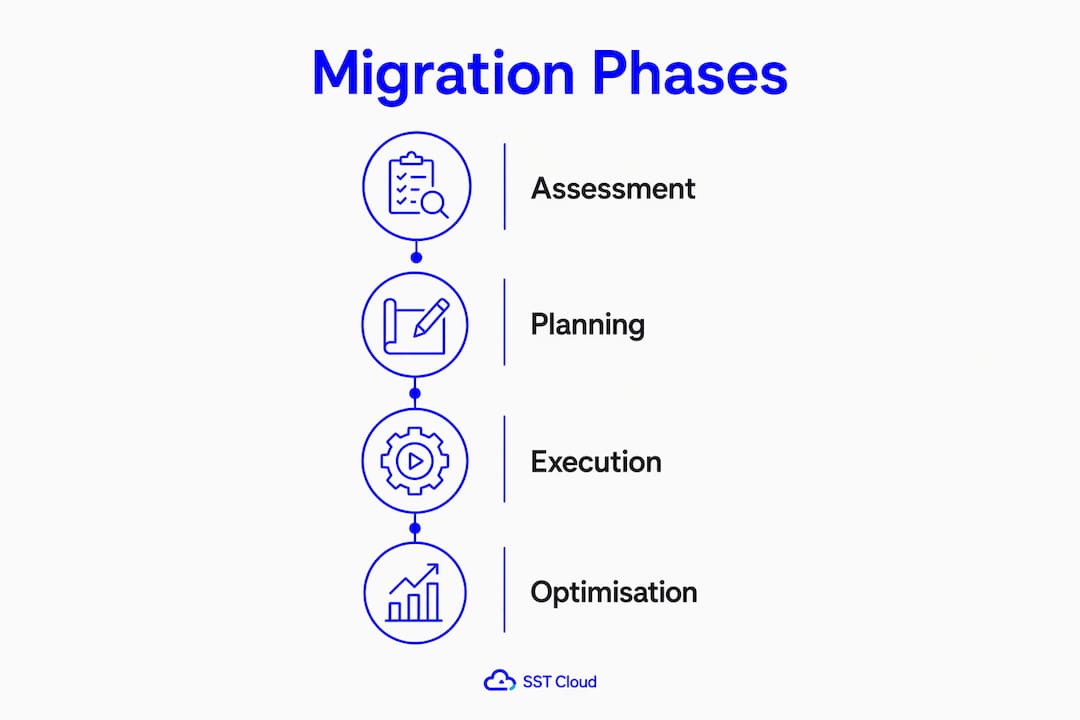
Phase 1: pre-migration assessment
The assessment phase produces the inventory and evidence base the entire programme depends on. Workload assessment should capture performance baselines, SLA commitments, RPO/RTO targets, regulatory constraints, and a complete dependency map including external APIs, partner systems, and ISV integrations. Without this, wave sequencing is guesswork.
Phase 1 outputs: application inventory, dependency map, cloud readiness score per workload, target architecture decision records (ADRs), regulatory and data residency constraints register.
Phase 2: planning and wave design
Planning translates the inventory into a migration wave schedule with sequenced workload groups, effort estimates, and resource allocation. This phase also produces the governance framework: tagging standards, budget baselines, security controls, and the risk register.

Phase 2 outputs: wave schedule, migration runbooks (draft), risk register, cost model, RACI matrix, change management plan.
Phase 3: execution and cutover
Execution follows the wave schedule. Each wave begins with a pre-cutover validation gate, runs the migration, and closes with a post-cutover validation before the next wave is approved. Pilot migrations validate the approach on lower-risk workloads before critical systems move.

Phase 3 outputs: completed migration runbooks, cutover records, rollback decisions log, post-cutover validation reports, updated risk register.
Phase 4: post-migration optimisation
Optimisation converts a technically live environment into a well-governed operating model. This includes right-sizing, reserved instance purchasing, security posture reviews, and embedding platform thinking into the cloud operating model.
Phase 4 outputs: optimised cost baseline, monitoring dashboards, updated runbooks, operating model documentation, 90/180/365-day improvement plan.
Pro Tip: At each phase gate, require the steering committee to sign a formal acceptance record, not just an email approval. That record becomes the audit trail for finance and compliance stakeholders.
How do you prioritise workloads and sequence migration waves?
Wave sequencing is where most enterprise programmes either gain control or lose it. The goal is to group workloads so that each wave is independently deliverable, dependency-safe, and sized to the team’s actual capacity.
A scoring framework gives the programme a repeatable, defensible basis for sequencing decisions. Score each workload against the following criteria:
Criterion | Weight | Scoring guidance |
|---|---|---|
Business criticality | 30% | Revenue-generating or safety-critical = 5; internal tooling = 1 |
Dependency complexity | 25% | Tightly coupled to 5+ systems = 5; standalone = 1 |
Compliance constraints | — | Regulated data (health, financial) = 5; no constraints = 1 |
Cost impact | 15% | High on-prem cost, clear cloud saving = 5; neutral = 1 |
Technical readiness | 10% | Cloud-ready today = 5; requires significant rework = 1 |
Multiply each raw score by its weight, sum the results, and sort workloads into three bands: Wave 1 (low complexity, low criticality, high readiness), Wave 2 (moderate complexity, medium criticality), Wave 3 (high criticality, tightly coupled, regulated). This approach prevents the common mistake of migrating mission-critical systems before the operating model is proven.
Dependency mapping must include synchronous calls, batch transfers, identity providers, certificate services, message queues, shared databases, third-party APIs, and manual operational procedures. A dependency used once per month may escape a short test window but still be critical to financial close or regulatory reporting. Conservative grouping rule: if two components share a synchronous runtime dependency, they belong in the same wave unless an interim integration architecture is in place.
Risk scoring uses a Likelihood × Impact matrix on a 1–5 scale for each dimension, producing an inherent risk score from 1–25. Scores of 16–25 require mitigation or avoidance before cutover is approved.
Treat the risk register as a living decision gate, not a static document. Review and re-score it before each wave, because architecture changes, new dependencies, and control failures all shift residual risk in ways that a one-time assessment cannot capture.
Pro Tip: Add a “dependency confidence” column to your wave schedule. If the team cannot confirm a dependency with a working test, that workload moves to the next wave, no exceptions.
Governance, security and cost control for Australian enterprises
Governance is not a post-migration concern. The controls that prevent budget overruns and compliance failures must be active before the first workload moves.
Governance constructs
Steering committee with defined quorum and a documented escalation path for risk acceptance decisions.
Migration policy that specifies acceptance criteria: tested rollback, validated monitoring, security sign-off, and business-owner approval before each wave proceeds.
Formal phase-gate records signed by the steering committee, retained for audit purposes.
Security and compliance checklist (Australian enterprise context)
Australian enterprises must address data residency requirements under the Privacy Act 1988 and, for health data, the My Health Records Act 2012. Regulated industries (financial services, health, government) should also reference the Australian Signals Directorate (ASD) Essential Eight controls and the Australian Prudential Regulation Authority (APRA) CPS 234 standard for information security.
Confirm cloud regions used are within Australia (Sydney, Melbourne) for data subject to residency obligations.
Apply ASD Essential Eight controls: application control, patching, MFA, and restricted admin privileges.
Classify all data assets before migration; apply encryption in transit and at rest.
Implement identity and access management using least-privilege principles and OIDC-based federation where CI/CD pipelines are involved.
Document compliance sign-off for each wave in the risk register.
A secure landing zone built with AWS Control Tower or equivalent Azure/GCP constructs provides the governance guardrails that enforce these controls automatically across accounts.
Cost governance
Unmonitored resources and egress fees are the most common source of budget overruns in enterprise migrations. Establish the following controls from day one:
Tagging standards: mandatory tags for environment, cost centre, workload owner, and wave number on every resource.
Budget alerts: cloud-native budget alerts (AWS Budgets, Azure Cost Management) set at 80% and 100% of monthly targets.
Egress modelling: calculate data transfer costs for each workload before migration, particularly for high-volume data pipelines between regions or to on-premises systems.
Right-sizing: use AWS Compute Optimizer, Azure Advisor, or Google Cloud Recommender to identify over-provisioned resources within the first 30 days post-migration.
Reserved instance planning: commit to reserved capacity only after 60–90 days of live usage data, not during the migration itself.
Treating cost governance as a primary planning pillar, not an afterthought, is the single most effective way to prevent the budget surprises that derail post-migration business cases.
What are the most common cloud migration pitfalls?
Understanding where enterprise migrations typically fail is as important as knowing the correct process. The following challenges appear repeatedly across large-scale programmes.
Undiscovered dependencies: the most frequent cause of cutover failures. Mitigation: run automated discovery tools (AWS Application Discovery Service, Azure Migrate) alongside manual interviews with application owners.
Testing gaps: functional testing without performance or integration testing misses the failure modes that matter most in production. Mitigation: define test cases from the dependency map, not from the application’s feature list.
Underestimated data movement: large datasets take longer to transfer than teams expect, particularly over constrained WAN links. Mitigation: measure actual transfer rates during assessment and build transfer time into the wave schedule.
Licence mismatches: on-premises licence agreements often do not transfer to cloud environments. Mitigation: audit licence portability for every commercial software component before finalising the migration strategy.
Change resistance: teams that were not involved in planning often resist new operating procedures. Mitigation: include workload owners in wave design from the start and run change management activities in parallel with technical execution.
For live databases, use change data capture (CDC) rather than dump-and-restore to preserve data continuity during cutover and reduce the rollback window.
Challenge | Mitigation action | Roadmap artefact |
|---|---|---|
Undiscovered dependencies | Automated discovery + owner interviews | Dependency map |
Testing gaps | Test cases derived from dependency map | Test plan per wave |
Data movement underestimate | Transfer rate measurement in assessment | Wave schedule with transfer windows |
Licence mismatch | Licence portability audit | Strategy decision per workload |
Change resistance | Workload owners in wave design | Change management plan |
CDC not implemented | Mandate CDC for all live databases | Runbook standard |
When a workload scores poorly on both business value and technical feasibility, the correct decision is often to retire it rather than migrate it. The “Retire” and “Retain” options in the 6 R’s framework exist precisely for this reason: not every workload belongs in the cloud, and recognising that early prevents wasted effort and budget.
What should a migration runbook and cutover checklist contain?
A runbook is the operational script that eliminates ambiguity on cutover day. Every wave needs one, and it must be tested in a staging environment with explicit pass/fail criteria before production cutover is approved.
Minimum runbook contents
Pre-cutover validation: confirm final dependency checks, verify backup completion, validate monitoring is active, confirm rollback environment is ready.
Final sync steps: execute final data sync or CDC catch-up; confirm source and target data checksums match.
Cutover steps: execute DNS or load-balancer switch, update configuration references, confirm application health checks pass.
Post-cutover validation: run smoke tests against production endpoints, confirm SLA metrics are within baseline, verify security controls are active.
Communication steps: notify stakeholders of cutover completion, update the status page, confirm support teams are on standby.
Rollback triggers: define the specific conditions (error rate threshold, latency breach, data integrity failure) that trigger an immediate rollback decision.
Rollback procedure: documented step-by-step reversion to the source environment, with the last safe rollback point clearly marked.
Escalation contacts: named decision owners for rollback authorisation, security incidents, and data integrity issues.
Rollback and RPO/RTO alignment
Rollback triggers must align with the RPO and RTO commitments documented during assessment. If the business cannot tolerate more than four hours of data loss, the rollback window must be shorter than four hours, and the runbook must prove that reversion is achievable within that window. Migration planning guidance recommends that rollback plans be specific and executable, not aspirational.
Test the runbook in staging at least once before production cutover. Record the actual elapsed time for each step. If any step takes longer than planned, revise the schedule before the live event.
Day-of checklist for operations teams
[ ] Confirm all pre-cutover validation steps passed and are signed off.
[ ] Verify rollback environment is healthy and accessible.
[ ] Confirm monitoring dashboards are active and alerting is configured.
[ ] Notify all stakeholder groups that cutover has commenced.
[ ] Execute cutover steps in sequence; record actual completion times.
[ ] Run post-cutover smoke tests; compare results against baseline.
[ ] Confirm rollback trigger thresholds have not been breached.
[ ] Obtain business-owner sign-off on post-cutover validation.
[ ] Update the risk register with cutover outcome and any residual items.
How do you measure success after migration?
Post-migration success is not a feeling. It is a set of measurable KPIs tracked against pre-migration baselines, reviewed at defined intervals, and used to drive a continuous improvement cycle.
Primary KPIs to track from day one
Availability: uptime percentage per workload against the SLA commitment documented in assessment.
Latency: application response time compared to the pre-migration baseline; regressions above 10% warrant immediate investigation.
Cost per workload: actual cloud spend versus the modelled cost; variances above 15% trigger a right-sizing review.
Licence utilisation: percentage of purchased licences actively in use; unused licences represent direct cost waste.
Security events: count and severity of security alerts from Cloud Security Posture Management (CSPM) tools such as AWS Security Hub, Microsoft Defender for Cloud, or Google Security Command Centre.
Deployment lead time: time from code commit to production deployment; a reduction here signals that the cloud operating model is delivering the agility promised in the business case.
Baselining and validation
Baseline metrics must be captured during the assessment phase, not after migration. Without a pre-migration baseline, post-migration comparisons are meaningless. Capture availability, latency, and cost data for at least 30 days before the first wave moves.
Post-migration optimisation timeline
A structured optimisation programme prevents the common pattern where teams declare victory at cutover and then allow cloud costs and technical debt to accumulate.
Days 1–30: stabilise operations, resolve post-cutover incidents, confirm monitoring coverage, begin right-sizing analysis.
Days 31–90: implement right-sizing recommendations, purchase reserved instances for stable workloads, conduct first security posture review.
Days 91–180: review licence utilisation, retire unused resources, begin application modernisation planning for Wave 1 candidates.
Days 181–365: assess operating model maturity, embed FinOps practices, plan next modernisation wave.
Embedding cost and performance monitoring into the cloud operating model means treating these as ongoing engineering responsibilities, not periodic finance reviews. Tools like AWS Cost Explorer, Azure Cost Management, and Google Cloud Billing provide the visibility; the operating model must define who acts on that visibility and within what timeframe.
Practitioner checklist: living risk registers, cost governance and wave policy
Experienced migration teams operate the risk register as a decision gate, not a compliance artefact. Before each wave is approved, the register must show inherent risk scores, the controls planned to reduce them, and residual risk scores after those controls are validated. A wave with unresolved red items (scores 16–25 on the Likelihood × Impact heatmap) does not proceed, regardless of schedule pressure.
Risk register structure
Field | Description |
|---|---|
Risk scenario | Specific failure mode (e.g., “CDC lag causes data loss during cutover”) |
Affected asset | Workload or data asset at risk |
Inherent risk score | Likelihood × Impact before controls (1–25) |
Planned controls | Specific mitigations with owners and due dates |
Residual risk score | Likelihood × Impact after controls are validated |
Decision | Approve, conditional approve, defer, or avoid |
Sign-off authority | Named steering committee member |
Cost governance checklist
Tagging policy enforced via AWS Service Control Policies (SCPs), Azure Policy, or GCP Organisation Policies before any resource is provisioned.
Budget alerts configured at 80% and 100% of monthly targets for each cost centre.
Egress costs modelled per workload and reviewed at each wave planning session.
Automated anomaly detection enabled (AWS Cost Anomaly Detection, Azure Cost Alerts).
Reserved instance or savings plan commitments deferred until 60–90 days of live usage data is available.
Monthly FinOps review cadence established with finance and engineering leads.
Wave approval policy
A wave may proceed only when the following evidence is on file and signed by the steering committee:
Dependency map validated by workload owners.
Risk register reviewed; all red items resolved or formally accepted with documented rationale.
Runbook tested in staging with recorded pass/fail results.
Rollback procedure confirmed executable within the agreed RTO window.
Business-owner approval for the cutover window.
Cost model reviewed and budget alerts active.
Modern enterprise migrations should include an AI-services dependency review as a standard item at each wave gate. AI integrations, whether inference APIs, vector databases, or managed ML endpoints, introduce latency, compliance, and cost-scaling variables that traditional lift-and-shift planning does not capture. A workload that calls an AI service in production needs that dependency documented, tested, and costed before it moves.
Pro Tip: Add a “governance confidence score” to your wave approval checklist: a simple 1–5 self-assessment by the migration lead that captures whether the team genuinely believes the wave is ready, separate from the formal checklist. A score below 3 is a signal to pause, even if all boxes are ticked.
Key takeaways
A cloud migration roadmap succeeds when assessment evidence, wave sequencing, and governance gates operate together as a single decision framework, not as separate workstreams.
Point | Details |
|---|---|
Assessment is the foundation | Capture dependency maps, RPO/RTO targets, and compliance constraints before sequencing any wave. |
Wave sequencing controls risk | Score workloads by criticality, dependency complexity, and compliance constraints; migrate low-risk workloads first to prove the operating model. |
Risk register as a live gate | Score inherent and residual risk using a Likelihood × Impact matrix; red scores (16–25) block wave approval until resolved. |
Cost governance from day one | Enforce tagging, budget alerts, and egress modelling before the first resource is provisioned to prevent post-migration budget overruns. |
SST Cloud for end-to-end delivery | SST Cloud designs and executes migration roadmaps across AWS, Azure, and GCP, covering assessment, wave planning, governance, and managed services. |
The governance habits that separate successful migrations from costly ones
The most consistent pattern in enterprise migrations that go wrong is not a technical failure. It is a governance failure: a wave that proceeded without a validated rollback, a cost model that was never updated after scope changed, or a risk register that was completed once and never reviewed again. The checklist and wave policy in this guide exist to prevent exactly those failure modes.
What actually works in practice is short, frequent governance touchpoints rather than long monthly reviews. A 30-minute wave readiness call the week before each cutover, where the migration lead walks through the risk register and the runbook test results, catches more issues than a quarterly steering committee meeting. Stakeholder communication at that cadence also keeps business owners engaged rather than surprised.
The other habit that consistently matters is rollback rehearsal. Teams that have never practised a rollback take far longer to execute one under pressure. Running a full rollback drill in staging, timing each step, and recording the results gives the team confidence and gives the steering committee evidence that the recovery plan is real.
For IT decision-makers building their first enterprise roadmap, the internal references to prepare are: the dependency map, the risk register, the wave schedule, and the runbook template. Those four documents, kept current and reviewed at each gate, are the governance backbone of any migration programme. SST Cloud’s customer case studies illustrate how this governance model translates into business outcomes across different industries and migration scales.
SST Cloud helps you build and execute your migration roadmap
Enterprise cloud migrations rarely fail because of technology. They fail because the roadmap was not specific enough, the governance was not active enough, or the team did not have the depth to manage wave sequencing, risk registers, and cost controls simultaneously. SST Cloud’s cloud transformation services address all three.
SST Cloud works with Australian enterprises to design migration roadmaps from the ground up: workload assessment, dependency mapping, wave sequencing, governance framework design, and hands-on migration execution across AWS, Microsoft Azure, and Google Cloud Platform. Engagements include cost governance setup, security landing zone configuration, and a managed services option for teams that need ongoing operational support after cutover. Whether your programme spans 50 workloads or 500, SST Cloud brings the engineering depth and strategic advisory to deliver it with controlled risk and measurable outcomes. To discuss your migration programme, contact SST Cloud and start with a scoped discovery engagement.
Useful references and further reading
The following authoritative sources support the frameworks and guidance in this article. Australian IT decision-makers should pay particular attention to the ASD and APRA references for compliance context.
Microsoft Azure Cloud Adoption Framework: Migration wave planning — wave sequencing methodology and phase outputs.
Microsoft Azure Cloud Adoption Framework: Assess workloads for cloud migration — assessment artefacts, dependency mapping, and RPO/RTO guidance.
Microsoft Azure Cloud Adoption Framework: Plan your migration — migration planning, rollback definitions, and dependency sequencing.
AWS: What is cloud migration? — overview of the 6 R’s and migration strategy taxonomy.
AWS: Cloud migration strategy explained — detailed guidance on the 7 R’s, mobilise phase, and migration factory patterns.
Microsoft Azure: What is cloud migration? — six-stage migration lifecycle and common challenges.
Google Cloud: Cloud migration strategy and process — multi-phase migration process, optimisation guidance, and checklist.
Cloud migration risk assessment framework with heatmap — Likelihood × Impact scoring model, risk register structure, and decision gates.
Australian Signals Directorate: Essential Eight — baseline security controls relevant to cloud environments for Australian organisations.
APRA CPS 234: Information Security — prudential standard for information security applicable to APRA-regulated entities migrating to cloud.
SST Cloud insights: cloud migration and governance — practitioner articles on cloud migration, governance, and platform engineering from the SST Cloud team.