Knowledge Base
Scalable architecture: principles, patterns, and best practices
Discover what scalable architecture is and how it ensures optimal system performance as workloads grow. Learn key principles and best practices.

Scalable architecture: principles, patterns, and best practices
Scalable architecture is the design approach that allows software systems to handle growing workloads by adding resources without requiring a fundamental redesign. Scalability is formally defined as the property of a system to manage increased work by adding resources effectively, making it a critical non-functional requirement for any system expected to grow over time. Whether you are building a cloud-native platform on AWS, a distributed data pipeline on Google Cloud Platform, or a microservices application on Microsoft Azure, the architectural decisions you make early will determine how well your system performs under pressure years later.
What is scalable architecture, and what makes it work?
A scalable system preserves performance as load increases, rather than degrading under pressure. Three attributes define whether an architecture genuinely qualifies: it maintains acceptable response times under higher load, it uses resources efficiently rather than over-provisioning by default, and it can adapt as both traffic patterns and business requirements shift.
The foundational elements that make this possible include:
Statelessness: Each service request carries all the information needed to process it, so any instance can handle any request. This removes session affinity constraints and lets you add or remove instances freely.
Loose coupling: Components interact through well-defined interfaces rather than direct internal dependencies. A change in one service does not cascade into others, and each component can be scaled independently.
Asynchronous processing: Work that does not need an immediate response is offloaded to queues or event streams, decoupling producers from consumers and smoothing out load spikes.
Modularity: Breaking a system into discrete, independently deployable units means you can scale the parts under pressure without touching the rest.
Fault tolerance: A scalable system degrades gracefully when a component fails, rather than collapsing entirely. Redundancy and circuit-breaker patterns are standard tools here.
Scalability is not the same as raw performance. A fast system that cannot grow beyond a single server is not scalable. The goal is a system that grows proportionally with demand, at a cost that remains predictable.
Why scalable architecture matters for your system and business

The business case for investing in scalable system design is direct. Systems that cannot handle growth force costly emergency redesigns, often at the worst possible moment, when a product is gaining traction or a regulatory deadline is approaching.
Key benefits include:
Performance under load: A well-designed architecture maintains low latency as concurrent users increase, rather than exhibiting the exponential degradation that plagues tightly coupled monoliths.
Reliability and availability: Distributing workloads across multiple nodes means a single failure does not take the entire system offline. Redundancy is a natural byproduct of horizontal distribution.
Cost-effective resource use: Cloud platforms allow you to pay for capacity only when you need it. Scalable architectures exploit this through autoscaling, provisioning resources in response to real demand rather than peak estimates.
Business agility: Teams can deploy new features to individual services without coordinating a full system release, compressing development cycles considerably.
Long-term sustainability: Systems designed with scalability as a first-class concern avoid the technical debt that accumulates when growth is bolted on as an afterthought.
The importance of scalable architecture becomes most visible when organisations face sudden demand spikes, whether from a marketing campaign, a regulatory change, or an unexpected surge in user adoption.
Horizontal scaling vs vertical scaling: which approach fits your system?
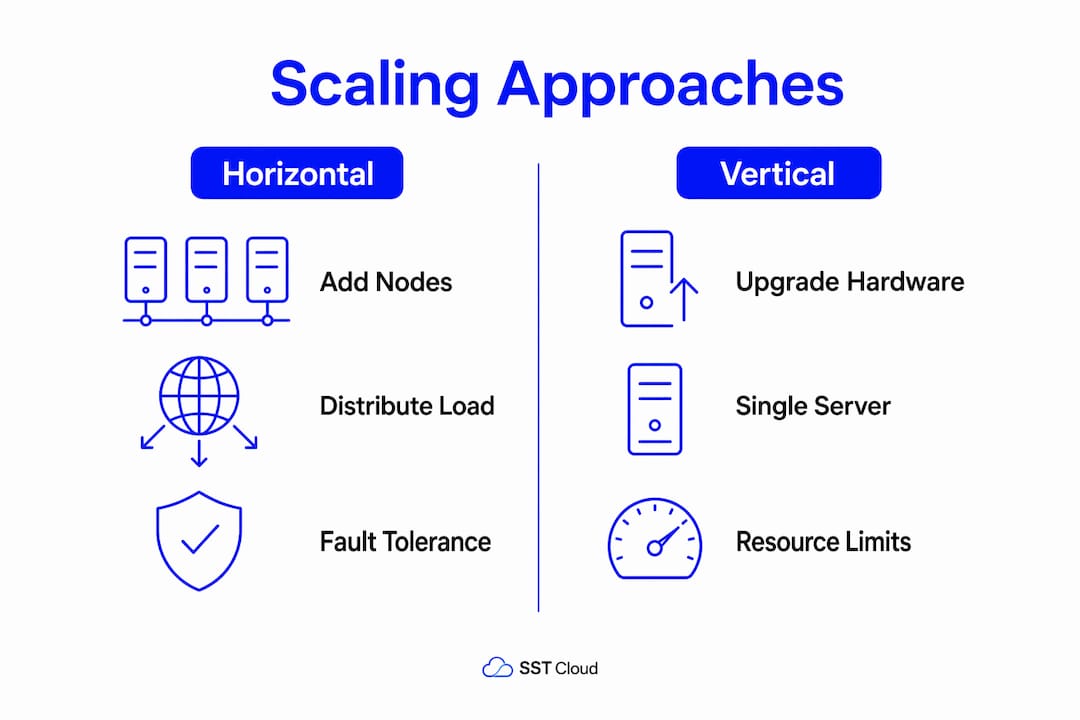
The two primary methods for increasing a system’s capacity are horizontal scaling (scale-out) and vertical scaling (scale-up). Understanding the practical difference between them shapes every infrastructure decision you make.
Horizontal scaling adds new nodes to a cluster to distribute load across more machines. Vertical scaling adds CPU, memory, or storage to an existing machine. Cloud applications favour horizontal scaling because it offers better fault resilience and removes the hard ceiling imposed by the largest available hardware instance.
Dimension | Horizontal scaling | Vertical scaling |
|---|---|---|
Mechanism | Add more servers or nodes | Add CPU, memory, or storage to one server |
Fault tolerance | High — failure of one node does not stop the system | Low — a single point of failure remains |
Cost model | Pay incrementally as load grows | Large upfront cost for bigger hardware |
Complexity | Requires distributed system design | Simpler to implement initially |
Upper limit | Theoretically unbounded | Constrained by the largest available hardware |
Best suited for | Cloud-native, stateless workloads | Legacy applications, databases with low write volume |
Vertical scaling is a reasonable first step for a system still finding its load profile. Once you approach hardware limits or need fault tolerance, horizontal scaling becomes the only viable path. Most production systems at scale use both: vertical scaling for individual database nodes, horizontal scaling for stateless application tiers.

Core principles that underpin every scalable system
Scalable architecture rests on a set of design principles that, when applied consistently, prevent the bottlenecks that kill performance at scale.
Statelessness in services: When a service holds no session state between requests, any instance in a pool can serve any request. This is the single most important enabler of horizontal scaling. State that must persist belongs in a dedicated data store, not in application memory.
Loose coupling and clear data ownership: Services that share writable data become tightly coupled, and tight coupling degrades performance as the system grows. Each service should own its data, exposing it to others through APIs or asynchronous events rather than shared database tables.
Asynchronous event-driven communication: Synchronous calls between services create latency chains. Replacing them with message queues or event streams, such as Apache Kafka or AWS SQS, lets producers and consumers operate at their own pace and absorb traffic spikes without cascading failures.
Modularity and decomposition: Breaking a system into smaller components allows teams to scale the parts under pressure independently. A checkout service experiencing high load can be scaled without touching the product catalogue service.
Fault tolerance and graceful degradation: Circuit breakers, retries with exponential backoff, and bulkhead patterns prevent a failure in one component from propagating across the system. Google’s NALSD methodology emphasises rigorous analysis of failure modes and graceful degradation as core skills in large-scale system design.
Resilience through redundancy: Running multiple instances of every critical component, across availability zones where possible, eliminates single points of failure without requiring architectural changes when a node goes down.
Pro Tip: Apply the principle of loose coupling to your data layer first. Shared writable databases are the most common source of tight coupling in systems that started as monoliths and grew without a deliberate decomposition strategy.
Common patterns used to build scalable systems
Practical scalable architecture relies on a set of well-established patterns. Each addresses a specific class of scaling problem, and most production systems combine several of them.
Microservices architecture: The application is decomposed into small, independently deployable services, each responsible for a specific business function. Each service can be scaled independently based on its own load profile, and updates to one service do not require redeploying others. The trade-off is operational complexity: you need service discovery, distributed tracing, and a mature CI/CD pipeline to manage it effectively.
Event-driven architecture: Components communicate by producing and consuming events rather than making direct calls. This decouples producers from consumers entirely and allows the system to absorb load spikes by buffering events in a queue or stream. AWS EventBridge, Apache Kafka, and Azure Service Bus are common implementations.
Caching: Serving frequently accessed data from an in-memory cache, such as Redis or Memcached, reduces load on backend databases by orders of magnitude. A stateless API service with a caching layer added incrementally is a proven starting point for scalable architecture without over-engineering.
Database sharding: Large databases are partitioned horizontally across multiple servers, with each shard holding a subset of the data. Sharding prevents any single database node from becoming a bottleneck as data volume grows, though it introduces complexity around cross-shard queries and data rebalancing.
Load balancing: Incoming requests are distributed across multiple service instances using algorithms such as round-robin or least-connections. Load balancers, whether hardware appliances or software solutions like AWS Elastic Load Balancing or NGINX, prevent any single instance from becoming saturated.
CQRS (Command Query Responsibility Segregation): Read and write operations are separated into distinct models, allowing each to be scaled independently. Write-heavy workloads and read-heavy workloads have different resource profiles, and CQRS lets you optimise each without compromising the other.
Auto-scaling: Cloud platforms allow you to define scaling policies based on observed metrics, such as CPU utilisation or request queue depth, so the system adds or removes instances automatically in response to real demand rather than manual intervention.
These patterns are not mutually exclusive. A production system might combine microservices with event-driven communication, a caching layer, and auto-scaling policies, each pattern addressing a different dimension of the scalability problem.
Why observability is inseparable from scalable architecture
You cannot scale what you cannot measure. Observability provides the feedback loop that makes scaling decisions grounded in evidence rather than guesswork. It comprises three components:
Metrics: Quantitative signals such as CPU utilisation, memory pressure, request latency (particularly p95 and p99 percentiles), and error rates. Metrics are the primary input for autoscaling triggers and capacity planning.
Logs: Structured records of system events that allow engineers to reconstruct what happened during an incident. Centralised log aggregation, using tools like the ELK Stack (Elasticsearch, Logstash, Kibana) or AWS CloudWatch Logs, makes this tractable at scale.
Distributed tracing: Traces follow a request across multiple services, revealing where latency accumulates in a distributed system. Tools like AWS X-Ray, Jaeger, or OpenTelemetry make it possible to identify which service in a chain is the bottleneck.
Automated provisioning and metrics-driven autoscaling are what separate a genuinely scalable system from one that merely claims to be. Without observability, scaling decisions default to intuition, which tends to produce either over-provisioned infrastructure or under-provisioned systems that fail under load.
Pro Tip: Instrument your system for observability before you need to scale it. Retrofitting distributed tracing into a production system under load is significantly harder than building it in from the start.
Scalable architecture must evolve continuously
No architecture is permanently scalable. The bottleneck that limits a system at one thousand concurrent users is rarely the same one that limits it at one million. Iterative design, where logical components are refined progressively rather than designed exhaustively upfront, is the approach that keeps architecture aligned with actual system behaviour.
Key considerations for architecture evolution include:
Shifting bottlenecks: As you resolve one constraint, another emerges. A caching layer that eliminates database read pressure may reveal that the application tier is now the bottleneck. Continuous profiling and load testing expose these shifts before they become production incidents.
Feedback loops from monitoring: Observability data should feed directly into architecture reviews. If p95 latency is climbing on a specific service, that is the signal to investigate decomposition or caching at that layer, not across the system as a whole.
Avoiding premature complexity: Google’s NALSD framework advocates assessing large systems through iteration and rigorous analysis of scaling and failure modes, rather than designing for theoretical peak load from day one. Build for your current load profile, measure, and evolve.
Decomposing complexity over time: A monolith that starts simple can be decomposed into services as team boundaries and load profiles become clear. Attempting full decomposition before those boundaries are understood typically produces a distributed monolith, which combines the complexity of microservices with the coupling of a monolith.
The high-growth enterprise modernisation challenge is precisely this: evolving architecture without disrupting the services that the business depends on today.
Scalable architecture in the Australian context
Australian organisations face a specific set of conditions that shape how scalable architecture is designed and operated. Data sovereignty requirements under the Privacy Act 1988 and the Australian Privacy Principles mean that data residency must be considered in any multi-region architecture. AWS, Azure, and Google Cloud Platform all operate local regions in Australia, making it straightforward to keep data onshore while still exploiting cloud-native scaling capabilities.
Australian cloud adoption has accelerated across financial services, government, healthcare, and education sectors, each with distinct compliance and performance requirements. Practical recommendations for Australian organisations include:
Prioritise Australian cloud regions for workloads subject to data residency requirements, and use region-specific availability zones for fault tolerance.
Automate infrastructure provisioning with tools like Terraform or AWS CloudFormation to maintain consistency across environments and reduce manual configuration drift. SST Cloud’s work on secure AWS landing zones demonstrates how Infrastructure as Code and federated CI/CD authentication underpin scalable, governable cloud environments.
Integrate security into the architecture from the outset, rather than adding it as a perimeter control. Identity federation using OIDC, role-based access control, and automated compliance checks are standard components of a scalable, secure cloud architecture.
Apply observability tooling appropriate to your cloud platform: AWS CloudWatch and X-Ray for AWS workloads, Azure Monitor for Azure, and Cloud Operations Suite for GCP.
SST Cloud has delivered scalable HR operations systems and scalable learning management platforms for Australian organisations, demonstrating that the principles described throughout this article translate directly into measurable business outcomes: faster deployment cycles, reduced infrastructure costs, and systems that grow with the organisation rather than constraining it.
Pro Tip: When designing for Australian data residency, map your data flows explicitly before selecting cloud regions. Latency between Australian regions and overseas regions can affect synchronous API calls in ways that are not obvious until load testing reveals them.
Key takeaways
Scalable architecture succeeds when statelessness, loose coupling, and observability are treated as foundational requirements rather than features added after the fact.
Point | Details |
|---|---|
Core definition | Scalable architecture lets systems handle growing workloads by adding resources without fundamental redesign. |
Horizontal scaling preferred | Cloud-native systems favour horizontal scaling for fault tolerance and elasticity beyond hardware limits. |
Foundational principles | Statelessness and loose coupling are the two design decisions that most directly enable independent scaling. |
Observability drives decisions | Metrics, logs, and distributed tracing provide the evidence base for autoscaling and architecture evolution. |
SST Cloud in Australia | SST Cloud has delivered scalable HR and learning management systems for Australian organisations, applying these principles in production. |
The case for pragmatic, metrics-driven scalability
The most common mistake in scalable system design is not under-investing in scalability. It is over-engineering for a scale the system will never reach, at the cost of speed, simplicity, and the ability to change direction quickly.
The principle that architectural decisions are trade-offs and that scaling must target identified bottlenecks rather than memorised patterns is one that experienced engineers learn through painful experience. A microservices architecture is not inherently more scalable than a well-structured monolith at ten thousand users. The question is always: what is the actual constraint, and what is the cheapest intervention that removes it?
The right approach is to start with a simple, stateless service and a database, instrument it thoroughly, and let the observability data tell you where to invest next. Add a cache when the database becomes the bottleneck. Introduce a queue when synchronous processing creates latency spikes. Decompose into services when team boundaries and load profiles make independent scaling genuinely valuable. This is not a compromise on ambition. It is how systems that actually scale at production are built.
Organisational maturity matters as much as architectural patterns. Automated provisioning, CI/CD pipelines, and a culture of data-driven decision-making are what allow a team to respond to scaling signals quickly, rather than spending weeks in planning cycles while the system degrades. The architecture is only as scalable as the team’s ability to change it.
SST Cloud’s approach to scalable cloud architecture
SST Cloud partners with Australian organisations to design and build cloud architectures that scale with real business demand, not theoretical peak estimates. The difference between a system that holds up under growth and one that requires emergency rearchitecting at the worst moment comes down to the engineering decisions made at the start, and the operational practices that sustain them.
SST Cloud’s cloud transformation services cover the full spectrum: cloud strategy, architecture design, migration, application modernisation, DevOps, Kubernetes, and managed cloud operations across AWS, Azure, and Google Cloud Platform. The team brings hands-on engineering depth alongside strategic advisory, so the architecture you end up with is one your team can actually operate and evolve. For organisations where data infrastructure underpins scalability, SST Cloud’s data and AI engineering practice builds the pipelines and platforms that keep systems performant as data volumes grow. If your current architecture is approaching its limits, or you are designing a new system and want to get the foundations right, SST Cloud is the partner to engage.