Knowledge Base
Data portability in the cloud: a guide for IT teams
Discover what is data portability cloud and how it enables seamless data transfer between providers while ensuring integrity and minimal disruption.

Data portability in the cloud: a guide for IT teams
Data portability in cloud computing is the ability to move data between cloud providers, or between cloud and on-premises environments, with minimal disruption and preserved integrity. The Cloud Standards Customer Council defines it as the ease of transferring data from one cloud service to another in a commonly used electronic format, which is a deliberately narrow definition. It is not the same as application portability, which involves migrating entire application environments, dependencies, and runtime configurations. Data portability concerns only the data itself: its format, its usability at the destination, and the absence of barriers that would trap it with a single vendor.
Data portability enables the movement of data between cloud providers or on-premises environments with minimal disruption and preserved integrity, using open, machine-readable formats such as CSV, XML, and JSON to facilitate transfer and reuse.
The core features of cloud data portability are:
Format standardisation: data must be exported and imported in open, machine-readable formats such as CSV, XML, or JSON
API-driven transfer: most cloud services expose APIs that allow programmatic extraction and ingestion of data
Data integrity: the data must arrive at the destination complete, accurate, and usable, without corruption or loss of semantic meaning
Minimal disruption: migrations should not require significant rearchitecting of the destination environment
Regulatory alignment: frameworks such as the GDPR’s right to data portability require that personal data be provided in a structured, commonly used, and machine-readable format
Vendor lock-in avoidance: portability is the primary technical mechanism for preventing dependency on a single cloud provider’s proprietary data formats or storage schemas
One distinction worth holding clearly: interoperability describes the ability of systems to work together and share data functionality in real time, while portability describes the ability to physically move data from one environment to another. Both matter, but they solve different problems.
Why data portability matters for your cloud strategy
Vendor lock-in is the most immediate risk that data portability addresses. When an organisation’s data is stored in a proprietary format or schema controlled entirely by a cloud provider, switching providers becomes expensive, time-consuming, and technically complex. Cloud portability enables IT teams to migrate workloads between public cloud, private cloud, multicloud, and hybrid cloud environments, preserving the organisation’s ability to negotiate on cost, performance, and compliance terms.
The benefits of data portability extend well beyond avoiding lock-in:
Regulatory compliance: GDPR grants individuals the right to receive their personal data in a structured, machine-readable format and to have it transmitted directly to another controller. Organisations that cannot fulfil this right face regulatory exposure.
Operational agility: the ability to move data freely between platforms means IT teams can respond to changing business requirements, adopt new services, or exit underperforming contracts without being held hostage by data format incompatibilities.
Cost control: cloud migration projects that lack a portability strategy often encounter unexpected data egress fees, transformation costs, and extended timelines. Planning for portability from the outset reduces these costs.
Business continuity: portable data can be replicated across environments for disaster recovery, reducing single points of failure.
Security posture: when data can be moved cleanly and completely, security teams can apply consistent access controls and encryption policies at the destination rather than inheriting the source environment’s configuration gaps.
Regulatory compliance is a more complex driver than it first appears. Not all data is subject to portability rights under GDPR or equivalent frameworks. The right applies specifically to personal data that an individual has actively provided to a controller, processed by automated means, and where the legal basis is consent or contract. Organisations that treat every dataset as equally portable under regulation risk misallocating compliance effort. The practical implication is that IT teams need to classify data before designing portability workflows, not after.
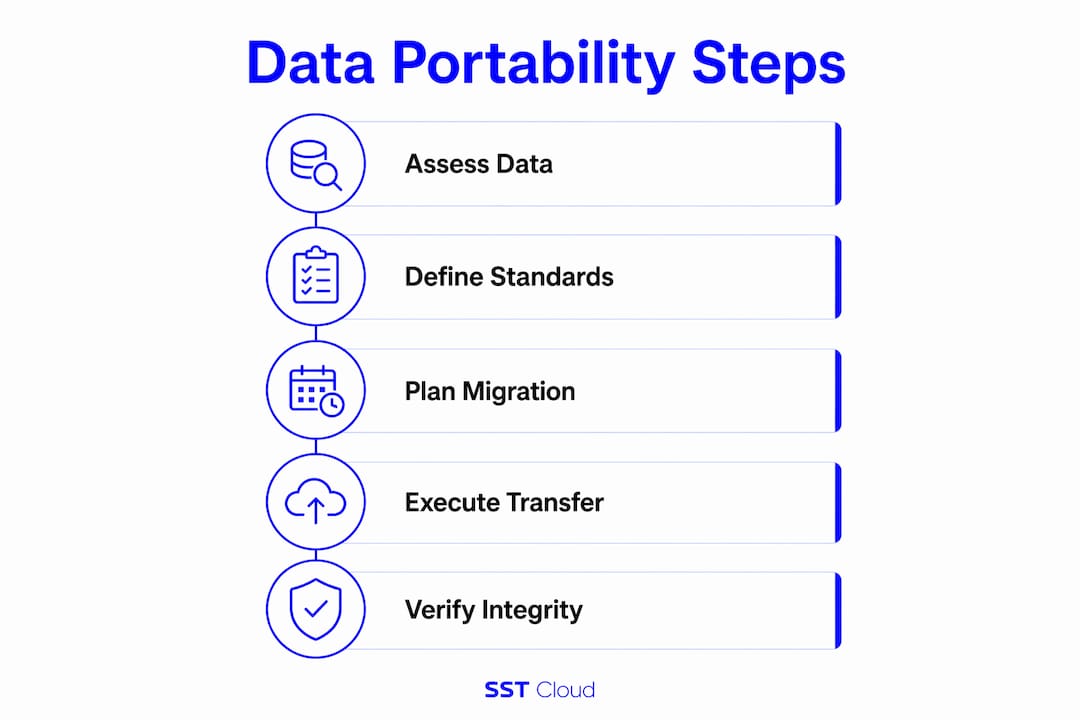
Cloud migration projects frequently fail due to inadequate planning around data transfer and standardisation, which is why portability strategy belongs in the architecture phase, not the migration phase.
How to achieve data portability across cloud service types
The technical approach to data portability differs significantly depending on whether the service in question is SaaS, PaaS, or IaaS. Understanding these differences is the starting point for any practical implementation plan.
For SaaS services, the cloud provider controls the data format, schema, and storage structure. The customer owns the data but has limited visibility into how it is stored. This makes SaaS the highest-risk category for portability, because moving from one SaaS provider to another requires the source provider to export data in a format the destination can ingest, and those formats rarely match exactly. The CSCC guide notes that differences in data extent or semantics between two SaaS services are a major barrier to portability, far more serious than simple syntax differences.
For PaaS services, the customer typically controls data formats, but the situation becomes complex when the PaaS layer includes managed database services. If two PaaS environments use different database technologies, a data transformation step is required. Generalised formats such as CSV and XML are supported by most database types and serve as a reliable intermediate layer.
For IaaS services, the customer controls both data syntax and semantics, since the cloud provider is supplying low-level storage such as block volumes or object stores. Portability is rarely a significant concern at the IaaS layer because the customer can read and write data in whatever format suits the application.
Service type | Who controls data format | Portability complexity | Common transfer method |
|---|---|---|---|
SaaS | Cloud provider | High | Provider export API, CSV/XML/JSON |
PaaS | Customer (with constraints) | Medium | Database dump, CSV, managed export tools |
IaaS | Customer | Low | Direct file transfer, object storage sync |
The most common technical methods for achieving portability across all service types are:
Export and import via APIs: most major cloud platforms, including AWS, Google Cloud, and IBM Cloud, expose REST APIs for data extraction and ingestion. AWS provides native data transfer services, Google Cloud offers data export tooling through BigQuery and Cloud Storage, and IBM Cloud supports data portability through its object storage and database services.
Standard data formats: exporting to CSV, XML, or JSON creates a format-agnostic intermediate state that most destination systems can ingest without custom transformation.
Data transformation pipelines: where source and destination schemas differ, transformation tools such as Apache Beam allow teams to reformat and remap data during transit rather than before or after.
Data Transfer Project: this open-source initiative, involving major technology companies, provides APIs and adapters to simplify user data migration between platforms.
Successfully migrating data is rarely as simple as copying files. Schema transformations and data reformatting are often required to match destination system requirements, particularly when moving between SaaS providers with different data models.
Pro Tip: When migrating between cloud environments, metadata and access control lists are almost never transferred automatically by standard portability tools. Build explicit steps into your migration runbook to audit and remap permissions, ACLs, and metadata at the destination before any workload goes live. Skipping this step is one of the most common causes of security posture degradation post-migration.
Best practices for managing data portability effectively
Planning is where most data portability efforts succeed or fail. Organisations that treat portability as an afterthought, something to address once a migration is already underway, consistently encounter format mismatches, incomplete data transfers, and compliance gaps. The following practices reflect what well-run cloud programmes do differently.
Classify data before designing portability workflows. Not all data requires the same portability treatment. Personal data subject to GDPR or the Australian Privacy Act needs a documented transfer process with audit trails. Operational data may only need a reliable export mechanism. Classifying data by sensitivity, regulatory scope, and business criticality allows teams to allocate effort appropriately.
Adopt open standards from the outset. Storing data in open, non-proprietary formats such as JSON or CSV from the point of ingestion reduces the transformation burden at migration time. Where proprietary formats are unavoidable, document the transformation logic and maintain it as code.
Build portability into API design. APIs that support data export should be treated as first-class features, not optional additions. This means versioning export schemas, documenting field semantics, and testing export completeness as part of the CI/CD pipeline.
Automate portability testing. Run regular exports and validate the output against a known schema. This surfaces format drift, missing fields, and schema changes before they become migration blockers.
Document data lineage and semantic mappings. When data moves between systems, the meaning of fields can shift. A field labelled “status” in one system may map to three separate fields in another. Maintaining a semantic mapping document prevents data loss that is invisible at the byte level but significant at the business logic level.
Engage legal and compliance stakeholders early. Portability decisions intersect with data residency requirements, cross-border transfer rules, and contractual obligations. IT teams that involve legal and compliance teams at the architecture stage avoid costly rework later.
Pro Tip: Community projects such as the Data Transfer Project and open standards bodies like the Object Management Group publish reusable adapters and format specifications. Referencing these in your portability architecture reduces custom development effort and gives your approach a defensible technical foundation when regulators or auditors ask how you handle data transfer requests.
The security dimension of portability deserves specific attention. Data in transit between cloud environments is exposed to interception if encryption is not enforced end-to-end. TLS for API-based transfers and server-side encryption for bulk file exports are baseline requirements, not optional controls. Access to export functions should be governed by role-based access control, with export events logged to an immutable audit trail.

Data portability considerations for Australian organisations
Australian organisations face a regulatory environment that is distinct from the European GDPR framework, though the two are converging in several important respects. The Privacy Act 1988 and the Notifiable Data Breaches scheme impose requirements on how personal data is handled, stored, and disclosed, and these requirements directly affect how portability workflows must be designed.
Key considerations for Australian IT teams include:
Data residency obligations: many Australian government agencies and regulated industries are required to store data within Australian borders. When designing portability workflows, teams must confirm that intermediate storage locations, including staging buckets used during migration, comply with residency requirements. AWS, Google Cloud, and IBM Cloud all operate data centres in Australia, but default configurations do not always enforce residency automatically.
Notifiable Data Breaches scheme: if a data transfer results in a breach of personal information, the organisation may be required to notify both the Office of the Australian Information Commissioner (OAIC) and affected individuals. This means portability processes must include breach detection and response procedures, not just transfer mechanisms.
Cross-border data transfers: the Privacy Act restricts transfers of personal data to overseas recipients unless the recipient is subject to a comparable privacy framework or the individual has consented. Cloud portability that involves moving data to a provider’s infrastructure outside Australia requires a legal basis for that transfer.
Consumer Data Right (CDR): Australia’s CDR regime, currently active in banking and energy, mandates data portability for consumers in those sectors. Organisations subject to CDR must implement accredited data recipient frameworks and API standards defined by the Australian Competition and Consumer Commission (ACCC). This is the closest Australian analogue to GDPR’s right to data portability, though its scope is sector-specific rather than universal.
Contractual obligations with cloud providers: Australian organisations should review their cloud service agreements for data export clauses, egress fee structures, and data deletion obligations. Some providers impose time limits on data availability after contract termination, which can create portability risk if not addressed before exit.
Vendor lock-in risk in the public sector: Australian government cloud procurement policies, including the Australian Government Cloud Policy, encourage the use of multiple cloud providers and explicitly flag vendor lock-in as a risk to be managed. Portability architecture is a direct response to this policy requirement.
The GDPR comparison is instructive even for Australian organisations that do not process EU personal data. GDPR’s Article 20 establishes a right to data portability that is more prescriptive than anything currently in the Australian Privacy Act, requiring structured, machine-readable formats and direct controller-to-controller transmission. Australian privacy reform discussions have referenced GDPR as a model, and the direction of travel suggests that portability obligations for Australian organisations will increase over time. Building portability capability now, rather than retrofitting it when regulation requires it, is the lower-cost path.
SST Cloud works with Australian organisations to design cloud architectures that address data residency, portability, and compliance requirements from the ground up. The team’s experience across AWS, Microsoft Azure, and Google Cloud Platform means portability strategies are grounded in the specific capabilities and constraints of each platform, rather than generic advice. For organisations navigating the intersection of cloud migration and Australian privacy obligations, that platform-specific knowledge is what separates a compliant migration from a costly remediation exercise.

For teams evaluating data centre and cloud software options as part of a broader portability review, understanding the full technology stack is a useful starting point before committing to a migration architecture.
Key takeaways
Data portability in cloud computing requires open formats, API-driven transfer mechanisms, and explicit handling of metadata, permissions, and regulatory obligations to succeed at enterprise scale.
Point | Details |
|---|---|
SaaS carries the highest portability risk | Provider-controlled schemas make SaaS migrations the most complex, requiring format transformation and semantic mapping. |
Open formats reduce migration cost | Storing and exporting data in CSV, XML, or JSON from the outset minimises transformation effort at migration time. |
Metadata and permissions need manual handling | Standard portability tools rarely transfer ACLs or metadata automatically; explicit runbook steps are required. |
Australian CDR and Privacy Act add local obligations | Data residency, cross-border transfer rules, and the Notifiable Data Breaches scheme must be built into portability workflows. |
Plan portability at architecture stage | Cloud migration projects that address data transfer and standardisation late consistently encounter format mismatches and compliance gaps. |
How SST Cloud supports your data portability strategy
Data portability is an architecture decision, not a migration task. Organisations that build portability into their cloud design from the start avoid the format lock-in, compliance gaps, and egress costs that make cloud migrations expensive and slow. SST Cloud’s cloud transformation services cover the full lifecycle: from data classification and format standardisation through to API design, migration execution, and post-migration security validation across AWS, Microsoft Azure, and Google Cloud Platform.
For Australian organisations managing privacy obligations, data residency requirements, and the evolving Consumer Data Right framework, SST Cloud brings the regulatory and technical depth to design portability workflows that hold up under audit. Explore SST Cloud’s data and AI engineering services to understand how a structured approach to data portability can reduce your migration risk and strengthen your long-term cloud strategy.