Knowledge Base
Cloud operations: a practical guide for Australian IT teams
Discover essential Cloud Operations practices for Australian IT teams. Enhance reliability, security, and cost-effectiveness of cloud workloads.

Cloud operations: a practical guide for Australian IT teams
Cloud operations (CloudOps) is the operating model, set of practices, and tooling that keeps cloud workloads running reliably, securely, and cost-effectively after they are deployed. Where DevOps focuses on building and shipping software, CloudOps owns what happens next: the day-2 operations that determine whether a workload actually delivers on its business case.
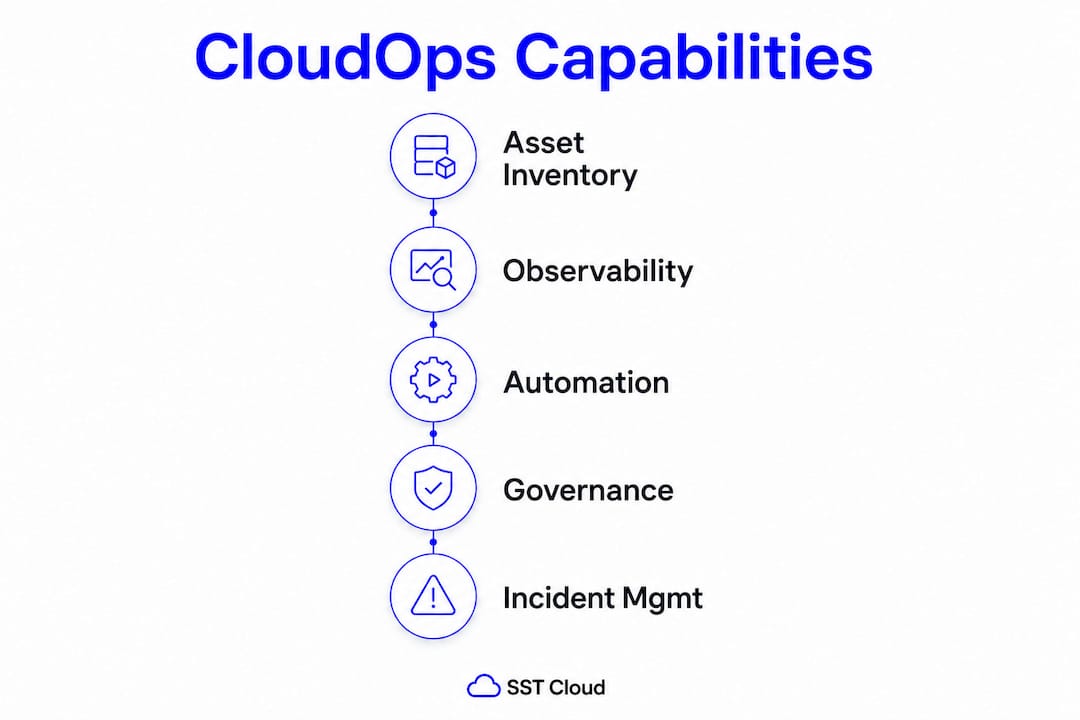
A mature CloudOps practice delivers on five core outcomes:
Observability: metrics, logs, and traces correlated to SLIs and SLOs so teams act on the right signals, not raw telemetry
Automation and orchestration: routine operational tasks executed by code, not people, reducing toil and error rates
Governance and guardrails: policy-as-code embedded in CI/CD pipelines so compliance is enforced continuously, not audited retrospectively
Cost management: rightsizing, scheduling, and chargeback mechanisms that tie cloud spend to workload value
Incident management: runbooks, on-call processes, and game days that convert passive monitoring into active resilience
The AWS Well-Architected operational excellence pillar and the Microsoft Cloud Adoption Framework both treat these five areas as the foundation of any credible cloud operating model. Australian organisations adopting well-architected frameworks are increasingly using them to align resilience and security with measurable business outcomes.
Table of Contents
What are cloud operations, and how do they differ from DevOps and SRE?
What benefits does a CloudOps practice actually deliver?
What are the core capabilities every CloudOps practice must cover?
What are the best practices for cloud operations teams?
Which tools should you evaluate for cloud operations?
Where does CloudOps make the biggest difference in practice?
How do Australian governance and compliance requirements shape CloudOps?
Which KPIs should a CloudOps team actually track?
How do you adopt CloudOps? A practical roadmap for Australian organisations
What does a managed CloudOps engagement with SST Cloud look like?
What roles and skills does a CloudOps team need?
Key takeaways
The gap between CloudOps theory and what actually changes outcomes
Useful sources and further reading
SST Cloud’s CloudOps practice for Australian organisations
What are cloud operations, and how do they differ from DevOps and SRE?
CloudOps, DevOps, site reliability engineering (SRE), and platform engineering are related but distinct disciplines. Conflating them leads to accountability gaps, duplicated tooling, and teams that are unclear about who owns what.
Discipline | Primary focus | Typical owners | Core practices |
|---|---|---|---|
CloudOps | Day-2 operations: run, secure, optimise, govern cloud workloads | Cloud ops engineers, SREs, FinOps | Observability, incident response, cost management, compliance, runbooks |
DevOps | Software delivery lifecycle: build, test, release, deploy | Development and platform teams | CI/CD pipelines, automated testing, release management |
SRE | Reliability engineering: define and defend SLOs, manage error budgets | SRE teams embedded in product squads | SLI/SLO definition, error budget policy, blameless postmortems |
Platform engineering | Internal developer platform: self-service infrastructure and tooling | Platform engineers | Golden paths, IaC templates, developer portals, paved roads |
In practice, CloudOps owns the operational layer that sits beneath all of these. It maintains the asset inventory, enforces compliance, responds to incidents, and manages cost across every workload, regardless of which team built it. Platform engineering builds the tooling that makes self-service safe; CloudOps operates the environment in which that tooling runs.
The cloud provider owns the physical infrastructure, network fabric, and hypervisor layer. CloudOps owns everything above that: the workload configuration, the observability stack, the access controls, the cost allocation, and the operational processes that keep the business running.
What benefits does a CloudOps practice actually deliver?
The business case for CloudOps rests on five measurable outcomes, each of which maps directly to a financial or operational metric.
Improved availability and resilience: well-defined SLOs, automated failover, and tested runbooks reduce unplanned downtime. For revenue-generating workloads, even a modest improvement in availability translates directly to protected revenue.
Faster lead time for changes: automating deployment pipelines and infrastructure provisioning compresses the time from code commit to production. Teams operating mature CloudOps practices typically measure lead time in hours rather than days.
Tighter cost control: rightsizing underutilised instances, scheduling non-production environments to power off outside business hours, and implementing chargeback mechanisms give finance teams visibility into cloud spend by workload. Automating “lights on/lights off” for non-production environments is one of the highest-return, lowest-risk cost optimisations available to Australian organisations.
Improved security posture: continuous compliance monitoring, automated patching, and identity and access management controls reduce the attack surface and the mean time to detect a misconfiguration.
Reduced operational toil: automating routine tasks such as certificate rotation, backup verification, and log archival frees engineers to focus on work that improves the platform rather than maintaining it.
A balanced scorecard approach prevents the common failure mode of monitoring everything but managing nothing. Aligning metrics to business outcomes means the operations team focuses on the signals that actually drive value, not the ones that are simply easy to collect.
What are the core capabilities every CloudOps practice must cover?
Google Cloud’s operational readiness guidance identifies four focus areas for a mature CloudOps practice: workforce, processes, tooling, and governance. Mapping those to specific capability areas gives teams a concrete maturity model to assess against.

Capability | What ‘good’ looks like | Maturity signal |
|---|---|---|
Observability | Metrics, logs, and traces correlated to SLIs/SLOs; dashboards tied to business KPIs | SLOs defined for all critical workloads; alerts route to the right team, not a shared inbox |
Automation and orchestration | Routine tasks (patching, scaling, backup) executed by code; workflows composed from individual automations | Runbooks are executable, not just documented; automation coverage tracked as a KPI |
Platform engineering | Self-service infrastructure via golden paths and IaC templates; developers provision without raising tickets | Internal developer platform exists; provisioning lead time measured in minutes |
Governance and guardrails | Policy-as-code enforced in CI/CD; cost and access controls applied automatically at account creation | No manual policy exceptions; guardrails version-controlled alongside IaC |
Security operations | Continuous compliance scanning; automated remediation for known misconfigurations; SIEM integrated with cloud logs | Mean time to detect misconfigurations under four hours |
Cost management | Workload-level cost allocation; rightsizing recommendations actioned within a defined cycle; chargeback or showback in place | Cost per workload tracked monthly; anomaly alerts configured |
Incident management | Runbooks tested in game days; blameless postmortems produce backlog items; MTTR tracked per severity | Runbooks cover all P1/P2 scenarios; postmortem action items closed within agreed SLAs |
Pro Tip: Automate only processes that are already well-understood and simplified. Automating an immature process accelerates failure and creates technical debt that is far harder to unwind than the original manual process. Stabilise and document first, then automate.
A complete asset and workload inventory is the prerequisite for all of these capabilities. Without knowing what is running, teams cannot define SLOs, enforce governance, or manage cost accurately. The Microsoft Cloud Adoption Framework lists a current asset inventory as a core CloudOps deliverable for exactly this reason.
What are the best practices for cloud operations teams?
The most durable CloudOps patterns share a common trait: they are designed to be safe by default, not safe by exception.
Make small, reversible changes. The AWS Well-Architected framework recommends frequent, small changes over large infrequent ones. Smaller changes reduce blast radius and make rollback straightforward.
Treat infrastructure as code. Every resource, configuration, and network rule should be defined in version-controlled IaC (Terraform, AWS CloudFormation, or Bicep) so changes are auditable and repeatable.
Encode guardrails as code. Governance policies embedded in CI/CD pipelines catch violations before they reach production. This shifts compliance from a gatekeeper role to an enabling one, maintaining developer velocity while improving posture.
Write testable runbooks. A runbook that has never been executed under pressure is a hypothesis, not a procedure. Runbooks should include: the SLI or alert that triggers them, the on-call contact chain, step-by-step remediation actions, rollback steps, and a validation check to confirm resolution.
Schedule game days. Game days and post-incident reviews convert passive monitoring into active resilience. They should be regular, measured events whose outcomes feed directly back into runbook, IaC, and platform changes.
Distinguish toil from strategic work. Toil is repetitive, automatable work that scales with the size of the environment. Tracking toil as a percentage of engineering time gives teams a concrete target for automation investment.
Runbook checklist for on-call incidents
When an alert fires, a well-structured runbook guides the on-call engineer through a consistent process:
Confirm the alert is genuine and identify the affected workload from the asset inventory.
Check the SLO dashboard to determine whether an error budget is being consumed.
Identify the triggering condition using correlated metrics, logs, and traces.
Execute the documented remediation steps in sequence.
Validate resolution against the SLI that triggered the alert.
Escalate if the runbook steps do not resolve the incident within the defined time window.
Open a postmortem ticket immediately after resolution, regardless of severity.
Which tools should you evaluate for cloud operations?
The tooling landscape for CloudOps spans cloud provider platforms, observability stacks, IaC frameworks, and cost management tools. The right combination depends on your existing environment, team skills, and data residency requirements. Australian organisations should confirm that any tool they adopt has local region support and, where data sovereignty applies, that data does not leave Australian borders.
Tool / Platform | Primary use case | Managed vs self-managed | CI/CD and IaC integration | Australia region / support |
|---|---|---|---|---|
AWS (EC2, EKS, Control Tower) | Full-stack cloud platform; landing zone governance | Managed (provider) | Native CodePipeline, CDK, CloudFormation | Sydney (ap-southeast-2) and Melbourne (ap-southeast-4) regions |
Microsoft Azure (AKS, Azure Policy) | Enterprise hybrid and multicloud workloads | Managed (provider) | Azure DevOps, Bicep, ARM templates | Australia East and Australia Southeast regions |
Google Cloud Platform | Data-intensive and AI/ML workloads | Managed (provider) | Cloud Build, Deployment Manager, Terraform | Sydney region (australia-southeast1) |
VMware (vSphere, Aria) | Private cloud and hybrid virtualisation management | Self-managed or managed | Terraform provider; integrates with CI/CD via APIs | Available via Australian partners |
IBM (Cloud Pak for Watson AIOps) | AIOps and hybrid cloud operations | Managed or self-managed | Jenkins, Tekton, Terraform | IBM Cloud Sydney region |
Kubernetes (EKS, AKS, GKE, self-managed) | Container orchestration and workload scheduling | Both | Helm, ArgoCD, Flux; Terraform for cluster IaC | All major providers offer Australian regions |
Terraform | Infrastructure as code across all providers | Self-managed (HCP Terraform managed option) | Native CI/CD integration via HCP Terraform or open-source runners | Provider-agnostic; runs anywhere |
Prometheus | Metrics collection and alerting for containerised workloads | Self-managed (or managed via cloud providers) | Integrates with Grafana, AlertManager, CI/CD | Runs in-cluster; no data residency constraint |
Grafana | Observability dashboards and alerting | Self-managed or Grafana Cloud (managed) | Connects to Prometheus, Loki, Tempo, cloud providers | Grafana Cloud has Australian data residency options |
Datadog | Full-stack observability, APM, security monitoring | Managed (SaaS) | Native CI/CD integrations; IaC via Terraform provider | AP region available; confirm data residency requirements with vendor |
Azure Monitor | Native Azure observability: metrics, logs, alerts | Managed (provider) | Integrates with Azure DevOps, Logic Apps, Bicep | Australia East and Southeast regions |
Google Cloud Operations (formerly Stackdriver) | Native GCP observability: logging, tracing, profiling | Managed (provider) | Cloud Build, Pub/Sub, Terraform | Sydney region |
Cloud management at enterprise scale combines policies, tooling, and processes to control multicloud and hybrid environments, including cost forecasting and chargeback. When evaluating tools, prioritise integration with your existing IaC and CI/CD pipelines, support for guardrails-as-code, and the vendor’s ability to demonstrate local data residency controls. A tool that requires data to leave Australia may create compliance obligations under the Privacy Act 1988 that outweigh its operational benefits.
For teams building or reviewing their AWS landing zone, AWS Control Tower combined with Account Factory for Terraform (AFT) and federated CI/CD authentication provides a governed, repeatable foundation for multi-account environments.
Where does CloudOps make the biggest difference in practice?
CloudOps practices apply across a range of operational scenarios. The use cases below represent the situations where a structured operating model most materially changes outcomes.
Cloud migration (day-2 operations): migrating workloads is the beginning, not the end. Without a defined operating model, migrated workloads accumulate technical debt, cost overruns, and security drift within months. Establishing CloudOps practices before or during migration prevents this. SST Cloud’s cloud transformation services address this directly by combining migration execution with operating model design.
Multicloud and hybrid management: organisations running workloads across AWS, Azure, and GCP need a unified observability and governance layer. Tools like Terraform for IaC and Datadog or Grafana for observability provide provider-agnostic control planes.
Autoscaling for seasonal demand: retail, government, and financial services organisations in Australia face predictable demand spikes. Kubernetes-based autoscaling combined with pre-defined runbooks for scale events reduces both cost and incident risk during peak periods.
Platform engineering for developer self-service: platform teams that build golden paths and IaC templates reduce the cognitive load on application developers and eliminate the “raise a ticket and wait” model. The shift from project delivery to platform thinking is one of the most significant organisational changes a CloudOps adoption triggers.
Managed services handover: organisations that engage a managed services provider need a clear responsibilities matrix, defined SLOs, and agreed escalation paths before handover. Without these, managed engagements default to reactive support rather than proactive operations.
For organisations new to CloudOps, the highest-return pilot is usually observability: deploying a monitoring stack, defining SLOs for two or three critical workloads, and establishing an on-call rotation. This produces immediate operational visibility and builds the muscle memory for more complex automation work. Understanding why cloud migration fails before it begins is equally useful context before committing to a broader programme.
How do Australian governance and compliance requirements shape CloudOps?
Australian organisations operating cloud workloads face a specific set of regulatory and compliance obligations that must be embedded into the CloudOps operating model from the outset, not retrofitted after a breach or audit finding.
IRAP and ASD guidance: workloads that process Australian Government data must be assessed under the Information Security Registered Assessors Program (IRAP). Cloud providers with IRAP-assessed services include AWS, Azure, and Google Cloud. When selecting a managed services partner, request evidence of their IRAP assessment status and the scope of assessed services.
Privacy Act 1988 obligations: the Australian Privacy Principles (APPs) impose obligations on how personal information is collected, stored, and transferred. CloudOps teams must confirm that data residency controls prevent personal information from being processed outside Australia unless an APP exception applies.
Data residency controls: all three major cloud providers offer Australian regions. Guardrails-as-code should include Service Control Policies (SCPs) in AWS or Azure Policy assignments that deny resource creation outside approved regions. This is a preventive control, not a detective one.
ISO 27001 and SOC 2 certifications: request current certificates and SOC 2 Type II reports from cloud providers and managed partners. These reports cover the period they were issued for; confirm the report date is current and that the scope covers the services you are consuming.
Operational resilience: the Australian Prudential Regulation Authority (APRA) CPS 230 standard, effective from 1 July 2025, requires APRA-regulated entities to maintain operational resilience and manage third-party risks. CloudOps teams in financial services must map their cloud dependencies and test recovery procedures against defined tolerance thresholds.
Pro Tip: When validating a managed provider’s compliance posture, request their IRAP assessment letter (not just a marketing claim), their current ISO 27001 certificate with scope, and their most recent SOC 2 Type II report. Ask specifically whether the scope covers the services and regions you will use. A provider that cannot produce these documents within 48 hours of a request is unlikely to have the governance maturity to manage your environment.
Guardrails-as-code examples for Australian compliance include: SCPs that deny resource creation outside ap-southeast-2 and ap-southeast-4; AWS Config rules or Azure Policy assignments that flag unencrypted storage; and identity and access management policies that enforce multi-factor authentication for all privileged roles. The digital integration considerations related to cloud platforms extend these governance requirements into broader enterprise integration patterns.
Which KPIs should a CloudOps team actually track?
The balanced scorecard approach recommended by the Microsoft Cloud Adoption Framework prevents the failure mode of measuring everything and managing nothing. A compact set of KPIs, each tied to a business outcome, is more useful than a comprehensive telemetry catalogue that no one acts on.
KPI | Definition | Suggested target | Typical owner |
|---|---|---|---|
Availability (SLO) | Percentage of time a workload meets its defined service level objective | High availability for production workloads | Cloud ops engineer / SRE |
Lead time for changes | Time from code commit to production deployment | Under a day for standard changes | Release manager / DevOps |
Mean time to restore (MTTR) | Average time to restore service after an incident | Under 1 hour for P1 incidents | On-call engineer / SRE |
Mean time to acknowledge (MTTA) | Average time from alert to engineer acknowledgement | Within minutes for P1 alerts | On-call engineer |
Change failure rate | Percentage of changes that result in a degraded service or rollback | Under 5% | Release manager / DevOps |
Cost per workload | Monthly cloud spend allocated to a specific workload or business unit | Tracked against budget; trend down quarter-on-quarter | FinOps / cost engineer |
Automated runbook coverage | Percentage of P1/P2 runbooks that are executable (not just documented) | High percentage | Cloud ops engineer |
Security posture score | Aggregated score from cloud security posture management (CSPM) tooling | Improving trend; no critical findings unresolved beyond SLA | Cloud security engineer |
Observability that combines metrics, logs, and traces and ties them to SLIs and SLOs is the prerequisite for tracking most of these KPIs accurately. Teams that skip the observability foundation end up tracking proxy metrics that do not reflect actual workload behaviour.
Avoid the trap of reporting on metrics that are easy to collect rather than metrics that reflect business outcomes. MTTR is meaningful; the number of alerts fired per day is not, unless it is trending toward zero as automation matures.
How do you adopt CloudOps? A practical roadmap for Australian organisations
A CloudOps adoption follows a predictable arc from experiment to operated platform. The timeline below reflects a realistic pace for a mid-sized Australian organisation with an existing cloud footprint and a small operations team.
Phase 1: experiment and pilot (months 0–3)
Conduct a cloud operations assessment: inventory all running workloads, identify gaps in observability, governance, and cost allocation.
Define SLOs for two or three critical workloads and instrument them with a monitoring stack (Prometheus and Grafana, Datadog, or the native provider tooling).
Establish an on-call rotation and write runbooks for the top five alert scenarios.
Identify the top three sources of operational toil and document them as automation candidates.
Stand up a governance baseline: SCPs or Azure Policy assignments for region restriction, encryption, and MFA enforcement.
Phase 2: platform build and guardrails (months 3–9)
Implement IaC for all new resources using Terraform or provider-native tooling; begin migrating existing resources to IaC.
Embed guardrails-as-code into CI/CD pipelines so policy checks run on every pull request.
Build or adopt an internal developer platform with golden paths for common workload patterns.
Expand observability coverage to all production workloads; connect dashboards to the KPI scorecard.
Run the first game day: simulate a P1 failure scenario, execute the runbook, and capture gaps for the postmortem backlog.
Implement workload-level cost allocation and configure anomaly alerts.
Phase 3: scale and embed (months 9–18)
Automate the top three toil items identified in Phase 1; measure the reduction in engineer hours.
Expand the game day programme to quarterly cadence; feed outcomes into runbook and IaC updates.
Formalise the FinOps practice: monthly cost reviews, rightsizing cycles, and chargeback or showback reporting.
Establish a community of practice or centre of excellence to share CloudOps patterns across teams.
Review and update SLOs annually or after significant architectural changes.
Cost considerations
Tooling licencing: managed observability platforms (Datadog, Grafana Cloud) are priced on data volume and host count. Budget for growth as coverage expands.
People and upskilling: CloudOps adoption requires investment in training, certifications (AWS, Azure, GCP), and potentially new roles (SRE, FinOps, platform engineer).
Automation engineering: the first automation investments require upfront engineering time before they reduce toil. Budget for a 3–6 month payback period.
Managed services: engaging a managed provider for specific capabilities (security operations, FinOps, platform engineering) can accelerate adoption and reduce the internal headcount required.
The role of cloud infrastructure in digital transformation provides useful context on how infrastructure decisions compound over time, which is directly relevant to the cost and architectural choices made during Phase 2.
What does a managed CloudOps engagement with SST Cloud look like?
SST Cloud’s CloudOps model follows a four-stage engagement structure that is designed to produce measurable outcomes at each stage rather than deferring value to a long implementation horizon.
Assessment: a structured review of the existing cloud environment covering workload inventory, observability gaps, governance posture, cost allocation, and security findings. The output is a prioritised remediation plan with effort estimates and expected outcomes.
Platform build: SST Cloud engineers implement the foundational controls: IaC for existing resources, guardrails-as-code in CI/CD, observability stack deployment, SLO definition, and runbook development. This phase typically runs for 8–16 weeks depending on environment complexity.
Operate: ongoing managed operations covering incident response, cost optimisation cycles, security posture management, and platform maintenance. Responsibilities are defined in a RACI matrix agreed before handover. Customers retain full visibility through shared dashboards and monthly reporting.
Continuous improvement: quarterly reviews assess KPI trends, identify new automation opportunities, and update the roadmap. Game days are scheduled as part of the continuous improvement cadence, not as one-off exercises.
Typical outcomes from a managed engagement include measurable improvements in availability, reductions in cloud spend through rightsizing and scheduling, and a reduction in mean time to restore for P1 incidents. The HR operations transformation case study illustrates how a structured engagement translates into operational and business outcomes.
Pro Tip: Request a responsibilities matrix (RACI) from any managed provider before signing. Ambiguity about who owns incident response, patching, and cost optimisation is the single most common source of friction in managed engagements. A provider that cannot produce a clear RACI at the proposal stage will not produce one after contract signature.
Organisations ready to assess their current CloudOps maturity can request an assessment through SST Cloud’s managed services page.
What roles and skills does a CloudOps team need?
A functional CloudOps team requires a mix of technical depth, process discipline, and cross-functional collaboration skills. The roles below represent the core functions; in smaller organisations, individuals often cover more than one function.
Cloud operations engineer: owns day-2 operations including monitoring, incident response, patching, and runbook execution. Technical skills: Kubernetes, Terraform, Prometheus, Grafana, scripting (Python, Bash). Process skills: incident management, change management, runbook authorship.
Site reliability engineer (SRE): defines and defends SLOs, manages error budgets, and leads blameless postmortems. Technical skills: distributed systems, observability tooling, chaos engineering. Soft skills: influencing development teams to prioritise reliability work.
Platform engineer: builds and maintains the internal developer platform, golden paths, and IaC templates. Technical skills: Kubernetes, Helm, ArgoCD, Terraform, CI/CD pipeline design. Soft skills: developer empathy, documentation discipline.
Cloud security engineer: owns continuous compliance scanning, identity and access management, and security incident response. Technical skills: CSPM tooling, SIEM integration, policy-as-code (Open Policy Agent, AWS Config, Azure Policy). Certifications: AWS Security Specialty, AZ-500, or equivalent.
FinOps / cost engineer: manages workload-level cost allocation, rightsizing recommendations, and chargeback reporting. Technical skills: cloud billing APIs, cost management tooling (AWS Cost Explorer, Azure Cost Management). Soft skills: financial communication, stakeholder reporting.
Release manager: coordinates change management, maintains the change calendar, and tracks change failure rate. Process skills: ITIL change management, release governance, risk assessment.
Upskilling existing staff through vendor certification programmes (AWS, Azure, GCP) and the FinOps Foundation’s certification track is typically faster and more cost-effective than hiring for every role. A community of practice model, where practitioners share patterns and tooling across teams, accelerates adoption without requiring a dedicated centre of excellence budget. The cultural shift from project delivery to platform thinking is as important as the technical skills investment.
Key takeaways
A mature cloud operations practice requires observability, automation, governance, cost management, and incident management working together as a coherent operating model, not as isolated tools or processes.
Point | Details |
|---|---|
Start with observability | Define SLOs for critical workloads and instrument them before automating anything else. |
Automate mature processes only | Stabilise and document a process before automating it to avoid accelerating failure. |
Embed guardrails as code | Policy-as-code in CI/CD enforces compliance continuously without slowing developer velocity. |
Use a balanced scorecard | Track a small set of KPIs tied to business outcomes; MTTR, change failure rate, and cost per workload are the highest-signal metrics. |
SST Cloud for local expertise | SST Cloud’s four-stage CloudOps model (assess, build, operate, improve) is designed for Australian organisations and covers AWS, Azure, and GCP. |
The gap between CloudOps theory and what actually changes outcomes
Most CloudOps guides focus on tooling selection. The harder problem is organisational: getting infrastructure, development, and security teams to operate from a shared model rather than three separate ones.
The Microsoft Cloud Adoption Framework frames this as moving from a “server-hugging” mindset to an engineering mindset where infrastructure is version-controlled and teams collaborate across IT, development, and security. That framing is accurate, but it understates the friction. In practice, the biggest barrier to CloudOps adoption is not the absence of tooling; it is the absence of agreed ownership. Teams that have never had a formal on-call rotation resist one. Security teams that have operated as gatekeepers resist policy-as-code because it reduces their control. Finance teams that have never received workload-level cost data do not know what to do with it when they first see it.
The organisations that get CloudOps right treat the operating model design as a change management programme, not a technical implementation. They define ownership before they deploy tooling. They run game days not to test the infrastructure but to surface the organisational gaps that only appear under pressure. And they measure outcomes, not activity: MTTR trending down, cost per workload stable or falling, change failure rate under control.
One pattern that consistently underdelivers is the “automate everything” mandate issued without a process maturity baseline. Automating a poorly understood process does not fix it; it makes it faster and harder to debug. The discipline of documenting, simplifying, and then automating is unglamorous but it is what separates teams with low MTTR from teams with impressive dashboards and slow recovery times.
Useful sources and further reading
Practitioners building or maturing a CloudOps practice should work from primary sources rather than secondary summaries. The following references are the most authoritative starting points.
AWS Well-Architected Operational Excellence Pillar: the definitive AWS guidance on observability, small reversible changes, and operational automation. Use it to assess workload readiness and identify gaps.
Microsoft Cloud Adoption Framework: Cloud Operations: covers asset inventory, SLO definition, performance monitoring, and operational compliance. The balanced scorecard guidance is particularly useful for KPI selection.
Microsoft Azure Well-Architected: Operational Excellence Principles: addresses the cultural and organisational dimensions of CloudOps adoption, including the shift to an engineering mindset.
Google Cloud Operational Readiness and Performance: Google Cloud’s four-focus-area model (workforce, processes, tooling, governance) with SLO and monitoring guidance.
AWS Cloud Operating Model Strategy Guide: prescriptive guidance on game days, post-incident reviews, and feedback loops for continuous improvement.
Google Cloud: What is Cloud Management?: covers multicloud and hybrid management, cost forecasting, and chargeback mechanisms.
Microsoft Cloud Adoption Framework: Cloud Adoption Strategy: connects cloud strategy to measurable business outcomes; useful for aligning CloudOps investment to executive priorities.
SST Cloud Managed Services: SST Cloud’s managed cloud and engineering services, covering ongoing operations, security, and cost management for Australian organisations.
This article is general information for IT professionals and cloud managers. Regulatory obligations, including those under the Privacy Act 1988 and APRA CPS 230, vary by organisation type and workload. Confirm your specific compliance requirements with a qualified adviser or the relevant regulatory body.
SST Cloud’s CloudOps practice for Australian organisations
For Australian IT teams that need to move from ad hoc cloud management to a structured operating model, SST Cloud offers a faster path than building every capability in-house. The four-stage engagement model (assess, build, operate, improve) is designed to produce measurable outcomes within the first quarter: a current workload inventory, SLOs defined for critical services, a governance baseline, and an observability stack that gives the operations team real signal rather than noise.
The concrete difference from a generic managed services arrangement is local accountability. SST Cloud’s engineers operate in Australian time zones, understand the IRAP, Privacy Act, and APRA CPS 230 obligations that shape Australian cloud governance, and have direct experience with the AWS Sydney and Melbourne regions, Azure Australia East, and GCP Sydney. There is no offshore escalation path for incidents that require Australian data handling.
SST Cloud covers AWS, Microsoft Azure, and Google Cloud Platform, which means multicloud environments are managed from a single engagement rather than three separate vendor relationships. For organisations that need data and AI engineering alongside CloudOps, that capability sits within the same team.
To request a cloud operations assessment or discuss your organisation’s current environment, visit SST Cloud’s cloud transformation services page or explore the full range of capabilities.