Knowledge Base
API development for engineering teams: practical guide
Master API Development with this practical guide. Learn essential steps like defining goals, crafting OpenAPI contracts, and using mock servers.

API development for engineering teams: practical guide
API development is the end-to-end practice of designing, building, and operating programmatic interfaces so other software can reliably consume your services. The most important decision you make is not which framework to use — it is whether you define the contract before writing a single line of implementation code. Start with an OpenAPI Specification, mock the endpoints immediately, and let frontend and backend teams work in parallel from day one.
Three steps to start right now:
Define goals and consumers. Identify who calls your API (internal services, mobile clients, third-party partners), what data they need, and what operations they must perform.
Craft an OpenAPI contract. Write a machine-readable specification that defines every endpoint, HTTP method, request/response schema, and error shape before any code is written.
Spin up mock servers. Use Swagger or Postman mock servers so client teams can integrate against the contract while the backend is still being built.
The OWASP API Security Top 10 belongs in your checklist from the first sprint, not as an afterthought before go-live. SST Cloud’s platform engineering teams apply this design-first workflow on every enterprise engagement, and the productivity gains from parallel development alone justify the upfront investment in specification work.
Pro Tip: Save your OpenAPI contract in version control alongside your source code. Treat a contract change as a code change — requiring a pull request, a reviewer, and a passing contract test suite before merge.
Table of Contents
What is an API, and which type do you need?
Why API development matters for products and teams
Core technical concepts every API developer must know
Which architectural style fits your use case?
The API development lifecycle: from plan to production
Design-first versus code-first: which approach should you use?
API security essentials: authentication, authorisation, and protection
Documentation and developer experience: docs as a product feature
Testing, CI/CD and observability: keeping APIs reliable at scale
API management and deployment: gateways, versioning, and operational controls
Recommended tooling for Australian engineering teams
A practical checklist for production-grade APIs
Common pitfalls and how to avoid them
How enterprise teams in Australia should organise API development
Key takeaways
The real cost of skipping the contract
SST Cloud’s API and platform engineering services
Useful sources and further reading
What is an API, and which type do you need?
An API (Application Programming Interface) is a formal contract between a provider and a consumer: it defines the operations available, the data structures exchanged, and the rules governing access. The contract is the API. The implementation behind it is an internal concern.
Five architectural styles dominate production systems today:
REST (HTTP/JSON): Resources are addressed by URI, operations map to HTTP verbs, and responses are typically JSON. The dominant style for public and mobile APIs because of its simplicity and broad tooling support.
GraphQL: A query language where the client specifies exactly which fields it needs. Reduces over-fetching and under-fetching, but shifts complexity to the query layer. The GraphQL specification is maintained by the GraphQL Foundation.
gRPC: Uses Protocol Buffers (protobuf) over HTTP/2 for strongly-typed, high-performance communication. The standard choice for internal microservice-to-microservice calls where latency and payload size matter.
SOAP: An XML-based messaging protocol with a formal WSDL contract. Still common in financial services, government systems, and legacy enterprise integrations where formal contracts and WS-Security are required.
Event-driven / webhooks: Rather than polling, the provider pushes events to a registered endpoint when something changes. Webhooks are HTTP callbacks; more sophisticated patterns use message brokers such as Apache Kafka or AWS SNS/SQS.
Two quick real-world examples illustrate the choice. A mobile banking app consuming account data uses a RESTful HTTP/JSON API because the client is diverse (iOS, Android, web) and the payload is modest. Two internal microservices exchanging high-frequency transaction records use gRPC because protobuf serialisation is faster and the schema is enforced at compile time, catching contract drift before deployment.
Why API development matters for products and teams
APIs are the primary mechanism by which modern software systems compose functionality without tight coupling. A well-designed API lets a product team expose a capability once and have it consumed by a mobile app, a partner integration, an internal analytics pipeline, and a third-party marketplace simultaneously.
The business value shows up in three concrete ways:
Speed to market. Teams that publish a stable API contract can ship frontend features, partner integrations, and internal tooling in parallel rather than sequentially. Google Cloud’s guidance frames documentation and contracts as first-class product assets precisely because they unlock this parallel delivery.
Ecosystem growth. A productised API turns a capability into a platform. Payment providers, mapping services, and identity platforms have built entire businesses on the back of a well-governed API surface.
Security boundaries. An API gateway enforces authentication, rate limiting, and input validation at a single chokepoint rather than scattering those controls across every service.
Teams that treat APIs as products track three operational metrics: adoption (active consumers, call volume), reliability (error rate, p99 latency), and cost (compute and egress per million requests). Getting a handle on run cost early matters because a high-traffic API with no caching or rate limiting can generate surprising infrastructure spend. The build-versus-run cost trade-off is worth modelling before you commit to a hosting pattern.
For Australian organisations building scalable integrations, APIs also carry compliance obligations around data residency and the Australian Privacy Principles — a point covered in detail in the enterprise implementation section below.
Core technical concepts every API developer must know
Understanding the building blocks prevents the most common design mistakes. These concepts surface in every architectural style, so getting them right early pays dividends across the entire lifecycle.

Endpoints, resources, and URIs
An endpoint is the combination of an HTTP method and a URI path that identifies a specific operation on a resource. A resource is a noun — /orders, /users/{id}, /invoices — not a verb. Microsoft’s API design best practices are explicit: URIs should identify resources, and HTTP verbs should express the action. /getOrder/123 is an anti-pattern; GET /orders/123 is correct.
CRUD operations map to HTTP verbs as follows:
GET— retrieve a resource or collection (idempotent, safe)POST— create a new resource (not idempotent)PUT— replace a resource entirely (idempotent)PATCH— partially update a resource (idempotent when designed correctly)DELETE— remove a resource (idempotent)
Idempotency matters operationally: a client that retries a PUT after a network timeout should not create duplicate records.
Status codes
Use status codes to communicate outcome, not just success or failure. The families are:
2xx— success (200 OK,201 Created,204 No Content)4xx— client error (400 Bad Request,401 Unauthorised,403 Forbidden,404 Not Found,429 Too Many Requests)5xx— server error (500 Internal Server Error,503 Service Unavailable)
A standard error body should always include a machine-readable code, a human-readable message, and optionally a details array for field-level validation errors:
Payloads, schemas, and headers
JSON is the default payload format for REST APIs; protobuf is standard for gRPC. Define schemas in your OpenAPI contract using JSON Schema — this enables automatic request validation, documentation generation, and client SDK generation. Use Content-Type: application/json and Accept: application/json headers for content negotiation. Cache-control headers (Cache-Control: max-age=300) reduce backend load for read-heavy endpoints. Rate limiting headers (X-RateLimit-Limit, X-RateLimit-Remaining, Retry-After) tell consumers how to back off gracefully.
A minimal curl example for a GET with an auth header:
And a POST with a JSON body referencing a schema:
Key principle: Every field in your request and response schema should have a defined type, a description, and an example value in the OpenAPI contract. Schemas without examples force consumers to guess — and guessing leads to integration bugs that are expensive to diagnose in production.
Which architectural style fits your use case?
Choosing the wrong style early is one of the more expensive mistakes a team can make, because changing it later means renegotiating contracts with every consumer. The Richardson Maturity Model offers a useful framing for REST API evolution (levels 0–3, from plain HTTP tunnelling to hypermedia-driven interfaces), but the more immediate question is which style fits the problem.
Style | When to use | Complexity | Performance & scalability | Security & compliance | Tooling & ecosystem | Operational cost |
|---|---|---|---|---|---|---|
REST | Public APIs, mobile clients, broad consumer base | Low | Good with caching; horizontal scale straightforward | OAuth2/JWT well-supported; OWASP guidance mature | Excellent (OpenAPI, Postman, gateways) | Low to medium |
GraphQL | Client-driven queries, multiple front-end clients needing different data shapes | Medium | Risk of N+1 queries; requires DataLoader patterns | Requires custom depth/complexity limits; auth at resolver level | Good (Apollo, Hasura, Postman) | Medium |
gRPC | Internal microservices, high-throughput, low-latency service mesh | Medium-high | Excellent; HTTP/2 multiplexing, binary serialisation | mTLS native; strong schema enforcement | Good for backend; limited browser support | Low (efficient payloads) |
SOAP | Legacy enterprise, financial/government systems with formal WS-Security requirements | High | Moderate; XML overhead | WS-Security, WS-Policy mature | Mature but declining | Medium-high |
Event-driven / webhooks | Near-real-time notifications, decoupled async workflows | Medium | Excellent for async; broker adds infrastructure | Payload signing (HMAC), TLS, consumer verification | Good (Kafka, SNS/SQS, EventBridge) | Varies by broker |
A few use-case pointers worth making explicit:
Use REST when your consumer base is diverse and you cannot predict client data requirements precisely.
Use GraphQL when multiple front-end clients (web, mobile, partner portals) need different projections of the same underlying data and you want to avoid maintaining multiple REST endpoints per client type.
Use gRPC for service-to-service communication inside a Kubernetes cluster or service mesh where you control both sides of the contract.
Use webhooks when a consumer needs to react to events (payment completed, file processed, status changed) without polling. Pair them with an event-driven architecture enhanced by AI agent systems over legacy data for cross-system intelligence at scale.
Reserve SOAP for integrations with existing enterprise systems (ERP, banking middleware) that mandate it — do not introduce it for greenfield work.
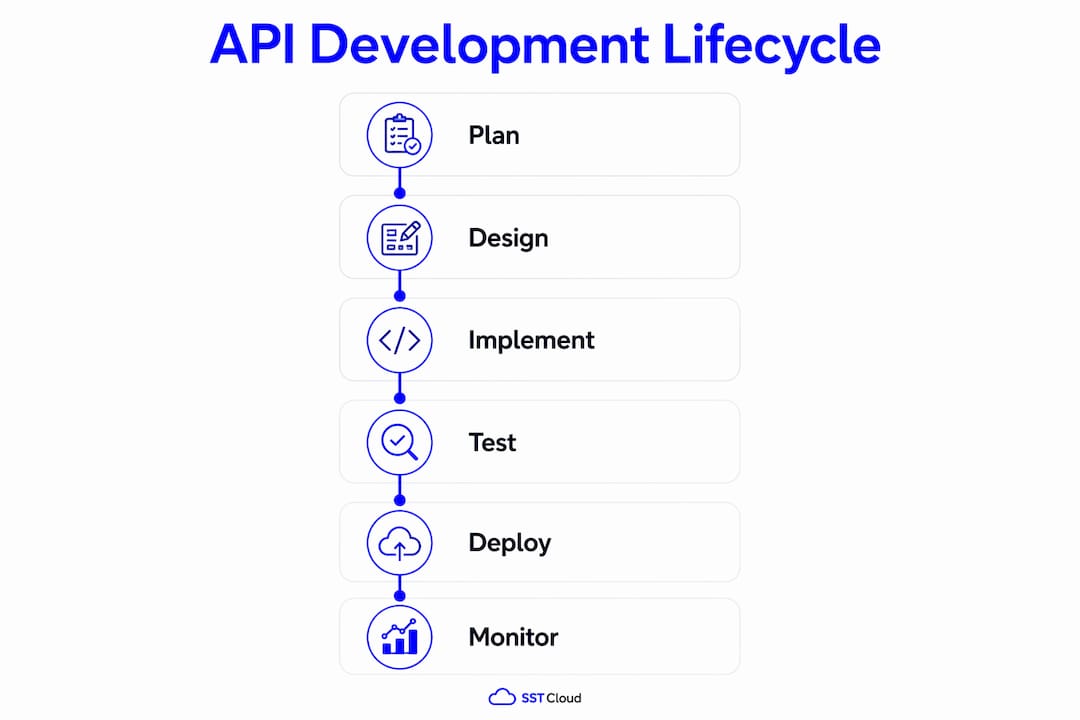
The API development lifecycle: from plan to production
A well-run lifecycle prevents the two most common failure modes: shipping a contract that consumers cannot use, and deploying to production without the observability to know when things break. The stages below apply whether you are building a small feature API or an enterprise platform.
Lifecycle stages and outputs
Plan. Define the API’s purpose, consumers, SLA targets, and data classification. Output: a one-page API brief with consumer stories and non-functional requirements.
Design. Write the OpenAPI contract, define resource models, error shapes, and auth patterns. Output: a versioned OpenAPI YAML/JSON file in source control.
Build. Implement against the contract using generated stubs or server skeletons. Output: a running service with unit and integration tests passing.
Test. Run contract tests, integration tests, security scans, and load tests. Output: a test report and a signed-off security checklist.
Deploy. Publish via a CI/CD pipeline to a staging environment, then production behind an API gateway. Output: a deployed, monitored endpoint with alerting configured.
Operate. Monitor latency, error rate, and usage; manage versioning and deprecation. Output: runbooks, SLO dashboards, and a deprecation schedule.
Role matrix
Stage | Product Manager | API Designer | Backend Engineer | QA Engineer | SRE / Ops |
|---|---|---|---|---|---|
Plan | Owns | Contributes | Contributes | — | Contributes |
Design | Reviews | Owns | Contributes | Reviews | Reviews |
Build | — | Reviews | Owns | Contributes | — |
Test | — | — | Contributes | Owns | Contributes |
Deploy | — | — | Contributes | Signs off | Owns |
Operate | Reviews metrics | Reviews contract | On-call | — | Owns |
Timeline estimates
A small feature API (3–5 endpoints, single consumer, no external dependencies) typically takes 1–2 weeks from contract to production with a single engineer. An enterprise platform API (20+ endpoints, multiple consumer teams, compliance requirements, gateway integration) typically takes 6–12 weeks from planning to first production release, with parallel workstreams enabled by the design-first approach. Handoffs between design and build, and between build and test, are the most common sources of delay — mock servers and contract tests reduce both.
Design-first versus code-first: which approach should you use?
Design-first is the recommended approach for any team with more than one consumer or more than one engineer working on the API. The contract is written before implementation begins, which means client teams, documentation, and tests can all start in parallel.
The workflow looks like this: write the OpenAPI specification → generate mock servers → write contract tests against the mock → generate server stubs and client SDKs → implement business logic → run contract tests against the real implementation. At no point does a consumer need to wait for the backend to be finished.

Code-first — where the spec is generated from annotations in the implementation code — is faster for solo developers prototyping a private API. The trade-off is that the contract becomes an output of the code rather than a constraint on it, which makes breaking changes easier to introduce accidentally.
Tooling for design-first workflows:
OpenAPI (Swagger): The OpenAPI Specification is the industry standard for describing REST APIs. Write it in YAML or JSON; it drives everything downstream.
Swagger UI: Renders the OpenAPI spec as interactive documentation. Consumers can try endpoints directly from the browser.
OpenAPI Generator: Generates server stubs and client SDKs in dozens of languages from the spec, reducing boilerplate and keeping client code in sync with the contract.
Postman: Supports importing OpenAPI specs, running collections as contract tests, and hosting mock servers. Widely used by Australian engineering teams for both design-time validation and CI integration.
Stoplight Studio: A visual OpenAPI editor that enforces style rules and linting as you write the spec, catching naming inconsistencies before they reach code review.
Pro Tip: Run a mock server as a standard job in your CI pipeline. Any pull request that changes the OpenAPI contract should automatically re-run the consumer contract tests against the updated mock — catching contract drift in the pull request rather than in a staging environment.
API security essentials: authentication, authorisation, and protection
Security failures in APIs are consistently among the most impactful breaches in production systems. The OWASP API Security Top 10 catalogues the most common vulnerabilities — broken object-level authorisation, excessive data exposure, lack of rate limiting — and every team should map their design against it before the first deployment.
Authentication and authorisation patterns:
API keys: Simple to implement, suitable for server-to-server calls where the client is trusted and the key can be rotated. Not suitable for user-delegated access.
OAuth2 with OIDC: The standard for delegated authorisation and user identity. Use the OAuth2 Authorization Code flow with PKCE for user-facing clients; use Client Credentials for machine-to-machine. Pair with OpenID Connect for identity tokens.
JWT (JSON Web Tokens): A compact, self-contained token format used to carry claims between parties. Validate the signature, expiry (
exp), issuer (iss), and audience (aud) on every request — never trust an unverified JWT.mTLS (mutual TLS): Both client and server present certificates, providing strong mutual authentication. Standard in service mesh environments (Istio, Linkerd) and required by some financial and government API standards in Australia.
Operational protections:
Rate limiting and throttling at the gateway layer (per client, per endpoint, per IP)
Input validation against the OpenAPI schema on every inbound request
Parameterised queries to prevent injection attacks in any database-backed endpoint
Request size limits to prevent payload-based denial-of-service
CORS configuration scoped to known origins, not wildcard
*for authenticated endpointsSecrets management via AWS Secrets Manager, Azure Key Vault, or HashiCorp Vault — never hardcoded credentials
Shift security left by including OWASP-aligned security tests in the CI pipeline. Tools like OWASP ZAP can run automated scans against a staging environment as part of a deployment gate. A vulnerability found in CI costs a fraction of one found in production.
Security principle: Treat every inbound API request as untrusted, regardless of network origin. Zero-trust means validating identity, authorisation, and input at the API layer — not relying on network perimeter controls.
Documentation and developer experience: docs as a product feature
Poor documentation is the single most common reason developers abandon an API, even when the underlying implementation is solid. Google Cloud’s API guidance is direct on this point: treat documentation and contracts as first-class product assets.
Core documentation components:
Quickstart guide: A working example that takes a new developer from zero to a successful API call in under 10 minutes. This is the highest-value documentation you can write.
OpenAPI-driven reference: Auto-generated from the spec using Swagger UI, Redoc, or a developer portal. Stays in sync with the contract automatically.
Code samples: At least one example per endpoint in the languages your consumers use most (Python, JavaScript, Java, Go are common in Australian enterprise teams).
SDKs: Generated from the OpenAPI spec using OpenAPI Generator. Reduce integration friction significantly for high-adoption APIs.
Changelog and deprecation notices: Consumers need advance notice of breaking changes. A minimum deprecation window of 6 months is a reasonable baseline for production APIs with external consumers.
Developer portal considerations:
A portal should handle API key issuance, interactive “Try it” consoles (Swagger UI or Postman Collections), onboarding documentation, and usage dashboards. AWS API Gateway and Google Apigee both include portal capabilities. For teams building a self-managed portal, open-source options like Backstage (Spotify’s developer portal framework) provide a foundation.
Pro Tip: Measure developer experience with three metrics: time to first successful request (TTFSR), error rate on first call, and support ticket volume. If TTFSR exceeds 30 minutes or first-call error rate is above 20%, the quickstart guide needs work before anything else.
Testing, CI/CD and observability: keeping APIs reliable at scale
A testing strategy that only covers unit tests will miss the class of bugs that matter most in API systems: contract drift, integration failures, and performance degradation under load. The following testing types should all be present in a production-grade pipeline.
Unit tests. Test individual functions and handlers in isolation, mocking dependencies. Run on every commit; fast feedback, low infrastructure cost.
Integration tests. Test the API against a real (or containerised) database and downstream services. Run on pull requests and merge to main.
Contract tests (consumer-driven). Verify that the provider implementation matches the OpenAPI contract and that consumer expectations are met. Tools: Pact (consumer-driven contract testing), Dredd (OpenAPI-to-live-API validation). Run in CI against mock servers and staging.
End-to-end tests. Test complete user journeys across multiple services. Run on staging before production promotion; slower and more brittle, so keep the suite small and focused.
Load and performance tests. Verify behaviour under expected and peak traffic. Tools: k6, Apache JMeter, Gatling. Run before major releases and after significant architectural changes.
Mock servers and virtualisation
Swagger’s mock server tooling and Postman’s mock server feature both generate responses from the OpenAPI spec automatically. Make mock servers a standard CI job: any pull request that modifies the contract should trigger a consumer contract test run against the updated mock. This catches contract drift in the pull request rather than in a staging environment, which is the most cost-effective place to find it.
Observability recommendations
Signal | What to capture | Tooling examples |
|---|---|---|
Metrics | Request rate, error rate (4xx/5xx), p99 latency, saturation | Prometheus, CloudWatch, Datadog |
Distributed tracing | Request path across services, span duration, error propagation | AWS X-Ray, OpenTelemetry, Jaeger |
Structured logs | Request ID, consumer ID, endpoint, status code, duration (JSON format) | Fluent Bit, CloudWatch Logs, Splunk |
Alerting | Error rate > threshold, latency SLO breach, upstream dependency failure | PagerDuty, OpsGenie, CloudWatch Alarms |
Correlate all three signal types using a shared request-id header propagated through every service call. Without a correlation ID, diagnosing a multi-service failure in production becomes significantly harder.
API management and deployment: gateways, versioning, and operational controls
An API gateway is the operational control plane for production APIs. It handles concerns that should not live in application code: authentication enforcement, rate limiting, request transformation, analytics, and routing.
Core gateway features every team needs:
Authentication and authorisation enforcement (JWT validation, OAuth2 token introspection)
Rate limiting and quota management per consumer or per plan
Request and response transformation (header injection, payload mapping)
Analytics and usage dashboards for consumption tracking and monetisation
TLS termination and certificate management
Canary routing and blue/green deployment support for staged releases
Versioning strategies:
URI versioning (/v1/orders, /v2/orders) is the most common pattern and the easiest for consumers to understand. Header-based versioning (Accept: application/vnd.example.v2+json) is cleaner but harder to test and cache. Semantic versioning of the OpenAPI contract (following semver: MAJOR.MINOR.PATCH) provides a machine-readable signal of breaking versus non-breaking changes. The key rule: never introduce a breaking change in a minor or patch version.
Backward compatibility patterns include: adding new optional fields (safe), deprecating fields with a deprecated: true flag in the OpenAPI spec before removal, and maintaining the previous major version for a defined sunset period.
Gateway options for Australian teams:
Gateway | When to use | Complexity | Security & compliance | Operational cost |
|---|---|---|---|---|
AWS API Gateway | AWS-native workloads; serverless (Lambda) or HTTP backends | Low-medium | WAF integration, IAM auth, VPC Link; AWS data residency in Sydney/Melbourne | Pay-per-request; low at moderate scale |
Google Apigee | Enterprise API programmes; monetisation, developer portals, analytics at scale | High | OAuth2, mTLS, threat protection policies; Google Cloud regions in Sydney | Higher; enterprise licensing |
Kong Gateway | Self-managed or hybrid; plugin ecosystem; Kubernetes-native | Medium | Plugin-based auth, rate limiting, OIDC; self-hosted data residency control | Open-source core; enterprise tier available |
AWS API Gateway suits teams already on AWS who need a managed, low-operational-overhead gateway. Google Apigee is the choice for large API programmes that need advanced analytics, monetisation hooks, and a full developer portal out of the box. Kong fits teams that need gateway capabilities across multiple clouds or on-premises environments and want full control over data residency — a consideration that matters for Australian government and financial services workloads.
Recommended tooling for Australian engineering teams
The tools below cover the full API workflow from specification through to production monitoring. All are available to Australian teams via cloud-hosted SaaS or self-managed deployment, with data residency options noted where relevant.
Specification and design:
OpenAPI (Swagger): The foundational spec format. Write in YAML; validate with Spectral (an OpenAPI linter). The Swagger toolchain (Swagger UI, Swagger Editor, Swagger Codegen) remains the most widely adopted in Australian enterprise teams.
Postman: API design, testing, mock servers, and documentation in one platform. Postman’s cloud is hosted in the US; teams with strict data residency requirements should use Postman’s self-hosted agent or Newman (the CLI runner) in their own infrastructure.
Stoplight: Visual OpenAPI editor with built-in style guide enforcement.
Testing and CI/CD:
Postman / Newman: Collections run in CI pipelines (GitHub Actions, GitLab CI, Bitbucket Pipelines) for automated API testing.
Pact: Consumer-driven contract testing framework; supports multiple languages.
k6: Load testing tool with a JavaScript scripting API; integrates with Grafana for results visualisation.
OWASP ZAP: Automated security scanning for APIs; can run as a CI gate against staging environments.
Gateways and management:
AWS API Gateway: Managed gateway with Sydney (
ap-southeast-2) and Melbourne (ap-southeast-4) regions, satisfying Australian data residency requirements for most workloads.Google Apigee: Available on Google Cloud’s Sydney region (
australia-southeast1).Kong Gateway: Self-managed; deploy in any Australian cloud region or on-premises.
Monitoring and observability:
Prometheus + Grafana: Open-source metrics and dashboarding; widely used in Kubernetes environments.
AWS CloudWatch: Native monitoring for AWS-hosted APIs; integrates with X-Ray for distributed tracing.
Datadog / Dynatrace: Commercial APM platforms with Australian data residency options.
For teams building enterprise integrations on IBM i or legacy systems, specialised integration tooling may be needed alongside standard API gateways to bridge older protocols to modern REST or event-driven interfaces.
GraphQL tooling deserves a specific mention: Apollo Server and Apollo Studio provide schema management, query analytics, and a developer portal for GraphQL APIs. Hasura offers a managed GraphQL layer over PostgreSQL, which is a practical option for teams that need a GraphQL API without building a custom resolver layer.
Tool | Category | Australia availability | Data residency option |
|---|---|---|---|
OpenAPI / Swagger | Spec & design | SaaS + self-hosted | Self-hosted |
Postman | Design, test, mock | SaaS (US-hosted) + local agent | Local agent / Newman |
AWS API Gateway | Gateway | Sydney + Melbourne regions | Yes (AWS regions) |
Google Apigee | Gateway + portal | Sydney region | Yes (GCP region) |
Prometheus + Grafana | Monitoring | Self-hosted | Yes |
k6 | Load testing | SaaS + self-hosted | Self-hosted |
A practical checklist for production-grade APIs
These practices apply from the first public API to a platform with hundreds of endpoints. Treat this list as a runbook checklist, not a theoretical ideal.
Consistent naming. Use plural nouns for collections (
/orders, not/order), camelCase for JSON fields, and kebab-case for URI path segments. Apply a linter (Spectral) to enforce the style guide automatically.Idempotency keys. For
POSToperations that create resources or trigger side effects, support anIdempotency-Keyheader so clients can safely retry without duplicating records.Pagination. Never return unbounded collections. Use cursor-based pagination for large, frequently-updated datasets; offset pagination for simpler use cases. Include
next,prev, andtotalin the response envelope.Meaningful errors. Return a structured error body (code, message, details) on every 4xx and 5xx response. Never return a bare HTTP status with an empty body.
Versioning from day one. Include a version in the URI or contract from the first release, even if you never increment it. Retrofitting versioning after consumers are in production is painful.
Monitoring and alerting. Define SLOs (e.g. p99 latency < 500ms, error rate < 0.1%) before go-live and configure alerts before the first consumer onboards.
Security tests in CI. Run OWASP ZAP or equivalent against staging on every deployment. Do not treat security scanning as a pre-release activity.
Graceful deprecation. Announce deprecation in the OpenAPI spec (
deprecated: true), in the changelog, and via aSunsetresponse header. Give external consumers a minimum of 6 months before removing an endpoint.Rate limiting documentation. Document rate limits in the OpenAPI spec and return
X-RateLimit-*headers on every response. Consumers who do not know the limits cannot implement backoff correctly.Cost modelling. Estimate run cost (compute, egress, gateway requests) at design time for high-traffic APIs. An API that costs $0.01 per thousand requests at 10 RPS costs very differently at 10,000 RPS.
A good error response shape for a validation failure:
A cursor-based pagination envelope:
Common pitfalls and how to avoid them
Most API failures in production trace back to decisions made (or skipped) in the design phase. The following anti-patterns appear repeatedly across teams of all sizes.
Skipping contract design. Teams that jump straight to implementation without an OpenAPI contract routinely discover that the response shape the frontend needs differs from what the backend built. The rework cost is high because both sides have already written code against incompatible assumptions. The fix is straightforward: write the contract first, review it with consumers, and only then begin implementation.
Inconsistent naming. An API where some fields are camelCase, others are snake_case, and some endpoints use singular nouns while others use plural creates cognitive overhead for every consumer. Apply a Spectral ruleset to the OpenAPI spec in CI and fail the build on naming violations.
Breaking changes without versioning. Removing a field, changing a field type, or altering an enum value in a response is a breaking change. A consumer that deployed against the previous contract will fail silently or loudly depending on how defensively they parse responses. The scenario: a team renames customerId to customer_id in a patch release. Three downstream services break in production. The fix takes four hours to diagnose because there is no contract test catching the drift. Contract tests and semantic versioning together prevent this class of incident.
Weak or absent monitoring. An API with no error rate alerting can degrade for hours before anyone notices. Configure SLO-based alerts before the first consumer onboards, not after the first incident.
Undocumented rate limits. Consumers who do not know the rate limits cannot implement exponential backoff. They will hammer the API on retry, making the problem worse. Document limits in the spec and return Retry-After headers on 429 responses.
Remediation guardrails:
Contract tests (Pact, Dredd) catch breaking changes in CI before they reach staging
API linters (Spectral) enforce naming and structure rules on every pull request
Staged releases (canary deployments via the gateway) limit blast radius when a change does cause issues
Runbook drills for common failure scenarios (upstream timeout, rate limit breach, auth service outage) reduce mean time to recovery
How enterprise teams in Australia should organise API development
At enterprise scale, API development is a platform engineering problem, not just a software development problem. The distinction matters because a platform team’s job is to make it easy for product teams to build and operate APIs correctly, rather than each team reinventing governance, security, and observability independently.
Platform architecture
The architecture has three tiers. The gateway tier handles all inbound traffic: authentication enforcement, rate limiting, routing, and analytics. AWS API Gateway, Google Apigee, or Kong sit here. The control plane manages the developer workflow: a contract registry (a Git repository or a tool like Backstage) stores all OpenAPI specs, CI/CD pipelines run contract tests and generate client SDKs, and policy-as-code tools (Open Policy Agent, AWS Service Control Policies) enforce governance rules. The runtime plane handles service-to-service communication: a service mesh (Istio or AWS App Mesh) provides mTLS, traffic management, and observability between microservices. A developer portal sits across all three tiers, giving internal and external consumers a single place to discover APIs, obtain credentials, and access documentation.
This shift from project delivery to platform thinking is one of the most significant changes in how mature engineering organisations operate — and it directly determines how fast product teams can ship new API capabilities.
Roles and responsibilities
Role | Responsibilities |
|---|---|
Platform engineer | Gateway configuration, CI/CD pipelines, contract registry, SDK generation tooling |
API product owner | Consumer requirements, API brief, versioning decisions, deprecation schedule |
Security engineer | Auth patterns, mTLS configuration, OWASP compliance, secret rotation |
SRE / Ops | SLO definition, alerting, incident response, capacity planning |
Support engineer | Developer portal, onboarding, consumer issue triage |
Platform build checklist for Australian organisations
Contract registry: All OpenAPI specs versioned in Git; automated linting on pull request.
Automated client generation: OpenAPI Generator runs in CI to produce SDKs for consumer teams; published to an internal package registry.
Centralised observability: Prometheus metrics, distributed tracing (OpenTelemetry), and structured logs aggregated into a single dashboard (Grafana, CloudWatch, or Datadog).
Policy-as-code: Gateway policies (rate limits, auth requirements, allowed origins) defined in code and deployed via CI/CD, not manually configured in a console.
Release governance: Semantic versioning enforced; breaking changes require an API product owner sign-off and a consumer migration plan before deployment.
Australian data residency: API gateways and data stores deployed in AWS Sydney/Melbourne (
ap-southeast-2/ap-southeast-4) or GCP Sydney (australia-southeast1) regions. Data classification reviewed against the Australian Privacy Principles and, for government workloads, the Australian Government Information Security Manual (ISM).Compliance logging: All API access logs retained per the organisation’s data retention policy; audit logs for privileged operations stored separately with tamper-evident controls.
For teams building modernised enterprise platforms without disrupting core systems, a phased approach works well: start with a gateway in front of existing services, introduce the contract registry, then progressively migrate services to the full platform model.
Key takeaways
Design-first API development, anchored by an OpenAPI contract and validated with consumer-driven contract tests, is the most reliable way to ship APIs that consumers can depend on at scale.
Point | Details |
|---|---|
Start with the contract | Write an OpenAPI specification before any implementation code to enable parallel work and automated docs. |
Security from the first sprint | Map every API against the OWASP API Security Top 10 and include OAuth2/JWT validation and rate limiting from day one. |
Treat docs as a product | Measure time to first successful request and first-call error rate; poor documentation kills adoption faster than poor performance. |
Observe before you scale | Define SLOs (p99 latency, error rate) and configure alerting before the first consumer onboards. |
SST Cloud for enterprise delivery | SST Cloud provides platform engineering, API integration, and managed cloud services for Australian organisations building production-grade API platforms. |
The real cost of skipping the contract
Most teams that struggle with API reliability share a common origin story: they started building before the contract was agreed. The backend engineer made reasonable assumptions about the response shape; the frontend engineer made different reasonable assumptions; and the integration test three weeks later revealed the gap. The fix took longer than writing the contract would have.
The design-first argument is not about process for its own sake. It is about the economics of finding problems early. A contract disagreement caught in a pull request costs an hour. The same disagreement caught in a staging integration test costs a day. Caught in production, it costs a consumer-facing incident, a post-mortem, and a hotfix deployment.
What tends to get underestimated is the compounding effect of a well-maintained contract over time. When the OpenAPI spec is the source of truth, SDK generation is automated, documentation stays current, and new consumers can onboard without a synchronous handoff from the backend team. That is not a marginal efficiency gain — for a platform with dozens of consumers, it is the difference between a team that can ship independently and one that is permanently blocked waiting for documentation updates.
The other underappreciated dimension is the security posture that a contract enforces. An OpenAPI spec with strict schema validation means the gateway can reject malformed requests before they reach application code. That is a meaningful reduction in attack surface, and it costs nothing beyond the discipline of writing the schema correctly in the first place.
Australian teams building APIs for regulated industries — financial services, health, government — have an additional reason to invest in contract rigour: the contract is the artefact that demonstrates to auditors what data the API exposes, to whom, and under what conditions. A well-maintained OpenAPI spec with security schemes documented is a compliance asset, not just a developer convenience.
SST Cloud’s API and platform engineering services
SST Cloud works with Australian organisations to design, build, and operate production-grade API platforms across AWS, Microsoft Azure, and Google Cloud Platform. The work spans the full lifecycle: from OpenAPI contract design and gateway configuration through to CI/CD pipeline automation, observability stack deployment, and ongoing managed services. For teams building digital and cloud transformation programmes, SST Cloud brings platform engineering expertise that covers API security (OAuth2, mTLS, OWASP alignment), data residency compliance for Australian Privacy Principles, and integration delivery for both greenfield and legacy modernisation programmes.
Whether your team is starting with a single API or building an internal platform to serve dozens of product teams, SST Cloud can help you establish the contract registry, gateway configuration, and observability foundations that make the platform self-service. Reach out via sstcloud.com.au to discuss your API programme and book a discovery call with the engineering team.
Useful sources and further reading
The sources below are the authoritative references for the standards, specifications, and design guidance cited throughout this guide.
OpenAPI Specification (Swagger): The canonical spec format for REST APIs. The Swagger toolchain (UI, Editor, Codegen) is the most widely adopted implementation. Start here for any design-first workflow.
Google Cloud API Design Guide: Google’s internal and external standard for resource-oriented API design, covering naming, methods, errors, and versioning. Authoritative for both REST and gRPC API design at scale.
Microsoft Azure API Design Best Practices: Practical guidance on URI design, HTTP method usage, status codes, and versioning. Well-suited as a reference for teams building on Azure or following REST conventions.
OWASP API Security Top 10: The definitive checklist for API security vulnerabilities. Map every production API against this list before go-live and include it as a CI gate.
OAuth2 Authorization Framework (RFC 6749): The specification for delegated authorisation. Required reading for any team implementing OAuth2 flows.
GraphQL Specification: The formal specification for the GraphQL query language, maintained by the GraphQL Foundation. Reference for teams implementing or consuming GraphQL APIs.
WSO2 REST API Design Guidelines: Covers the Richardson Maturity Model and practical REST design rules. Useful for teams planning long-term API evolution and maturity progression.
Coursera API Development and Architecture Specialisation: A structured learning path covering REST, security, gateways, and advanced API technologies. Suitable for engineers building team capability systematically.
Source | Best used for |
|---|---|
OpenAPI / Swagger | Spec authoring, mock generation, SDK generation |
Google Cloud API Design Guide | Resource-oriented design, naming standards, gRPC |
Microsoft Azure API Best Practices | REST conventions, versioning, status codes |
OWASP API Security Top 10 | Security checklist, CI security gates |
OAuth2 RFC 6749 | Delegated auth implementation |
GraphQL Specification | GraphQL schema and query design |
WSO2 REST Guidelines | Maturity modelling, REST evolution planning |
Coursera API Specialisation | Team skill development, structured learning |