Knowledge Base
Application modernisation explained for IT leaders
Discover what application modernisation is and how it enhances scalability, reduces costs, and improves deployment speed for IT leaders.

Application modernisation explained for IT leaders
Application modernisation updates or replaces an application’s architecture, code, and infrastructure to improve scalability, maintainability, and cost-efficiency, most commonly by moving from on-premises monoliths to cloud-native patterns using containers and orchestration. The outcome is a system that can be deployed faster, scaled independently, and operated at lower overhead than its predecessor.
Modernisation spans more than a cloud migration. It touches code quality and technical debt, application architecture (monolith vs. microservices vs. serverless), underlying infrastructure (bare metal, virtual machines, containers, managed cloud services), data pipelines and storage models, and the operational practices that govern how teams build, test, and release software.
The typical technical targets of a modernisation programme are:
Rehost — move the application to cloud infrastructure with minimal code changes
Replatform — migrate to a managed service or container platform with targeted optimisations
Refactor — restructure code to improve quality and cloud alignment without changing external behaviour
Rearchitect — redesign the application’s structure, often decomposing a monolith into services
Rebuild — rewrite the application from scratch using modern patterns
Replace — retire the application and adopt a commercial or SaaS alternative
Retire — decommission applications that no longer serve a business purpose
Table of Contents
What does application modernisation actually cover?
Why do organisations modernise? Measurable business outcomes
The 7 R’s: which strategy fits your application?
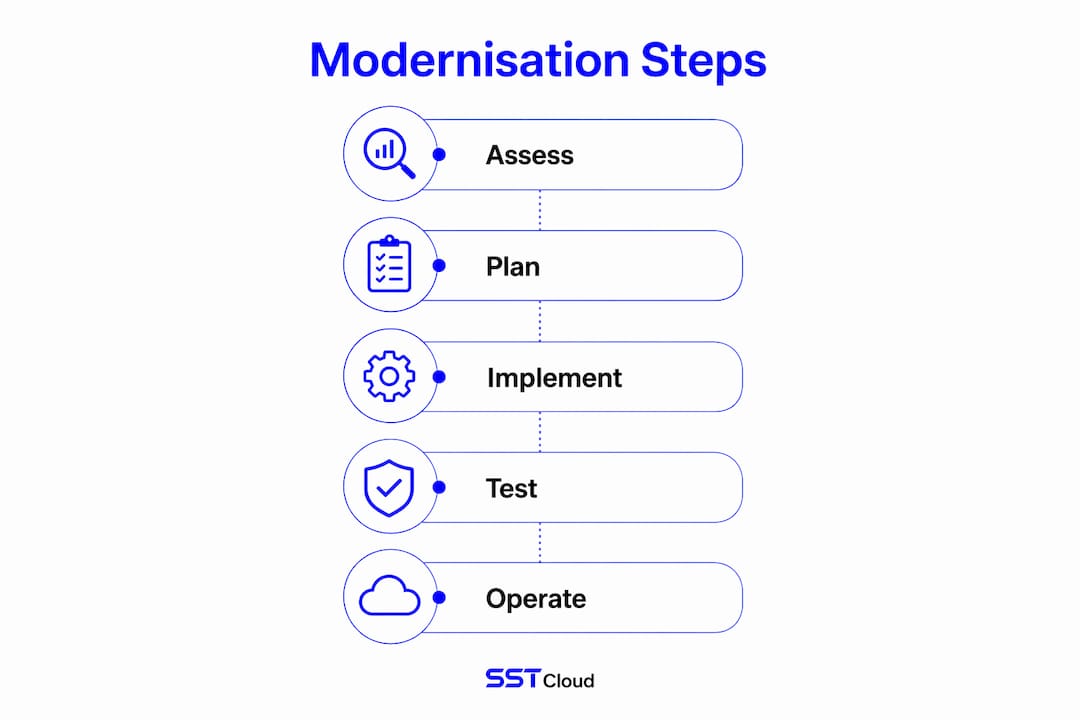
How to run a modernisation programme: assess, plan, implement, test, operate
Which technical patterns should you adopt?
What are the main risks and how do you mitigate them?
What does modernisation cost and how long does it take?
How do you choose the right modernisation approach?
Australian considerations for application modernisation
How SST Cloud approaches application modernisation
Key takeaways
The case for treating modernisation as a continuous capability
SST Cloud can accelerate your modernisation programme
Further reading and authoritative sources
What does application modernisation actually cover?
The scope of application modernisation is wider than most initial project charters acknowledge. At its narrowest, it means lifting an application from a physical server into a cloud virtual machine. At its broadest, it means redesigning the entire delivery model: architecture, data layer, release pipeline, and team operating model.
A useful way to frame scope is across five dimensions:
Code and architecture — refactoring tightly coupled modules, decomposing monoliths, adopting API-first design
Infrastructure — moving from on-premises or co-located hardware to cloud-managed compute, storage, and networking on AWS, Microsoft Azure, or Google Cloud Platform (GCP)
Data — migrating databases, modernising data pipelines, and enabling analytics or AI workloads on cloud-native data services
Deployment model — adopting containers, Kubernetes orchestration, or serverless functions to replace manual deployments
Operational practices — introducing DevOps, CI/CD pipelines, site reliability engineering (SRE), and automated testing
The distinction between a tactical migration and a strategic modernisation matters. A lift-and-shift rehost moves an application to the cloud quickly, preserving existing code and architecture. It reduces hardware costs and improves availability, but it does not address technical debt or unlock cloud-native capabilities. A refactor or rearchitect, by contrast, restructures the application so it can scale elastically, be deployed independently, and integrate with modern data and AI services.
Concrete examples illustrate the difference. Containerising a monolithic Java application and deploying it to Amazon Elastic Kubernetes Service (EKS) is a replatform: the application structure is unchanged, but it now runs on a portable, orchestrated platform. Breaking that same monolith into bounded-context microservices, each with its own database and CI/CD pipeline, is a rearchitect. Both are valid modernisation paths; the right choice depends on the application’s change frequency, team capability, and business objectives.
Legacy systems are mission-critical assets in most enterprises. A pragmatic modernisation strategy protects embedded business logic while incrementally modernising the layers that constrain agility, rather than attempting a wholesale replacement.

Why do organisations modernise? Measurable business outcomes
The business case for modernisation rests on outcomes that are measurable, not aspirational. Organisations that complete structured modernisation programmes typically report improvements across several dimensions:
Faster feature delivery — modular architectures allow independent teams to deploy updates without coordinating a full-system release cycle
Improved scalability — cloud-native workloads scale horizontally on demand, eliminating the capacity planning cycles that constrain on-premises systems
Lower infrastructure run costs — pay-per-use cloud pricing replaces fixed capital expenditure on hardware and data centre facilities
Stronger security posture — modern platforms support automated patching, secrets management, identity federation, and compliance controls that legacy environments cannot easily adopt
AI and analytics readiness — modular, cloud-aligned architectures are easier to instrument and scale for AI integration and data-driven decision-making
Modular architectures reduce release risk in a specific, measurable way. When a service boundary isolates a change, a failed deployment affects only that service, not the entire system. Teams can use canary releases or blue/green deployments to validate changes against a subset of traffic before full rollout, reducing mean time to recover (MTTR) and deployment-related incidents.
The connection to AI readiness deserves particular attention. Organisations that have not modernised their data and application layers find it difficult to instrument workloads, expose clean APIs, or feed reliable data into machine learning pipelines. Modernisation is frequently a prerequisite for AI agent integration over enterprise data, not a parallel initiative.
The 7 R’s: which strategy fits your application?
The 7 R’s framework provides a practical decision map for matching modernisation strategy to application characteristics and business goals. Rehosting is typically the fastest path, while refactoring offers the highest potential for cloud optimisation at considerably higher effort.
Rehost (lift-and-shift): Move the application to cloud infrastructure with no code changes. Best for stable, low-change systems where the primary goal is hardware cost reduction or data centre exit. Effort is low; risk is low; cloud-native benefits are minimal.
Replatform (lift-and-reshape): Migrate to a managed service or container platform with targeted optimisations, such as moving a database to Amazon RDS or containerising an application for Kubernetes. Delivers meaningful operational improvements without a full refactor.
Refactor: Restructure existing code to improve quality, reduce technical debt, and align with cloud patterns, without changing external behaviour. Suitable for applications with high change frequency where the current codebase is slowing delivery.
Rearchitect: Redesign the application’s structure, typically decomposing a monolith into microservices or event-driven components. High effort and complexity; appropriate when scalability or independent deployability is a hard business requirement.

Rebuild: Rewrite the application from scratch using modern frameworks and cloud-native patterns. Justified when the existing codebase is too degraded to refactor economically, or when a domain requires capabilities the current system cannot support.
Replace: Retire the custom application and adopt a commercial SaaS or platform alternative. Appropriate when a vendor product covers the functional requirement and the cost of maintaining custom code exceeds its strategic value.
Retire: Decommission applications with no active users or business value. Often surfaces during portfolio assessment and frees engineering capacity for higher-value work.
Strategy | Best for | Effort | Cost implications | Risk | Typical timeline | Business outcome |
|---|---|---|---|---|---|---|
Rehost | Data centre exit, hardware cost reduction | Low | Low migration cost; limited run-cost saving | Low | 2–8 weeks per app | Reduced CAPEX; minimal agility gain |
Replatform | Operational efficiency, managed services adoption | Low–Medium | Moderate migration; lower run costs over time | Low–Medium | 4 weeks per app | Improved reliability and portability |
Refactor | High-change codebases, technical debt reduction | Medium | Higher engineering effort; lower long-term maintenance | Medium | 2–6 months per domain | Faster delivery cycles |
Rearchitect | Scalability, independent deployability | High | High engineering cost; significant run-cost optimisation | High | 6 months | Elastic scale; team autonomy |
Rebuild | Degraded codebases, new capability requirements | Very high | Highest upfront cost | High | 12 months | Full cloud-native capability |
Replace | Commodity functions, unsustainable maintenance cost | Low–Medium | Licensing cost replaces engineering cost | Low–Medium | 4 weeks | Reduced maintenance burden |
Retire | Unused or redundant applications | Very low | Immediate cost saving | Very low | Days–weeks | Freed engineering capacity |
How to run a modernisation programme: assess, plan, implement, test, operate
Modernisation projects that skip the assessment phase consistently underdeliver. Data-driven baseline assessments that map technical debt, dependencies, and constraints lead to higher ROI than migration-focused projects that treat all applications as equivalent candidates for the same strategy.
Assess — inventory and baseline. Catalogue every application in scope: technology stack, runtime dependencies, integration surface, data flows, compliance requirements, and current infrastructure cost. Identify technical debt hotspots and classify each application against the 7 R’s. Deliverable: baseline assessment report with application portfolio map and modernisation candidates ranked by business value and risk.
Plan — roadmap and business case. Sequence modernisation work by business criticality, dependency order, and team capacity. Define success metrics (deployment frequency, MTTR, cost per transaction) and build a phased roadmap with clear milestones. Deliverable: modernisation roadmap with business case, risk register, and rollback plan for each phase.
Implement — migration and engineering work. Execute the chosen strategy for each application: rehost, replatform, refactor, or rearchitect. Run a pilot on a lower-risk application first to validate tooling, pipelines, and team capability before scaling. Deliverable: migrated or refactored application with Infrastructure as Code (IaC) templates, CI/CD pipeline configuration, and runbook.
Test — validation and compliance checks. Execute functional, performance, security, and compliance tests against the modernised application. Use automated test suites where possible; validate data integrity after any database migration. Canary or blue/green deployment patterns reduce production risk during cutover. Deliverable: test report and signed-off go-live checklist.
Operate — SRE, observability, and optimisation. Establish observability (metrics, logs, traces) using tools such as AWS CloudWatch, Azure Monitor, or Google Cloud Operations Suite. Define SLOs and incident response runbooks. Continuously optimise cloud spend using reserved instances, right-sizing, and autoscaling policies. Deliverable: post-launch runbook with SLO definitions, alerting configuration, and cost optimisation baseline.
Assessment checklist for the first phase:
Technical inventory: language, framework, runtime, OS, and dependency versions
Technical debt: code quality metrics, test coverage, known defects
Integration surface: APIs, message queues, shared databases, third-party services
Data flows: data classification, volume, latency requirements, residency constraints
Compliance: regulatory obligations (APRA, Privacy Act, ISO 27001, SOC 2) and audit requirements
Infrastructure cost: current run cost baseline for comparison post-migration
Understanding why cloud migration projects fail before they begin is as important as knowing the steps. Inadequate dependency mapping and underestimated data migration complexity are the two most common causes of programme overruns.
Which technical patterns should you adopt?
Technical pattern selection should follow from the modernisation strategy, not precede it. The patterns below are the most commonly adopted in cloud-native modernisation programmes.
Containers and Kubernetes — package applications and their dependencies into portable container images; orchestrate them with Kubernetes (Amazon EKS, Azure Kubernetes Service, Google Kubernetes Engine). Delivers environment consistency, horizontal scaling, and self-healing. Requires investment in platform engineering and operational expertise.
Microservices — decompose a monolith into independently deployable services aligned to business domains. Enables team autonomy and elastic scaling per service. Increases operational complexity: service discovery, distributed tracing, and inter-service authentication all require deliberate design.
Serverless — run event-driven functions (AWS Lambda, Azure Functions, Google Cloud Functions) without managing server infrastructure. Ideal for variable, spiky workloads; cost shape is consumption-based. Less suited to long-running or latency-sensitive processes.
API-first design — expose application capabilities through well-defined APIs (REST, GraphQL, gRPC) to decouple consumers from implementation. Enables enterprise AI API integration and third-party connectivity without tight coupling.
CI/CD pipelines — automate build, test, and deployment workflows using tools such as GitHub Actions, GitLab CI, AWS CodePipeline, or Azure DevOps. Reduces manual release risk and enables deployment frequency improvements.
Cloud-native data services — replace self-managed databases with managed services (Amazon Aurora, Azure SQL Managed Instance, Google Cloud Spanner, BigQuery) to reduce operational overhead and improve availability.
Adopting DevOps, SRE, and CI/CD practices is often necessary for cloud-native approaches to deliver their expected velocity and reliability gains. Cloud-native platforms are less effective without accompanying changes to team practices and delivery pipelines.
A critical caution on microservices: refactoring a monolith into microservices is frequently oversold. For many stable, low-change systems, containerising the monolith delivers the majority of operational benefits at a fraction of the engineering risk. The recommended staged path is to replatform first (containerise), then selectively refactor high-change bounded contexts into services once the platform is stable.
Pattern | Operational complexity | Scalability | Cost shape | Skills required |
|---|---|---|---|---|
Containers / Kubernetes | Medium–High | High | Moderate fixed + variable | Platform engineering, Kubernetes operations |
Microservices | High | Very high | Variable per service | Distributed systems design, DevOps |
Serverless | Low–Medium | Very high | Consumption-based | Function development, event-driven design |
API-first | Low | High | Minimal additional | API design, gateway management |
CI/CD pipelines | Low | N/A | Low | DevOps tooling, scripting |
Managed cloud data services | Low | High | Consumption + licensing | Data engineering, SQL/NoSQL |
The shift from project delivery to platform thinking is what separates organisations that sustain modernisation gains from those that regress. Shared platforms with reusable CI/CD pipelines, guardrails, and runbooks reduce the per-team effort of adopting cloud-native patterns.
What are the main risks and how do you mitigate them?
Modernisation programmes encounter a predictable set of challenges. Recognising them early and building mitigation into the programme plan is more effective than reacting after the fact.
Hidden technical debt — legacy codebases frequently contain undocumented dependencies, hardcoded configuration, and untested code paths that only surface during migration. Mitigation: invest in static analysis tools (SonarQube, Checkmarx) and dependency scanning during the assessment phase before committing to a strategy.
Stateful data migration — migrating live databases with zero data loss and minimal downtime is the highest-risk activity in most programmes. Mitigation: use change data capture (CDC) tools such as AWS Database Migration Service or Debezium; run parallel validation between source and target before cutover.
Skills gaps — cloud-native patterns require expertise in Kubernetes, Terraform, CI/CD tooling, and distributed systems that many enterprise teams do not have in depth. Mitigation: combine targeted upskilling with specialist partner engagement; embed knowledge transfer into delivery contracts.
Vendor lock-in — heavy use of proprietary managed services (AWS-specific APIs, Azure-specific PaaS) can create dependency that constrains future optionality. Mitigation: adopt open standards where practical (Kubernetes, OpenTelemetry, Terraform); document architecture decisions and evaluate portability trade-offs explicitly.
Cultural and organisational resistance — teams accustomed to infrequent, high-ceremony releases often resist the operational changes that CI/CD and SRE require. Mitigation: start with a pilot team, demonstrate measurable wins, and build internal champions before scaling the operating model change.
Regulatory and compliance constraints — data classification, audit logging, and access control requirements must be validated against the target architecture before go-live, not after. Mitigation: involve your compliance and security teams in the assessment phase; map controls to cloud-native equivalents early.
Pro Tip: Run a time-boxed, two-week technical spike on your highest-risk application before committing to a full programme budget. The spike surfaces hidden dependencies, validates tooling choices, and produces a realistic effort estimate that a desk-based assessment cannot. It is the single highest-leverage investment in programme risk reduction.
What does modernisation cost and how long does it take?
Cost and timeline vary significantly by scope, but the primary drivers are consistent across programmes.
Primary cost drivers:
Engineering labour: the dominant cost in most programmes, particularly for refactor and rearchitect strategies
Cloud run costs: the ongoing cost of the target environment, which may be higher initially before right-sizing and reserved instance commitments reduce it
Licensing: commercial tooling (container registries, observability platforms, security scanning), database licensing changes, and SaaS replacement costs
Data transfer and rework: egress costs and the engineering effort to validate migrated data
Testing and compliance: automated test suite development, penetration testing, and compliance audit costs
Training and change management: upskilling existing teams and managing the operational transition
Indicative timeline ranges by scope:
Small scope (containerise a single service, rehost a non-critical application): 2–8 weeks
Medium scope (replatform a domain, refactor a high-change application): 2–6 months
Large scope (rearchitect a core platform, rebuild a complex system): 6–24 months
Effort estimation is most reliable when it starts from an assessment baseline. Function point proxies, sprint-based pilot estimates from a technical spike, and historical velocity data from comparable engagements all produce more accurate forecasts than top-down analogies. For high-growth enterprises managing modernisation without disrupting core systems, phased delivery with defined rollback points is the standard approach to managing cost and risk simultaneously.
How do you choose the right modernisation approach?
The right strategy for each application emerges from a structured evaluation, not a blanket policy. Apply the following decision checklist to each application in your portfolio.
Decision checklist:
Business criticality — what is the revenue or operational impact of downtime? High criticality demands conservative strategies and thorough rollback planning.
Change frequency — how often does the application need new features or fixes? High change frequency makes technical debt expensive and justifies refactor investment.
Integration surface — how many upstream and downstream systems depend on this application? A large integration surface increases migration complexity and risk.
Technical debt level — is the codebase maintainable, or is every change slow and fragile? Severe debt may make rebuild more economical than refactor.
Compliance constraints — does the application handle regulated data (financial, health, personal)? Compliance requirements affect architecture choices and testing scope.
Team capability — does the team have the skills to operate the target architecture? A microservices target with no distributed systems expertise is a risk, not a benefit.
Cost sensitivity — is the primary driver cost reduction, agility, or capability? The answer shapes which strategy delivers the best return.
Decision rules (example scoring rubric):
High criticality + high change frequency → Refactor or Rearchitect with phased delivery
Low change frequency + cloud cost pressure → Rehost or Replatform
Severe technical debt + strategic domain → Rebuild
Commodity function + viable SaaS alternative → Replace
No active users or business value → Retire
KPIs to track during and after modernisation:
Lead time for changes — time from code commit to production deployment
Deployment frequency — how often the team releases to production
Mean time to recover (MTTR) — average time to restore service after an incident
Change failure rate — percentage of deployments that cause a production incident
Cost per transaction — infrastructure cost relative to application throughput
These four metrics, drawn from the DORA (DevOps Research and Assessment) framework, provide an objective baseline for measuring modernisation outcomes against pre-programme performance.
Australian considerations for application modernisation
Technology leaders in Australia face a set of constraints and opportunities that differ from those in other markets, and architecture decisions should reflect them.
Data residency and sovereignty — Australian organisations handling personal information under the Privacy Act 1988 must understand where data is stored and processed. AWS operates Sydney and Melbourne regions; Microsoft Azure operates Sydney and Melbourne regions; Google Cloud Platform operates a Sydney region. Workloads with strict residency requirements should be architected to pin data to Australian regions, with explicit controls on cross-region replication.
APRA guidance — financial services organisations regulated by the Australian Prudential Regulation Authority (APRA) must comply with CPS 234 (information security) and CPS 231 (outsourcing). Cloud migrations and modernisation programmes that involve third-party managed services require APRA notification and due diligence documentation. Architecture decisions, particularly around shared responsibility models, must be mapped to APRA’s requirements.
Healthcare data — organisations handling My Health Record data or other health information under the My Health Records Act 2012 and the Privacy Act face additional obligations around data handling, access controls, and audit logging that must be validated against the target cloud architecture.
Skills market — Australia’s cloud engineering talent market is competitive. Kubernetes, Terraform, and cloud-native development skills are in demand, and programme timelines should account for recruitment lead times or partner engagement. The Red Hat and AWS partner ecosystems have established presences in Australia, and IBM and VMware maintain local professional services practices.
Procurement and contracting — many Australian government and enterprise organisations operate under procurement frameworks (AusTender, panel arrangements) that affect how modernisation engagements are structured and contracted. Phased delivery with defined milestones and exit points is often preferred over large fixed-scope contracts.
Local cloud partner ecosystem — AWS, Microsoft Azure, and GCP all maintain Australian partner networks with certified practitioners. Engaging a locally based partner with Australian Signals Directorate (ASD) alignment and relevant industry certifications reduces compliance risk and simplifies data handling governance.
How SST Cloud approaches application modernisation
SST Cloud’s modernisation methodology follows a structured assess-to-operate model that mirrors the phases described in this article, with platform engineering and SRE handover built into the delivery model from the outset.
The methodology covers:
Inventory and baseline — technical assessment of the application portfolio, mapping dependencies, data flows, compliance requirements, and current infrastructure costs to produce a prioritised modernisation roadmap
Pilot delivery — a time-boxed pilot on a selected application to validate tooling, pipeline configuration, and team operating model before scaling
Phased rollout — incremental delivery across the portfolio, sequenced by business value and risk, with defined rollback points at each phase boundary
Platform engineering — shared platform delivery including reusable CI/CD pipelines, Infrastructure as Code templates, guardrails, and observability configuration that reduce per-team modernisation effort
SRE handover — post-cutover support including SLO definition, alerting configuration, runbook development, and cost optimisation baseline
SST Cloud’s relevant service areas include:
Cloud strategy and advisory — assessment, roadmap, and business case development
Application modernisation and cloud migration — rehost, replatform, refactor, rearchitect, and rebuild engagements across AWS, Azure, and GCP
Platform engineering — Kubernetes, Terraform, CI/CD, and DevOps tooling
Data and AI engineering — data pipeline modernisation and AI integration for modernised platforms
Managed cloud services — ongoing operations, SRE, and cost optimisation
SST Cloud holds partner certifications across AWS, Microsoft Azure, and Google Cloud Platform, and works with Red Hat technologies for container and Kubernetes platform delivery. Engagements are structured to transfer knowledge and operational capability to client teams, not to create ongoing dependency.
Key takeaways
Application modernisation is most effective when treated as a continuous, portfolio-level capability rather than a one-off migration project, with strategy matched to each application’s business criticality, change frequency, and technical debt profile.
Point | Details |
|---|---|
Definition and scope | Modernisation updates code, architecture, infrastructure, data, and operational practices to improve scalability, maintainability, and cost-efficiency. |
The 7 R’s framework | Rehost, Replatform, Refactor, Rearchitect, Rebuild, Replace, and Retire provide a decision map; match strategy to each application’s characteristics, not a blanket policy. |
Assessment first | Data-driven baseline assessments that map technical debt, dependencies, and compliance constraints produce higher ROI than migration-first approaches. |
Operational change is required | Adopting DevOps, CI/CD, and SRE practices alongside technical modernisation is necessary for cloud-native approaches to deliver velocity and reliability gains. |
SST Cloud engagement | SST Cloud delivers structured assess-to-operate modernisation programmes across AWS, Azure, and GCP, with platform engineering and SRE handover built into every engagement. |
The case for treating modernisation as a continuous capability
The most consequential mistake organisations make with modernisation is treating it as a project with an end date. A programme that concludes with a successful migration and then returns to a traditional release cadence will accumulate new technical debt within two to three years, and the cycle repeats.
The organisations that sustain modernisation gains are those that build the capability into their operating model: continuous measurement of DORA metrics, a platform team that maintains shared tooling and guardrails, and a portfolio review cadence that reassesses application strategies as business priorities shift. This is not a philosophical position; it is what the evidence from mature cloud programmes consistently shows. Modernisation should be measured, instrumented, and iterated rather than aimed at a single end-state.
There is also a tendency to conflate modernisation with microservices, which leads teams to over-engineer solutions for problems they do not have. A containerised monolith running on Kubernetes with a solid CI/CD pipeline and proper observability is a genuinely modern system. It may not be architecturally elegant by every standard, but it delivers the operational outcomes that matter: fast deployments, reliable recovery, and cost visibility. The decision to decompose further should be driven by a specific, measurable constraint, not by architectural fashion.
The practical lesson from engagements across financial services, healthcare, and enterprise software is that incremental wins, measured against a pre-programme baseline, build the organisational confidence and executive support that sustain a multi-year programme. Start with the applications where modernisation delivers clear, near-term value. Measure the outcomes. Use those results to fund the next phase.
SST Cloud can accelerate your modernisation programme
Organisations that have completed a structured assessment know which applications to modernise first and which strategy to apply. Those that have not are making expensive guesses. SST Cloud’s cloud and digital transformation services start with a technical assessment that produces a prioritised roadmap, a realistic business case, and a phased delivery plan your team can act on immediately.
SST Cloud engineers hold certifications across AWS, Microsoft Azure, and Google Cloud Platform, and bring hands-on experience with Kubernetes, Terraform, CI/CD pipeline design, and SRE operating models. Engagements are structured to deliver measurable outcomes at each phase boundary, with knowledge transfer built in so your team owns the platform at handover. Whether your priority is data centre exit, AI readiness, or reducing the cost and fragility of a legacy system, SST Cloud can scope and deliver the right programme for your context. Speak to an adviser or request a technical assessment at sstcloud.com.au.
Further reading and authoritative sources
Teams planning a modernisation programme will find the following resources useful for deeper technical and strategic planning:
Application modernisation overview — Cloudflare’s explanation of the 7 R’s framework and cloud migration patterns
What is application modernisation? — Microsoft Azure’s guide covering assessment methodology, cloud-native patterns, and business outcomes
Application modernisation explained — Red Hat’s documentation on containerisation, Kubernetes, and DevSecOps modernisation paths
Application modernisation — VMware’s perspective on legacy system pragmatism and incremental modernisation strategies
AI integration for business document workflows — practical guidance on integrating AI into modernised application and document workflows
SST Cloud insights and thought leadership — SST Cloud’s published perspectives on cloud modernisation, platform engineering, and enterprise transformation
SST Cloud advisory and strategy services — assessment, roadmap, and business case services for organisations beginning a modernisation programme