Knowledge Base
What is integration architecture: a guide for enterprises
Discover what integration architecture is and how it unifies IT systems. Learn to improve operations and decision-making in your enterprise.

What is integration architecture: a guide for enterprises
Integration architecture is the strategic framework that defines how diverse IT systems, applications, and data sources connect and communicate within an enterprise. Without it, organisations running 400 or more applications face isolated systems that create operational blind spots and slow decision-making. That isolation is the core problem integration architecture solves. It provides the design discipline that turns disconnected platforms into a unified, functioning ecosystem.
What is integration architecture and why does it matter?
Integration architecture is defined as the structured set of principles, patterns, and components that govern how systems exchange data and trigger actions across an enterprise. The industry also refers to this discipline as enterprise integration design or system interoperability architecture. Both terms describe the same foundational concern: making sure your applications talk to each other reliably, securely, and at the right speed.
The reliability and cost of distributed systems depend directly on how services interact and exchange data. That means a poorly designed integration layer does not just cause technical debt. It raises operating costs and limits how fast the business can respond to change.

Integration architecture sits above individual technology choices. It defines the rules of engagement between systems before any tool is selected. That ordering matters because organisations that pick tools first and design later end up with brittle, point-to-point connections that multiply in complexity as the application estate grows.
What are the main types of integration architecture?
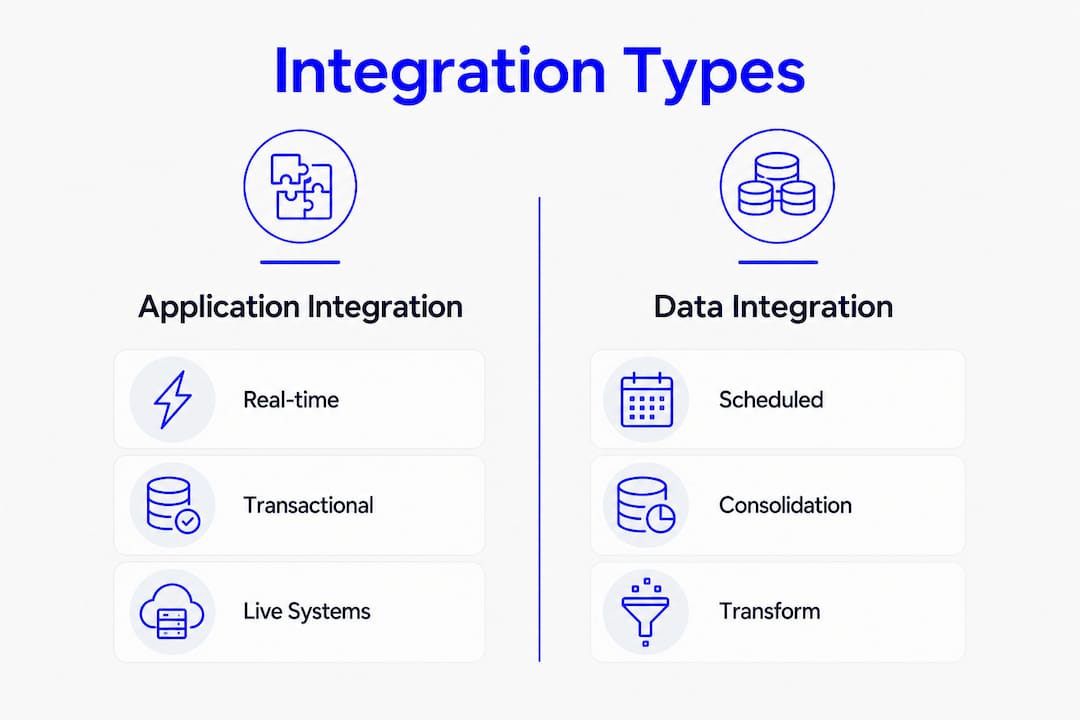
Choosing between integration types depends on whether the dominant business goal is data integration or application integration. These two categories have distinct characteristics and serve different operational needs.
Application Integration focuses on real-time, transactional communication between live systems. A payment gateway confirming a transaction to an order management system is a classic example. Latency is low, and the interaction is typically synchronous or near-synchronous.
Data Integration focuses on transformation, consolidation, and reusability. It moves data between systems on a scheduled or batch basis, feeding analytics platforms, data lakehouses, and reporting tools. The priority is accuracy and completeness rather than speed.
Type | Primary goal | Typical cadence | Common use case |
|---|---|---|---|
Application Integration | Real-time transactional communication | Synchronous or event-driven | Order processing, CRM updates |
Data Integration | Transformation and reusability | Batch or scheduled | Analytics, data warehousing |
Hybrid | Both goals coexist | Mixed | Supply chain with live tracking and reporting |
Most enterprise environments require both types. A supply chain platform, for instance, needs live inventory updates (application integration) and nightly sales consolidation for forecasting (data integration). Treating these as separate concerns with separate governance prevents the two from creating conflicting data contracts.
Pro Tip: Map your highest-volume data flows before choosing a type. If most of your pain comes from stale reports, start with data integration. If it comes from failed transactions, start with application integration.
What are the common integration architecture patterns?
Integration patterns should be evaluated against five criteria: data flow direction, latency requirements, number of endpoints, data volume, and cadence. These criteria separate simple implementations from complex, event-driven architectures.
The main patterns in use today are:
Point-to-point: Direct connections between two systems. Suits environments with fewer than 20 applications. Simple to implement but creates a web of dependencies that becomes unmanageable at scale.
Hub-and-spoke: A central integration broker mediates all communication. Scales to 50–200 applications with complex needs. The central hub can become a bottleneck if not designed for high availability.
API-first: Every capability is exposed through a versioned, documented API. Treats integration as a core business capability rather than a plumbing concern. This pattern suits organisations building for long-term extensibility.
Message broker: Systems publish messages to a queue or topic. Consumers read at their own pace. This decouples producers from consumers and handles spikes in load without data loss.
Event-driven architecture: Systems react to events rather than polling for state changes. Reduces latency and coupling across distributed services.
Service mesh: A dedicated infrastructure layer manages service-to-service communication, including load balancing, retries, and observability. Suited to Kubernetes-based microservices environments.
Integration has evolved from centralised enterprise service buses to decentralised, distributed service meshes and event-driven architectures. That shift reflects the move to cloud-native ecosystems where no single broker can serve as the universal intermediary.
Pattern | Coupling | Scalability | Best for |
|---|---|---|---|
Point-to-point | High | Low | Small estates, under 20 apps |
Hub-and-spoke | Medium | Medium | Mid-size enterprises |
API-first | Low | High | Long-term extensibility |
Message broker | Low | High | Asynchronous, high-volume flows |
Event-driven | Very low | Very high | Real-time, distributed systems |
Service mesh | Very low | Very high | Kubernetes microservices |
The integration architecture vs microservices question often arises here. Microservices is a deployment pattern. Integration architecture is the design discipline that governs how those microservices communicate. The two are complementary, not competing.
What are the critical components of modern integration architecture?
Modern integration architecture relies on several distinct components working together. Each plays a specific role, and omitting any one of them creates gaps in reliability, security, or visibility.
API gateway: The entry point for external and internal API traffic. Handles authentication, rate limiting, routing, and protocol translation. Azure API Management is one example of a cloud-native gateway that supports secure API publishing at enterprise scale.
Integration platform: Orchestrates workflows across systems. Azure Logic Apps and Azure Service Bus are practical examples that support workflow orchestration, messaging, and event-driven programming within a single cloud ecosystem.
Message broker: Manages asynchronous communication between services. Decouples the sending system from the receiving system, which prevents cascading failures.
Orchestration engine: Coordinates multi-step processes across systems, managing sequencing, error handling, and compensation logic.
Security layer: Governs identity, access, encryption, and audit logging. Security must be a foundational layer from the outset, not added after the architecture is built. This is especially critical in regulated industries such as manufacturing and financial services.
Observability stack: Collects logs, metrics, and traces from every integration point. Observability detects operational failures before users notice them, which is the difference between proactive and reactive operations.
Circuit breakers and retry logic: Prevent a failing downstream service from taking down the entire integration layer. Standard retry logic with exponential backoff is the baseline expectation for any production integration.
Pro Tip: Build your observability stack before you go live, not after your first production incident. Distributed tracing across integration points is far harder to retrofit than to design in from the start.
What are the main benefits of a well-designed integration architecture?
A well-designed integration architecture delivers measurable outcomes across both technical and business dimensions. Successful integration reduces development time by 60% and can achieve return on investment within 120 days. That pace is possible because reusable integration patterns and standardised APIs eliminate the need to rebuild connections from scratch for each new system.
The core benefits include:
Faster time to market: Reusable APIs and pre-built connectors mean new capabilities can be delivered without renegotiating every system interface.
Improved data quality: Centralised data contracts reduce the risk of conflicting data definitions across systems, which directly improves the accuracy of analytics and reporting.
Reduced operational complexity: A governed integration layer replaces ad hoc point-to-point connections, cutting the number of failure points in the estate.
Support for cloud and hybrid strategies: Integration architecture provides the connective tissue between on-premises systems and cloud platforms, which is the foundation for any cloud transformation programme.
Better decision-making: When data flows reliably across systems, business leaders get accurate, timely information rather than reconciling conflicting reports from siloed platforms.
Integration also enables the shift from fragmented data to unified intelligence, which is the prerequisite for AI and advanced analytics initiatives. Organisations that treat integration as an afterthought find their AI projects stall at the data preparation stage.
How to design and implement an effective integration architecture
Designing integration architecture works best as an iterative process, not a single enterprise-wide blueprint exercise. Starting with the highest-priority pain point and proving a solution in a limited scope before expanding is the most reliable path to success.
A practical approach follows these steps:
Identify the highest pain point. Choose one integration problem that is causing measurable business impact. A failed order-to-cash flow or a broken HR-to-payroll sync are good candidates.
Define your data contracts. Agree on the schema, versioning policy, and ownership for every data exchange before writing any code. Loose coupling depends on clear contracts.
Select the right pattern. Apply the five criteria: data flow direction, latency, endpoint count, volume, and cadence. Match the pattern to the problem, not to the technology your team already knows.
Build in observability from day one. Instrument every integration point with logging, metrics, and distributed tracing before the first deployment.
Implement security as a foundation. Apply identity verification, encryption in transit and at rest, and audit logging at the integration layer itself, not just at the application layer.
Expand iteratively. Once the first integration is stable and monitored, apply the same pattern and governance to the next highest pain point. Avoid the temptation to redesign the entire estate before proving the approach.
Pro Tip: Assess your team’s cloud readiness before selecting patterns. An event-driven architecture on Kubernetes is the right answer for many problems, but only if your team can operate it. Architectural discipline matters more than architectural ambition.
The shift from project delivery to platform thinking is directly relevant here. Integration architecture is most effective when it is treated as a platform capability with its own governance, versioning, and ownership, rather than a series of one-off project deliverables.
Key takeaways
Integration architecture is the design discipline that determines whether your enterprise systems operate as a unified platform or a collection of isolated applications.
Point | Details |
|---|---|
Definition matters first | Integration architecture governs how systems connect, exchange data, and handle failures across the enterprise. |
Type selection is goal-driven | Choose application integration for real-time transactions and data integration for analytics and batch processing. |
Pattern choice drives scalability | API-first and event-driven patterns suit large, distributed estates; point-to-point suits small ones. |
Observability is non-negotiable | Instrument every integration point before go-live to detect failures before users do. |
Iterate, do not over-architect | Start with the highest pain point, prove the pattern, then expand across the estate. |
Why I think most enterprises are still getting integration wrong
The most common mistake I see is treating integration as a technical problem rather than a business capability. Teams spend months designing the perfect enterprise-wide integration blueprint, then stall because the scope is too large to govern or fund as a single initiative.
The organisations that get integration right treat it the way they treat their cloud platform: as a product with an owner, a roadmap, and a set of standards that every team must follow. They do not try to solve every integration problem at once. They pick the one that is costing the business the most, fix it properly with the right pattern and full observability, and then use that as the template for the next one.
The other pattern I see repeatedly is the security afterthought. Teams build the integration layer, get it working, and then try to bolt on identity and encryption later. In regulated industries, that approach fails compliance reviews and creates rework that costs far more than designing security in from the start.
The technology choices matter less than the architectural discipline. Loose coupling, clear contracts, graceful failure handling, and end-to-end observability are the four principles that determine whether an integration architecture ages well or becomes a liability. Any cloud-native toolset can support those principles. The question is whether your team has the discipline to apply them consistently.
— Engineering and Growth Manager
How SST Cloud supports enterprise integration architecture
SST Cloud works with enterprises across AWS, Microsoft Azure, and Google Cloud Platform to design and implement integration architectures that connect complex application estates without creating new technical debt. The team brings hands-on engineering experience across API management, event-driven design, platform engineering, and managed cloud services that keep integration layers running reliably after go-live.
For organisations at the start of their cloud or modernisation programme, SST Cloud’s digital and cloud transformation services include integration architecture assessment, pattern selection, and iterative implementation support. The focus is on delivering measurable outcomes, whether that means reducing integration development time, improving data availability, or connecting on-premises systems to cloud platforms.
FAQ
What is the difference between application and data integration architecture?
Application integration focuses on real-time, transactional communication between live systems. Data integration focuses on scheduled transformation and consolidation of data for analytics and reporting.
How many integration patterns are there?
The six most widely used patterns are point-to-point, hub-and-spoke, API-first, message broker, event-driven, and service mesh. Each suits a different scale and latency requirement.
What components does an integration architecture need?
A complete integration architecture requires an API gateway, integration platform, message broker, orchestration engine, security layer, observability stack, and circuit breaker logic.
What are the main benefits of integration architecture for enterprises?
Well-designed integration reduces development time, improves data quality, cuts operational complexity, and provides the foundation for cloud migration and AI initiatives.
How does integration architecture relate to microservices?
Microservices is a deployment pattern for building applications as independent services. Integration architecture is the design discipline that governs how those services communicate and exchange data reliably.