How High-Growth Enterprises Approach Modernisation Without Disrupting Core Systems
Most modernisation efforts fail not because of technology, but because enterprises attempt to change core systems too quickly. The more effective approach is incremental transformation built around stability, not disruption.
Most enterprises underestimate how tightly coupled their systems actually are.
On the surface, applications look independent. A billing system here, a CRM there, a data warehouse somewhere else. But underneath, these systems are constantly interacting through undocumented APIs, scheduled jobs, file transfers, and manual processes that have evolved over years.
When organisations attempt a full replacement strategy, they are not just migrating software. They are attempting to recreate an entire ecosystem without fully mapping how it behaves under real conditions.
This is where failure begins.
High-growth enterprises approach this problem differently. Instead of treating modernisation as a replacement exercise, they treat it as an architectural evolution problem.
The first step is not building. It is understanding.
Teams spend time mapping system boundaries, identifying critical data flows, and understanding which parts of the system are truly stable versus which parts are accidental complexity that accumulated over time.
Once this is clear, modernisation becomes incremental rather than disruptive.
A common pattern is introducing abstraction layers between systems. These could be APIs, event streams, or data integration layers. The purpose of these layers is not to immediately replace legacy systems, but to decouple them from direct dependency chains.
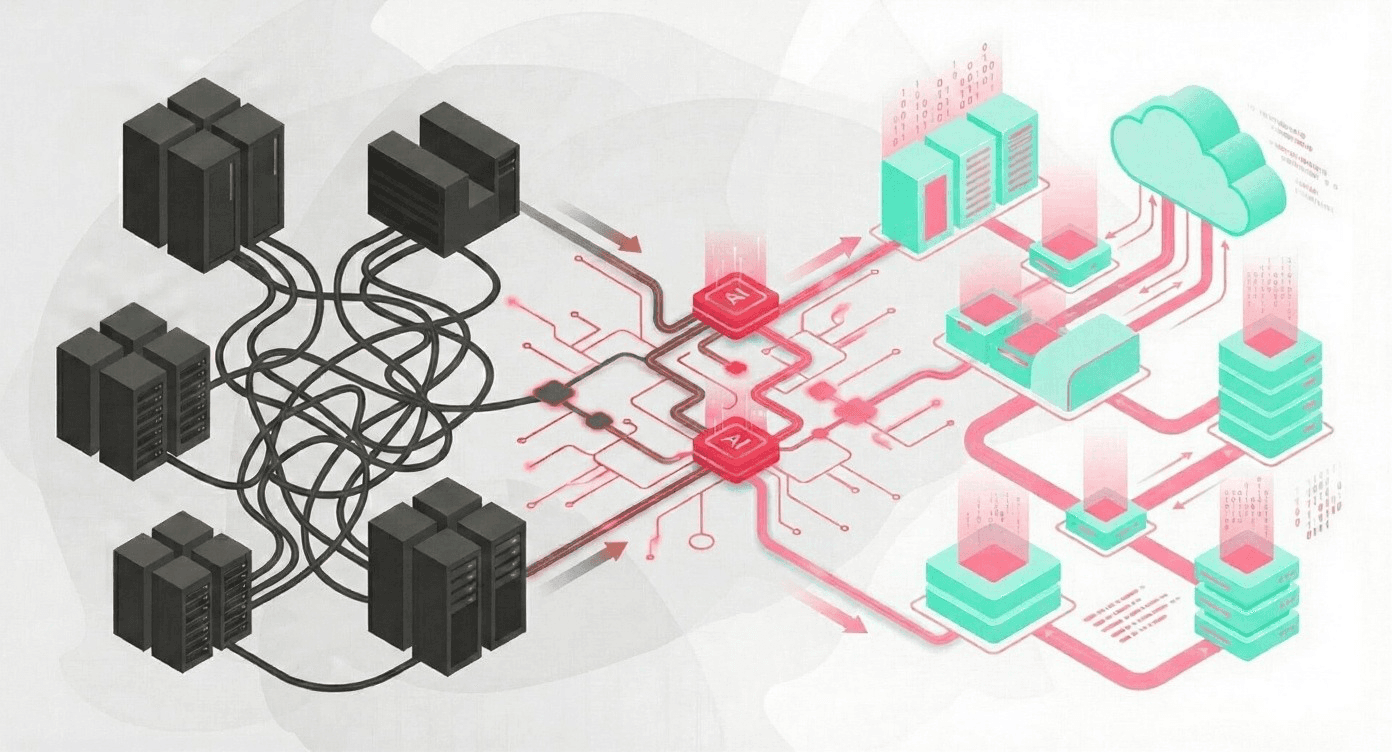
Over time, these layers become the new control points of the architecture. Once enough functionality is routed through them, legacy systems can be replaced gradually, without forcing a complete system shutdown.
This approach also changes how risk is managed.
Instead of betting on a single large migration event, enterprises distribute risk across multiple smaller changes. Each change is reversible. Each step can be validated independently.
The result is slower transformation in the short term, but significantly lower failure risk and higher long-term stability.
Modernisation, in this sense, is not a project. It is a continuous architectural discipline that evolves alongside the business.
ready to build?
Partner with us to turn information into impact. Whether you're designing modern systems, solving complex engineering challenges, or building the next generation of intelligent platforms, our team helps you move from insight to execution at speed and at scale.