Knowledge Base
User growth infrastructure planning: a staged guide
Discover effective user growth infrastructure planning. Learn to build scalable tech that meets user demand without overspending.

User growth infrastructure planning: a staged guide
User growth infrastructure planning is the process of designing and evolving your technology stack to handle increasing numbers of users without sacrificing performance or driving excessive costs. Most growing businesses treat infrastructure as a reactive concern, fixing problems only after users complain. The most effective approach is the opposite: plan your infrastructure in stages, aligned to measurable growth thresholds, so that each investment is justified by actual demand. This guide covers the key growth stages, the infrastructure components that matter most, automation practices, and the common mistakes that create technical debt before a product reaches scale.
What are the key stages of user growth infrastructure planning?
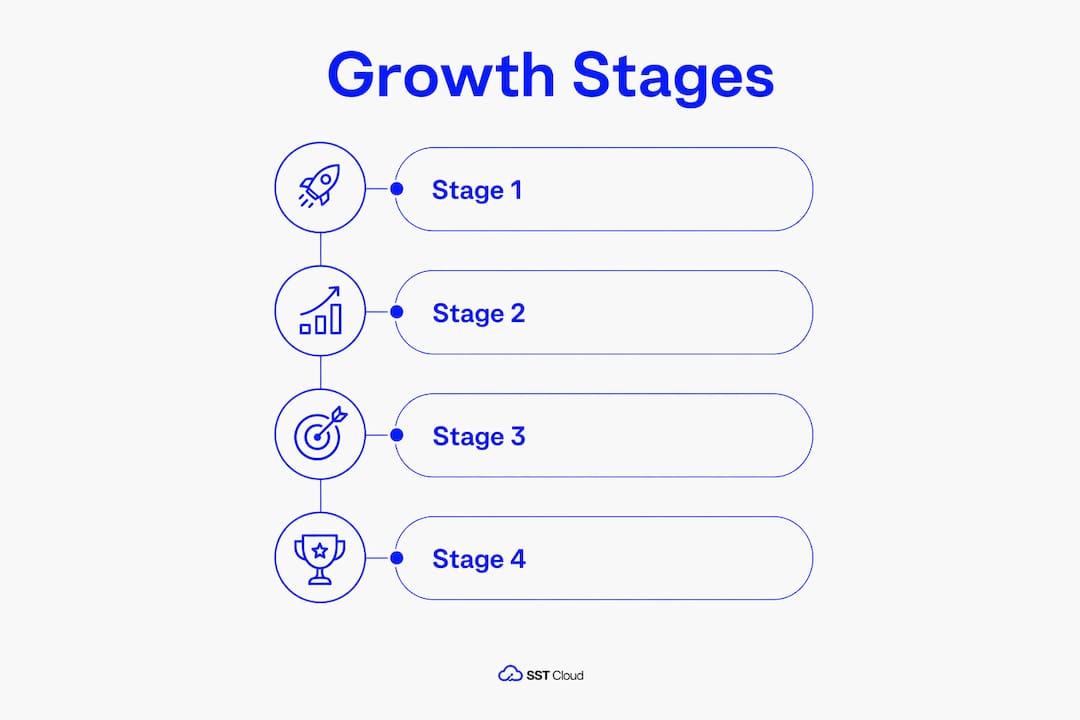
User growth infrastructure planning follows a predictable progression. Each stage introduces new bottlenecks, and the fix that works at 1,000 users will not work at 100,000. Understanding these thresholds before you hit them is the difference between planned investment and emergency spending.
Stage 1: 0 to 1,000 users
At this stage, a single server and a single database handle all traffic. The priority is speed of delivery, not architectural complexity. Most teams run a monolithic application on a single cloud instance, which is the correct call. The database is the first component to show strain, typically through slow queries and connection exhaustion.
Stage 2: 1,000 to 10,000 users
Database pressure becomes the defining constraint. Connection pooling allows 20–30 database connections to serve 100 concurrent user connections efficiently. That ratio means you can multiply your effective capacity without provisioning additional database instances. At this stage, adding a caching layer and separating read traffic from write traffic delivers the highest return per dollar spent.
Stage 3: 10,000 to 100,000 users
Read replicas become necessary. Read replicas cut primary database CPU by 50–70% for roughly $100–200 per month. That is one of the most cost-effective infrastructure investments available at this scale. Load balancers and auto-scaling groups enter the picture here, distributing traffic across multiple application instances and adjusting capacity automatically in response to demand spikes.

Stage 4: 100,000 users and beyond
At this scale, traffic, data, and compute must all be managed together. Optimising one without the others creates new bottlenecks. Background job queues, content delivery networks, and database sharding become relevant. Teams that skipped earlier optimisations often arrive here carrying significant technical debt, which makes every subsequent change more expensive.
Pro Tip: Map your current user count to the stage above before making any infrastructure decision. The right fix at Stage 2 is often the wrong fix at Stage 4.
Which infrastructure components support scalable user growth?
The components that deliver the most impact at each growth stage are well understood. The challenge is applying them in the right order, at the right time, rather than building for a scale you have not yet reached.
Caching with Redis
A well-tuned Redis caching layer absorbs 80–95% of read traffic for common queries. That means the vast majority of user requests never reach your database at all. Redis stores frequently accessed data in memory, returning results in milliseconds. The practical effect is a dramatic reduction in database load and a measurable improvement in response times for end users.
Read replicas and connection pooling
Read replicas direct all SELECT queries to a secondary database instance, leaving the primary instance free for writes. Combined with connection pooling, this pattern supports a large number of concurrent users without requiring a larger or more expensive primary database. The cost is modest relative to the performance gain.
Load balancers and auto-scaling groups
Load balancers distribute incoming requests across multiple application servers. Auto-scaling groups adjust the number of active servers based on real-time traffic metrics. Together, they prevent any single server from becoming a bottleneck and allow your infrastructure to contract during low-traffic periods, reducing cost.
Background job queues
Background job queues offload non-essential work from the main request cycle. Tasks like sending emails, processing analytics events, and generating reports do not need to complete before a user receives a response. Moving them to a queue reduces latency and improves the experience for users during peak load periods.
The table below summarises these components, their primary function, and the growth stage at which they typically become necessary.
Component | Primary function | Typical stage |
|---|---|---|
Connection pooling | Multiplies effective DB connections | Stage 2 (1K–10K users) |
Redis caching | Absorbs read traffic from the database | Stage 2–3 |
Read replicas | Offloads read queries from primary DB | Stage 3 (10K–100K users) |
Load balancers | Distributes traffic across app servers | Stage 3–4 |
Auto-scaling groups | Adjusts server count to match demand | Stage 3–4 |
Background job queues | Removes async work from request cycle | Stage 3–4 |
Pro Tip: Implement caching before read replicas. Caching is cheaper, faster to deploy, and often eliminates the need for additional database instances entirely at Stage 2.
How do you plan and evolve infrastructure using automation and monitoring?
Infrastructure planning is not a one-time exercise. Scaling infrastructure requires continuous automation and observability to keep costs and capacity aligned with actual user growth. Teams that treat their infrastructure plan as a static document will find it obsolete within months of a growth event.
Infrastructure as Code (IaC) tools such as Terraform and AWS CloudFormation allow teams to define infrastructure in version-controlled configuration files. This means every change is auditable, repeatable, and reversible. An AWS landing zone built with IaC and CI/CD pipelines gives teams the ability to provision or modify infrastructure consistently across environments, reducing the risk of configuration drift between staging and production.
Observability is the other half of the equation. Real-time monitoring tools track CPU utilisation, memory pressure, database query latency, and error rates. Without this data, teams make infrastructure decisions based on assumptions rather than evidence. The goal is to identify which component is under strain before it fails, not after.
The following practices form the foundation of a continuous infrastructure planning process:
Define all infrastructure in version-controlled IaC templates, using tools like Terraform or AWS CloudFormation.
Set up automated alerts for CPU, memory, database connection counts, and query latency thresholds.
Review infrastructure costs and capacity weekly, not quarterly.
Run load tests before each significant product release to identify new bottlenecks before they affect users.
Document the current growth stage and the trigger metrics that will prompt a move to the next stage.
Pro Tip: Treat your infrastructure plan as a living document. Attach specific user count thresholds and performance metrics to each planned upgrade, so the decision to act is data-driven, not reactive.
What are common pitfalls in user growth infrastructure planning?
The most expensive mistakes in growth planning come from acting too early or too late. Both errors are avoidable with a stage-based approach and clear performance data.
Premature microservices. Adding microservices before identifying bottlenecks creates unmaintainable complexity and significant technical debt. Microservices introduce network latency, distributed tracing requirements, and deployment overhead. None of these costs are justified until a specific service has been identified as a bottleneck through measured data.
Ignoring the database first. The database is the most common first bottleneck in any scaling exercise. Teams that add application servers or move to microservices without first addressing database query performance and connection management will find that the new architecture inherits the same bottleneck.
Skipping the hot path analysis. Microservices do not automatically provide scalability. The hot path, meaning the specific sequence of operations that runs on every user request, must be identified and optimised first. Adding architectural complexity around a slow hot path does not fix the underlying problem.
Over-provisioning without monitoring. Teams that provision large infrastructure to “be safe” without monitoring actual utilisation pay for capacity they do not use. Auto-scaling groups and observability tools eliminate this waste by matching provisioned capacity to real demand.
The database is the first thing to break. Fix it with connection pooling, caching, and read replicas before touching anything else. Every team that skips this step pays for it twice: once in performance problems, and again in the cost of unwinding premature architectural decisions.
Key takeaways
Effective user growth infrastructure planning requires stage-based decisions, data-driven automation, and a clear understanding of where bottlenecks appear first.
Point | Details |
|---|---|
Stage-based planning | Match infrastructure investments to your current user count, not your aspirational scale. |
Database first | Address connection pooling, caching, and read replicas before any other architectural change. |
Caching impact | A Redis caching layer absorbs up to 95% of read traffic, reducing database load dramatically. |
Automate with IaC | Use Terraform or AWS CloudFormation to make infrastructure changes auditable and repeatable. |
Avoid premature complexity | Microservices create overhead that is only justified after bottlenecks are identified by data. |
What I’ve learned from watching teams scale badly
After working with engineering teams across a range of growth stages, the pattern I see most often is not under-investment. It is misaligned investment. Teams spend engineering time building microservice architectures at 5,000 users, then discover their PostgreSQL instance is running at 95% CPU because nobody added connection pooling.
The uncomfortable truth is that most scaling problems at the 1,000 to 50,000 user range are database problems. They are not architecture problems. A well-configured database with Redis caching and a read replica will outperform a poorly configured microservice cluster every time, at a fraction of the cost and operational complexity.
What I have also observed is that platform thinking changes the outcome. Teams that treat infrastructure as a product, with defined interfaces, version-controlled configuration, and clear ownership, make better decisions under pressure. They have the observability data to justify changes, and they have the IaC tooling to execute those changes safely.
The business leaders who get this right are the ones who ask their engineering teams one question consistently: “What is the current bottleneck, and what does the data say?” That question cuts through architectural debate and focuses effort where it delivers the most value. Simplicity, backed by measurement, beats complexity every time.
— Engineering and Growth Manager
How SST Cloud supports your infrastructure growth planning
Growing companies need infrastructure that scales with their user base, not against it. SST Cloud works with business leaders and IT teams to design, build, and manage cloud infrastructure across AWS, Microsoft Azure, and Google Cloud Platform.
SST Cloud’s cloud transformation services cover everything from initial architecture reviews and IaC implementation to managed scaling and observability setup. Whether your team is moving from a single server to a multi-region deployment, or untangling premature microservices to fix a database bottleneck, SST Cloud provides the engineering expertise to do it efficiently. Contact SST Cloud to discuss a growth infrastructure plan tailored to your current stage and your next milestone.
FAQ
What is user growth infrastructure planning?
User growth infrastructure planning is the process of designing and evolving your technology stack in stages to handle increasing user loads without performance degradation or excessive cost.
When should I add read replicas to my database?
Add read replicas when your primary database CPU consistently exceeds 70% under normal load. Read replicas can cut primary database CPU usage by 50–70% for a modest monthly cost.
What is the most common bottleneck when scaling a web application?
The database is the most common first bottleneck. Connection pooling, caching with Redis, and read replicas are the most cost-effective fixes before any architectural changes.
Does moving to microservices improve scalability automatically?
Microservices do not automatically improve scalability. They introduce significant operational overhead and should only be adopted after specific bottlenecks have been identified through performance data.
How does Infrastructure as Code help with scaling?
Infrastructure as Code tools like Terraform allow teams to define, version, and automate infrastructure changes, making scaling events repeatable, auditable, and less prone to configuration errors.