Knowledge Base
The role of cloud elasticity in driving enterprise growth
Discover the role of cloud elasticity growth in boosting enterprise efficiency. Learn how it cuts costs and enhances responsiveness to market changes.

The role of cloud elasticity in driving enterprise growth
Cloud elasticity is defined as the ability of a cloud system to automatically provision and de-provision computing resources in real time, matching supply precisely to workload demand. This capability sits at the centre of the role of cloud elasticity growth, enabling enterprises to avoid the twin costs of over-provisioning and under-provisioning without manual intervention. Business analysts and IT leaders who understand elasticity gain a direct lever over infrastructure spend, system reliability, and the speed at which their organisations can respond to market shifts. Unlike fixed infrastructure, elastic cloud systems adjust resources automatically and transparently, removing provisioning delays entirely.
How does cloud elasticity differ from cloud scalability?
Elasticity and scalability are related but distinct concepts, and conflating them leads to poor architectural decisions. Scalability is long-term capacity planning for growth, while elasticity is the short-term, automatic capability to handle variance in demand. A useful way to think about it: scalability is deciding how large a warehouse you need for the next five years; elasticity is renting extra floor space for a single busy weekend and returning it on Monday.
The practical difference shows up in how each concept affects cost and response time. Scalability decisions happen in planning cycles, often quarterly or annually, and involve architectural changes like adding nodes, upgrading instance types, or redesigning data tiers. Elasticity operates in seconds, triggered by real-time metrics such as CPU utilisation, memory pressure, or request queue depth. Both capabilities are necessary. Scalability sets the baseline architecture; elasticity handles the variance on top of that foundation.

Characteristic | Elasticity | Scalability |
|---|---|---|
Response time | Seconds to minutes | Days to weeks |
Trigger | Automated, metric-driven | Manual or planned |
Cost model | Pay-per-use, variable | Fixed or tiered |
Best use case | Bursty, unpredictable workloads | Steady, long-term growth |
Risk if misapplied | Runaway costs, policy drift | Over-provisioning waste |
Business analysts and IT leaders must treat scalability as capacity planning and elasticity as real-time demand response. Treating them as interchangeable produces infrastructure that is either too rigid or too expensive to operate.
What are the key benefits of cloud elasticity for enterprises?
The most direct benefit of cloud elasticity is cost reduction. Static provisioning for peak demand wastes approximately 95% of capacity cost, because peak usage occurs only briefly. Elastic systems eliminate that waste by releasing resources the moment demand drops. The financial impact is significant: shifting to elastic cloud models can reduce infrastructure capacity costs by 90% or more for applications with fluctuating demand.
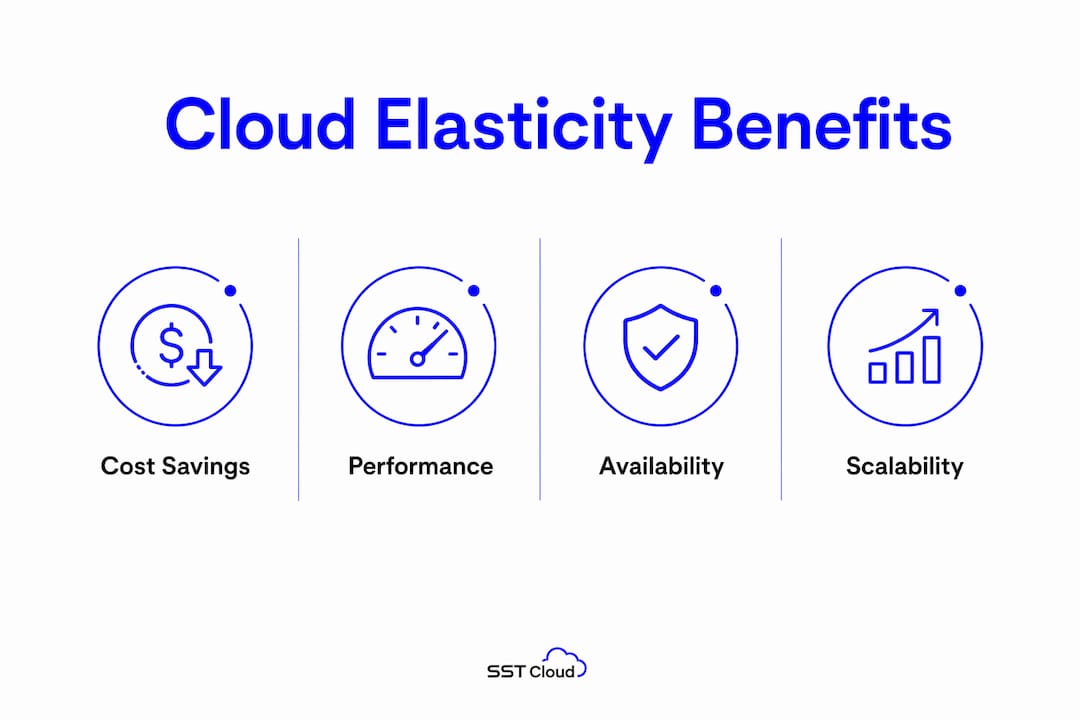
Beyond cost, elasticity delivers four concrete operational advantages:
Performance reliability. Elastic systems absorb demand spikes without degrading response times. A retail platform handling a flash sale or a financial system processing end-of-month batch jobs maintains consistent performance because resources scale up before queues overflow.
Operational agility. Teams can release new features or enter new markets without pre-purchasing infrastructure. The cloud absorbs the uncertainty of launch traffic automatically.
Risk reduction. Automation removes the human error that occurs during manual scaling events. Engineers do not need to wake at 2:00 AM to provision servers during an unexpected traffic surge.
Pay-per-use efficiency. Elastic cloud systems operate on a pay-per-use model that eliminates idle resource spending, avoiding both over-provisioning and under-provisioning risks simultaneously.
The combination of cost control and performance consistency is what makes elasticity a growth enabler rather than simply an infrastructure feature. Organisations that master it can redirect capital from idle servers to product development, hiring, and market expansion.
How do automation and hybrid scaling enhance elasticity?
Automation is the defining factor in operational efficiency for elastic cloud environments. Smart, hands-off resource management during demand spikes depends entirely on orchestration platforms that monitor real-time metrics and enact scaling policies without human intervention. Tools like Kubernetes Horizontal Pod Autoscaler, AWS Auto Scaling groups, and Azure Virtual Machine Scale Sets are the practical mechanisms that translate elasticity from concept into running infrastructure.
Two scaling approaches underpin most enterprise deployments. Reactive scaling triggers resource changes after a metric threshold is crossed, for example, adding instances when CPU exceeds 70%. Predictive scaling uses historical patterns and machine learning models to provision resources before demand arrives. Each method has a weakness: reactive scaling introduces a lag between the spike and the response; predictive scaling can over-provision when patterns change unexpectedly.
Hybrid elasticity combining reactive and predictive methods achieves superior availability for enterprise workloads, with leading deployments reaching 99.999% uptime. The hybrid approach covers both bursty, unpredictable traffic and regular, foreseeable load cycles. Elastic systems can provision and de-provision resources within seconds, but only when the orchestration layer is configured correctly.
Pro Tip: Trigger scaling policies on a combination of latency and queue depth rather than CPU alone. CPU is a lagging indicator. Queue depth and p95 latency reflect user experience directly, giving your auto-scaling policies a head start before performance degrades.
Establishing a stable baseline capacity before applying elasticity is non-negotiable. Elasticity handles variance; it does not replace thoughtful architecture. Teams that skip baseline sizing end up in a constant cycle of reactive scaling that never quite catches up to demand. A secure, well-structured cloud foundation is the prerequisite for elasticity to function as intended.
What are common pitfalls in applying cloud elasticity?
The most common mistake is treating elasticity as a substitute for architectural planning. Relying solely on elasticity without solid baseline sizing results in cost spikes and performance degradation, because the system is permanently chasing demand rather than absorbing variance around a stable core. Elasticity works best as a layer on top of a well-sized baseline, not as the entire capacity strategy.
Several other pitfalls consistently affect enterprise deployments:
Runaway scaling. Misconfigured policies with no upper bound on instance counts can generate unexpected costs within hours. Always set maximum instance limits and budget alerts.
Instance launch latency. Latency in launching new instances affects elasticity responsiveness. Understanding these delays is critical for setting effective scaling policies, particularly for latency-sensitive applications.
Provider quota limits. Cloud providers enforce regional quotas on instance types. Hitting a quota ceiling during a demand spike negates the elasticity benefit entirely. Request quota increases before you need them.
Application design misalignment. Elasticity-aware application design, including cloud-native containers and API-first services, is required to fully exploit dynamic resource allocation. Monolithic applications that cannot start quickly or share state cleanly will not scale elastically regardless of the infrastructure policy.
Pro Tip: Run a quarterly elasticity audit. Review scaling event logs, check whether policies triggered as expected, and compare actual spend against projections. Most policy drift goes undetected until a cost anomaly surfaces in a monthly bill.
Understanding why cloud migrations fail before they begin often comes down to exactly these issues: skipping baseline architecture, ignoring application design constraints, and treating cloud features as a replacement for engineering discipline.
How can IT leaders use elasticity to drive organisational growth?
Cloud elasticity translates directly into business outcomes when IT leaders align it with workload patterns and growth trajectories. The most effective approach starts with mapping demand variability across business units. An e-commerce platform has predictable seasonal peaks; a SaaS analytics product may have unpredictable usage bursts tied to customer behaviour. Each pattern calls for a different elasticity configuration, and the business analyst’s role is to surface those patterns before the engineering team sets policy.
Elasticity also accelerates digital transformation by removing the infrastructure bottleneck from product delivery cycles. When a development team can spin up a full production-equivalent environment in minutes and tear it down after testing, release velocity increases without a corresponding increase in infrastructure cost. This is the impact of cloud growth on engineering throughput: faster experimentation, lower cost per deployment, and reduced risk from over-committed infrastructure.
Collaboration between business analysts, IT operations, and cloud providers is the practical mechanism for realising these gains. Analysts bring workload data and business context; IT operations bring policy design and monitoring expertise; cloud providers bring the tooling and quota headroom. SST Cloud’s managed cloud and engineering services support this collaboration by providing the orchestration expertise and monitoring frameworks that make elasticity reliable at scale.
The organisations that extract the most value from cloud infrastructure flexibility are those that treat elasticity as a business capability, not a technical setting. They measure it in terms of cost per transaction, time to scale, and availability during peak periods, not just in CPU utilisation graphs.
Key takeaways
Cloud elasticity drives enterprise growth by automatically matching resource supply to demand, cutting infrastructure waste and maintaining performance without manual intervention.
Point | Details |
|---|---|
Elasticity vs scalability | Elasticity handles real-time demand variance; scalability addresses long-term capacity growth. Both are required. |
Cost reduction potential | Shifting to elastic models can cut infrastructure capacity costs by 90% or more for variable workloads. |
Hybrid scaling superiority | Combining reactive and predictive scaling achieves the highest availability and cost-performance balance. |
Baseline sizing is mandatory | Elasticity layered on a stable baseline outperforms elasticity used as the sole capacity strategy. |
Application design matters | Cloud-native containers and API-first services are prerequisites for elasticity to function at full effectiveness. |
Why most organisations are still getting elasticity wrong
I have worked with enough enterprise cloud programmes to say this plainly: most organisations deploy elasticity as a feature tick rather than a capability. They enable auto-scaling on their compute layer, set a CPU threshold, and consider the job done. What they miss is that elasticity is an outcome of three things working together: a well-sized baseline, an orchestration layer tuned to the right metrics, and applications designed to start and stop cleanly.
The misconception I see most often is that elasticity will compensate for under-investment in architecture. It will not. A monolithic application that takes eight minutes to initialise cannot scale elastically to absorb a two-minute traffic spike. The infrastructure responds; the application does not. The result is cost without benefit.
The future of elasticity is moving toward AI-driven predictive models and edge computing workloads, where latency constraints make pre-emptive scaling even more critical. Organisations that invest now in orchestration maturity, metric-driven policy design, and elasticity-aware application architecture will be positioned to absorb that shift without rebuilding from scratch. The teams that treat elasticity as a configuration task will keep paying for the gap between what their infrastructure can do and what their applications actually deliver.
— Engineering and Growth Manager
SST Cloud’s approach to elastic cloud infrastructure
SST Cloud specialises in digital and cloud transformation that makes elastic infrastructure a practical reality for enterprise teams, not just a theoretical capability. SST Cloud’s engineers design baseline architectures sized for your actual workload patterns, configure orchestration platforms across AWS, Microsoft Azure, and Google Cloud Platform, and implement hybrid scaling policies that balance cost against performance from day one.
Whether your organisation is moving workloads to the cloud for the first time or tuning an existing elastic architecture that is generating unexpected costs, SST Cloud brings the engineering depth and advisory experience to close the gap. Speak with the SST Cloud team to assess your current cloud infrastructure and identify where elasticity can deliver measurable cost and performance improvements.
FAQ
What is cloud elasticity in simple terms?
Cloud elasticity is the automatic adjustment of computing resources to match real-time workload demand. Resources scale up during high traffic and scale down when demand drops, without manual intervention.
How does cloud elasticity reduce infrastructure costs?
Elastic systems use a pay-per-use model that eliminates idle resource spending. Static provisioning for peak demand wastes approximately 95% of capacity cost, which elasticity removes by releasing unused resources immediately.
What is the difference between elasticity and scalability in cloud computing?
Scalability is the long-term architectural capacity to handle growth, while elasticity is the short-term, automatic capability to handle demand variance. Both are necessary for a complete cloud growth strategy.
What causes elasticity policies to fail in production?
The most common causes are misconfigured scaling thresholds, instance launch latency, provider quota limits, and applications not designed to start and stop quickly. Quarterly policy audits reduce the risk of undetected drift.
How does hybrid scaling improve cloud elasticity?
Hybrid scaling combines reactive threshold-based triggers with predictive machine learning models. This approach covers both bursty, unpredictable traffic and regular load cycles, achieving higher availability than either method alone.