Knowledge Base
Cloud native development explained for developers
Discover how cloud native development explained can transform your app building. Learn about containers, microservices, and essential tools.

Cloud native development explained for developers
Cloud native development is defined as the practice of building applications specifically designed to exploit cloud environment characteristics from the ground up, using containers, microservices, and dynamic orchestration to achieve elasticity, resilience, and automation. The Cloud Native Computing Foundation (CNCF), backed by the Linux Foundation, provides the authoritative standards and tools landscape that guides these practices across the industry. Unlike simply hosting an existing application on a cloud server, cloud native architecture means designing for cloud failure and scaling from day one. Kubernetes, Docker, CI/CD pipelines, and Infrastructure as Code are the named technologies that define this approach in practice.
What is cloud native development, and what technologies power it?
Cloud native architecture is defined as building applications as collections of independently deployable services, packaged in containers, dynamically orchestrated, and built to scale and recover automatically. That definition matters because it separates cloud native from the older model of lifting a monolithic application into a virtual machine and calling it “cloud.”
The core technologies work as a stack, each solving a distinct problem:
Containers are lightweight, portable packages that bundle an application and its dependencies so it runs identically across development, staging, and production environments. Docker is the canonical example. Containers eliminate the “works on my machine” problem that plagued traditional deployments.
Microservices architecture structures an application as loosely coupled, independently deployable units. Each service owns its own data and logic. This means a payment service can be updated and redeployed without touching the user authentication service.
Kubernetes automates container management at scale, handling deployment, scaling, self-healing, and networking. It is the de facto orchestration platform, though it represents only one layer of the full cloud native stack.
Declarative infrastructure and GitOps use tools like Terraform and Helm to define infrastructure as code stored in version control. GitOps pipelines automate resource management and application lifecycle, enabling governance and self-service deployment models.
CI/CD pipelines automate the build, test, and release cycle. Combined with containers, they allow teams to ship changes multiple times per day with confidence.
Cloud native applications are also typically polyglot by design. Each microservice can use the language or framework best suited to its function. A data processing service might run Python, while an API gateway runs Go. That flexibility accelerates development and allows teams to adopt the right tool per workload.
Pro Tip: Start with a single containerised service and a working CI/CD pipeline before introducing Kubernetes. Proving the pattern at small scale prevents costly rework later.

How does cloud native differ from traditional application architectures?
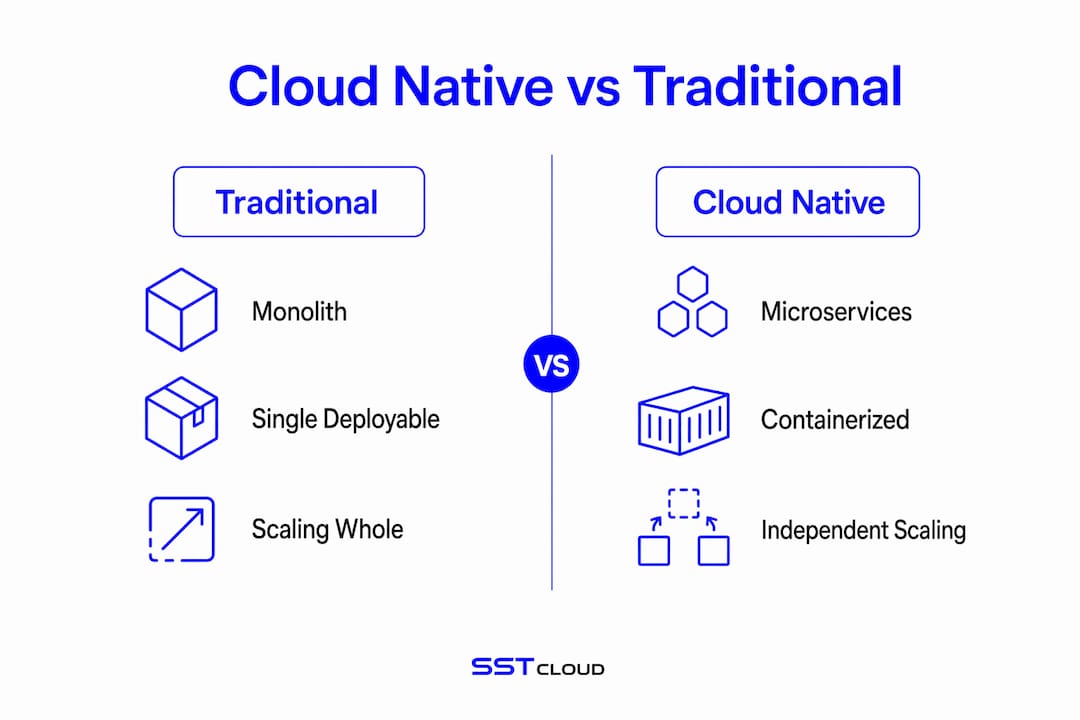
The cloud native versus traditional debate is fundamentally about architecture, not hosting location. An application running on AWS but built as a tightly coupled monolith is not cloud native. The distinction lies in how the application handles failure, scaling, and deployment.
Dimension | Traditional monolith | Cloud native |
|---|---|---|
Deployment unit | Single deployable artefact | Independent services per container |
Scaling | Scale the entire application | Scale individual services on demand |
Failure handling | Single point of failure | Services fail independently; others continue |
Release cadence | Infrequent, high-risk releases | Frequent, automated, low-risk releases |
Infrastructure | Manually provisioned servers | Declarative, code-driven infrastructure |
Traditional architectures are not inherently wrong. For small teams with straightforward applications, a well-built monolith on managed infrastructure can be a better engineering decision than full cloud native complexity. Premature adoption of microservices and Kubernetes creates operational overhead that outweighs the benefits. The honest question is whether your application’s scale and team size justify the investment.
Cloud native adoption also exists on a spectrum. Many teams achieve real cloud native benefits by implementing containerisation and automated CI/CD even for partially monolithic systems. You do not need to adopt every CNCF tool or decompose every service to gain meaningful improvements in deployment speed and reliability. Understanding why cloud migration fails often comes down to teams attempting full transformation without this incremental perspective.
Pro Tip: Map your application’s scaling and reliability requirements before choosing an architecture. If a single service handles all traffic and rarely changes, a monolith with containers and CI/CD may be the right starting point.
How do you adopt cloud native development in practice?
Adoption works best as a staged progression, not a single large migration. Each stage builds on the previous one and delivers value before the next layer of complexity is introduced.
Containerise your application. Package existing services in Docker containers and validate that they run consistently across environments. This step alone improves deployment repeatability and sets the foundation for everything that follows.
Implement automated CI/CD pipelines. Connect your container builds to a pipeline that runs tests and deploys to a staging environment on every commit. Tools like GitHub Actions, GitLab CI, or AWS CodePipeline are well-established starting points. A working CI/CD authentication pattern using OIDC and federated identity reduces credential risk from day one.
Decouple services incrementally. Identify the bounded contexts in your application where independent deployment would deliver the most value. Extract those into separate microservices. Avoid decomposing everything at once; the coordination cost rises sharply with the number of services.
Introduce Kubernetes when scale justifies it. Kubernetes is powerful, but it carries a significant operational burden. Introduce it when you are managing multiple containerised services that need automated scaling, rolling updates, or self-healing. Managed Kubernetes services on AWS (EKS), Azure (AKS), or Google Cloud (GKE) reduce the operational overhead of running the control plane.
Adopt declarative infrastructure. Use Terraform or AWS CloudFormation to define all infrastructure as code. Store it in version control and apply changes through automated pipelines. This creates an auditable, repeatable record of your environment.
Build a DevOps culture. Cloud native tools only deliver their full value when development and operations teams share responsibility for reliability. Agile workflows, on-call rotations, and shared observability tooling are organisational requirements, not optional extras.
The shift from project delivery to platform thinking is a natural outcome of mature cloud native adoption. Teams stop building one-off solutions and start building internal platforms that other teams consume as self-service infrastructure.
What benefits and challenges should developers expect?
Cloud native development delivers concrete, measurable advantages when applied to the right problems. Understanding both sides helps teams set realistic expectations.
Benefits:
Dynamic scaling allows individual services to scale up or down based on actual demand, reducing infrastructure waste during low-traffic periods.
Resilience through failure isolation means a failing microservice does not cascade into a full application outage. Kubernetes and other orchestration tools restart failed containers automatically.
Zero-downtime deployments are achievable through rolling updates and blue-green deployment strategies. Kubernetes orchestration minimises service disruption during releases, enabling true continuous delivery.
Technology flexibility lets teams choose the best language, framework, or data store per service rather than being locked into a single stack.
Faster release cycles result from automated pipelines and independently deployable services, reducing the coordination cost of each release.
Challenges:
Operational complexity increases significantly. Distributed systems introduce network latency, partial failures, and distributed tracing requirements that monoliths do not have.
Kubernetes has a steep learning curve. It is the de facto orchestration platform, but misconfigured clusters create security and reliability risks. Teams need dedicated time to build competency.
Observability demands grow. Monitoring dozens of services requires centralised logging, distributed tracing (using tools like OpenTelemetry), and alerting across service boundaries.
The platform tax is real. Early-stage teams that adopt full cloud native tooling before their application warrants it spend more time managing infrastructure than building product.
The key discipline is aligning cloud native adoption with actual business and technical requirements. Enterprise modernisation without disruption is achievable, but it requires honest assessment of where complexity is justified.
How does cloud native shape future application design and enterprise modernisation?
Cloud native practices are redefining how enterprises think about application design, not just deployment. The shift is from building applications to building platforms that host capabilities.
Trend | What it means in practice |
|---|---|
Platform engineering | Internal developer platforms abstract Kubernetes and CI/CD complexity, giving teams self-service deployment without managing the underlying stack |
AI and data integration | Cloud native microservices architecture makes it straightforward to expose AI model endpoints as independent, versioned services |
FinOps and cost visibility | Per-service resource allocation in Kubernetes enables granular cost attribution that monoliths cannot provide |
Security as code | Policy-as-code tools like Open Policy Agent (OPA) enforce security guardrails at the infrastructure layer automatically |
Multi-cloud portability | Container-based workloads run consistently across AWS, Azure, and Google Cloud Platform, reducing vendor lock-in risk |
The CNCF landscape now includes over 1,000 projects and tools, reflecting the breadth of the cloud native ecosystem. That breadth is both an asset and a risk. Teams that adopt tools without a clear architectural rationale accumulate technical debt faster than teams that start with a minimal, well-understood stack and expand deliberately.
Cloud native development also integrates naturally with data engineering and AI workloads. Containerised model serving, event-driven data pipelines, and API-first design patterns all benefit from the same orchestration and automation primitives that power cloud native applications.
Key takeaways
Cloud native development delivers its full value only when containers, microservices, orchestration, and CI/CD pipelines are adopted in stages aligned to actual team capacity and application complexity.
Point | Details |
|---|---|
Definition is precise | Cloud native means architecting for cloud elasticity and failure from the start, not just hosting in the cloud. |
Adoption is a spectrum | Containerisation and CI/CD alone deliver real cloud native benefits without full microservices decomposition. |
Kubernetes has a cost | Introducing Kubernetes before scale justifies it creates operational overhead that slows teams down. |
Culture matters as much as tooling | DevOps workflows and shared reliability ownership are prerequisites for cloud native to function effectively. |
Platform thinking is the destination | Mature cloud native teams build internal platforms, not just individual applications. |
My honest view on cloud native adoption
I have worked with teams across a range of industries, and the most common mistake I see is treating cloud native as a destination rather than a direction. A team reads about Kubernetes and microservices, decides their application needs both immediately, and spends six months building infrastructure instead of product. The application they end up with is more complex, harder to debug, and no faster to deploy than what they started with.
The teams that get cloud native right start with a single containerised service, a working CI/CD pipeline, and a clear definition of what problem they are solving. They add Kubernetes when they have enough services that manual orchestration becomes the bottleneck. They decompose microservices when a specific bounded context genuinely needs independent scaling or a different technology stack. Every architectural decision is driven by a concrete requirement, not by what the CNCF landscape diagram suggests is best practice.
The other thing I would push back on is the idea that cloud native is only for large engineering organisations. A two-person team running containerised services on a managed platform with automated deployments is practising cloud native development. The tools are more accessible than they have ever been. The discipline is knowing which tools to adopt and when.
Cloud native is a valuable approach. It is not a silver bullet. Start small, prove the pattern, and expand deliberately.
— Engineering and Growth Manager
How SST Cloud supports cloud native development
SST Cloud works with organisations at every stage of cloud native adoption, from initial containerisation through to full platform engineering on AWS, Azure, and Google Cloud Platform.
Whether your team is containerising its first application, introducing Kubernetes at scale, or building an internal developer platform, SST Cloud’s digital and cloud transformation services cover the full engineering stack. SST Cloud’s engineers bring hands-on expertise in DevOps automation, Kubernetes, Terraform, and CI/CD pipeline design. The goal is to reduce the operational burden on your team while building the cloud native foundations that support long-term growth. Contact SST Cloud to discuss your cloud native development requirements.
FAQ
What is cloud native development?
Cloud native development is the practice of building applications designed from the ground up to use cloud characteristics such as elasticity, automated scaling, and failure resilience. It relies on containers, microservices, orchestration platforms like Kubernetes, and automated CI/CD pipelines.
Do you need Kubernetes to be cloud native?
Kubernetes is the de facto orchestration platform but is not a requirement for cloud native development. Teams can achieve significant cloud native benefits through containerisation and automated CI/CD pipelines alone, adding Kubernetes when service complexity and scale justify the operational investment.
What is the difference between cloud native and traditional architecture?
Traditional architectures deploy applications as single, tightly coupled artefacts that scale as a whole and fail as a whole. Cloud native architectures deploy independently scalable services in containers, with automated recovery and frequent, low-risk releases.
How long does cloud native adoption take?
Adoption timelines vary by team size and application complexity. Containerising a single service and establishing a CI/CD pipeline can take days to weeks. Full microservices decomposition and Kubernetes adoption in a large enterprise typically takes months to years, depending on the scope of change.
What role does the CNCF play in cloud native development?
The Cloud Native Computing Foundation (CNCF), backed by the Linux Foundation, defines cloud native standards and maintains the tools landscape that guides industry practice. Projects like Kubernetes, Prometheus, and Envoy are CNCF-graduated projects widely used in production cloud native environments.